

Posts Tagged: "pharmaceuticals"
When Did Medical Innovation Become a Bad Thing?
Congress has been holding hearings on pharmaceutical patents and drug prices, along with U.S. Patent and Trademark Office (USPTO) fee-setting and oversight. During these hearings, America’s pharmaceutical innovators face an unusual criticism: They are accused of abusing the patent system not only when they invent new medicines, but also when they improve them.
U.S. Government Says SCOTUS Should Skip Pharma Companies’ Challenge to Medicare Negotiation Program
The U.S. government filed its brief in opposition yesterday to Janssen Pharmaceuticals and Bristol Myers Squibb Company’s (BMS) petition for writ of certiorari challenging the government’s Medicare Drug Price Negotiation Program. A split U.S. Court of Appeals for the Third Circuit decision in September 2025 affirmed a grant of summary judgment to the government that the imposition of the Program via the Inflation Reduction Act (IRA) does not violate the companies’ constitutional rights.
Foreign Price Controls: A Risk to U.S. Medical Innovation and Patient Access
As policymakers consider the future of American healthcare, it is imperative to recognize the potential dangers of adopting foreign price controls for life-saving medications. These price controls, which are referred to as foreign “reference pricing,” would tie the price of medicines in the United States to prices set by foreign governments that are paid in other countries with vastly different healthcare systems. While this approach may initially sound appealing, the reality is that foreign reference pricing imports the failed models of other countries rather than rewarding innovation or recognizing the true value of breakthrough therapies. It pegs prices here to bureaucratic decisions made abroad and threatens to undermine the very engine of medical innovation that has made the United States a global leader in life sciences and benefited millions of patients.
Hatch-Waxman Safe Harbor: Lessons from Recent Court Precedent
We recently wrote an introductory overview of navigating the Common Law Research Exemption and the Hatch-Waxman Safe Harbor and an exploration of the application of the Common Law Research Exemption. Here, we take a closer look at the Hatch-Waxman safe harbor under 35 U.S.C. § 271(e)(1), particularly through treatment by the courts over the past decade.
The Impact of Price Controls and Biologics on the Future of U.S. Pharmaceutical Innovation and Investment
Over the last several years the pharmaceutical industry has come under increased pressure. While many often say the pharmaceutical industry has the most powerful lobby, the truth is many politicians have grown increasingly frustrated with what they characterize as high drug prices; or at least much higher than in virtually every other country around the world. This has led to patents being blamed, with billboards and buses in Washington, DC, wrapped with slogans like “patents kill”.
FTC Renews Campaign to Remove ‘Junk’ Inhaler and Device Patents from Orange Book Listings
Yesterday, the Federal Trade Commission (FTC) sent a series of seven warning letters to several pharmaceutical companies renewing the agency’s challenge to dozens of patent listings in the U.S. Food & Drug Administration’s (FDA) Approved Drug Products with Therapeutic Equivalence Evaluations, also known as the Orange Book. The FTC’s redoubled effort to improve consumer access to generic drugs by removing patent listings from the FDA’s list of approved New Drug Applications (NDAs), which continues under the FTC’s new Republican leadership, targets inhaler and drug delivery device patents without addressing decades of calls from the pharmaceutical industry seeking clarity on the guidelines for listing device patents in the Orange Book.
Navigating the Narrow Confines of the Common Law Experimental Use Exemption
In a previous article, we analyzed the contours of the common law experimental use exemption. Now, we will explore the application of the exemption to common research activities, including those at universities and research institutions, in cases spanning recent decades. These cases illustrate the narrow confines of the experimental use exemption and its limited applicability in scenarios involving activities with direct or indirect commercial or business-related objectives. As a result, researchers should tread carefully and not count on the exemption to shield them from liability for patent infringement.
Latest Trump Executive Order Redirects Drug Pricing Debate
On Sunday, May 11, President Donald Trump announced on Truth Social that he would sign an Executive Order today aimed at lowering prescription drug prices. The order refocuses the drug pricing debate, which often is centered around patents, on “equalizing” pricing among developed nations. In his social media post, Trump blamed pharmaceutical companies for chalking up the high price of drugs in the United States to research and development costs. “It was always difficult to explain and very embarrassing because, in fact, there was no correct or rightful answer,” Trump wrote. He also implied that Democrats have resisted efforts to lower prices due to campaign contributions from the industry and said the Order signed today will reduce drug prices “almost immediately, by 30% to 80%” via a “most favored nations” policy that will mandate U.S. citizens pay the same price as the nation paying the lowest price.
Federal Circuit Reverses Injunction Against Avadel Due to Hatch-Waxman Safe Harbor
In a precedential decision issued May 6, 2025, the U.S. Court of Appeals for the Federal Circuit (CAFC) reversed in part and vacated in part a Delaware district court’s injunction that blocked Avadel CNS Pharmaceuticals from conducting clinical research and seeking regulatory approval for expanded uses of its once-nightly narcolepsy drug, Lumryz. The Federal Circuit ruled that the injunction unlawfully covered conduct protected by the Hatch-Waxman Act’s “safe harbor” provision, 35 U.S.C. § 271(e)(1), which exempts pre-approval research and regulatory activities from infringement liability.
The Growing Market for Weight Loss Treatments: Innovation, Patents, and the Future of GLP-1 Agonists
In recent years, the pharmaceutical industry has undergone significant changes in the focus of its innovation, research and development efforts. Historically, oncology and immunology were the primary targets for pharmaceutical companies, with most resources and capital allocated to developing new technologies in these areas.
The Case for Market Economics, Innovation and Rule of Law | IPWatchdog Unleashed
This week our conversation is with Patrick Kilbride, who is a public policy expert with significant expertise at the intersection between market economics, innovation and intellectual property. At the beginning of our conversation Kilbride explains that “one of the most remarkable things about the American economy is that what we have done historically does seem to be so unique.” He then pointed to five distinguishing features, which we spend the rest of our conversation discussing. According to Kilbride, what makes the U.S. unique is that the American economic approach enables risk taking and failure, fosters competition and ensures goods and services can cross state lines, provides property rights, is based on the rule of law, and establishes markets.
Are Patents to Blame for High Drug Prices? | IPWatchdog Unleashed
Pharmacy benefit managers, or simply PBMs, are often owned by either the pharmacies themselves or sometimes by insurers, which creates a lot of self-dealing to say the least. These PBMs are middlemen who receive 50% of the value of the drug, significantly raising drug prices. This has nothing to do with IP whatsoever.
CAFC Says Generic’s Public Statements Make Induced Infringement Claims Plausible
The U.S. Court of Appeals for the Federal Circuit (CAFC) issued a precedential decision today reversing a district court’s grant of Hikma Pharmaceuticals’ motion to dismiss Amarin Pharma, Inc.’s complaint against it for induced infringement. Amarin claimed Hikma induced infringement of its “icosapent ethyl” product, an ethyl ester of an omega-3 fatty acid commonly found in fish oils, marketed as Vascepa. U.S. District Court for the Western District of Texas Judge Alan Albright was sitting by designation on the CAFC panel.
March-In Drive Loses a Wheel: Generics Industry Says No to Biden Framework
In what has to be the unkindest cut of all, those expected to benefit from the proposed misuse of march-in rights so the government can impose drug price controls say they don’t support it either. The proponents promoting this hot house theory have seen it denounced by those who created the Bayh-Dole Act as being unauthorized under their law and seen evidence they can’t refute that it would have little impact on drug prices but would devastate small business entrepreneurs in all fields of federally supported research and development. And now they’ve lost the generic drug industry.
HELP Committee Grills Pharma Reps on U.S. Drug Pricing Problems
The U.S. Senate Committee on Health, Education Labor & Pensions held a hearing today on why the United States pays “by Far, the Highest Prices in the World for Prescription Drugs.” Patents came up throughout the hearing as one barrier to lowering prescription drug prices, while pharmaceutical industry representatives underscored the cost of bringing innovative and life-saving drugs to market and the superior access Americans have to such drugs compared with other countries.
Varsity Sponsors
From the IPWatchdog Institute


Latest IPW Posts
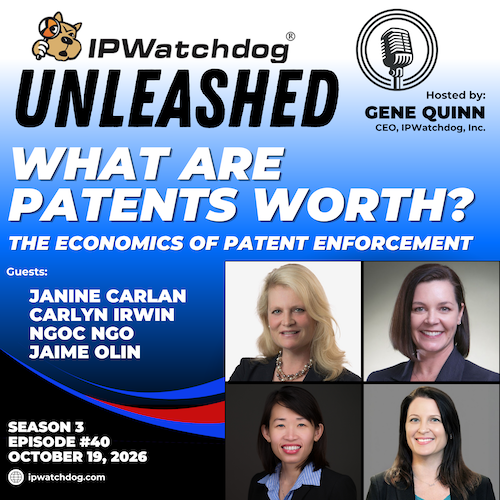
Patent Value and Licensing Price: What is a Patent Really Worth?| IPWatchdog Unleashed
October 20, 2026 @ 10:01 amCAFC Agrees Google Failed to Show Unpatentability of Claims for Merging Search Engine Results
October 19, 2026 @ 04:15 pmEU Rulings Affirm Large Platform Designations Under Digital Services Act, Digital Markets Act
October 19, 2026 @ 02:15 pmBeyond the Trademark: Protecting a Beauty Brand in Brazil
October 19, 2026 @ 09:15 amFederal Circuit Affirms Section 101 Dismissal Over Method for Treating Patients Using Remote Devices
October 19, 2026 @ 08:15 am
Latest Podcasts

IPWatchdog Events
Webinar: Leveraging AI for Patent Administration – Expanding Capacity Without Expanding Headcount
October 20 @ 12:00 pm - 1:00 pm EDTWebinar: Patent Search in the AI Era – Separating Hype from Real Productivity Gains
October 22 @ 12:00 pm - 1:00 pm EDTWebinar: AI for Patent Licensing – Beyond Statistical Triage to Evidence-Grounded Product Analysis
October 28 @ 12:00 pm - 1:00 pm EDTWebinar: Building Verifiable AI Intelligence – Connecting Tools, Data and Workflows with MCP
October 29 @ 12:00 pm - 1:00 pm EDT
Industry Events
From IPWatchdog

