
![[IPWatchdog Logo]](https://ipwatchdog.com/wp-content/themes/IPWatchdog%20-%202023/assets/images/temp/logo-small@2x.png)
Posts Tagged: "patent prosecution"
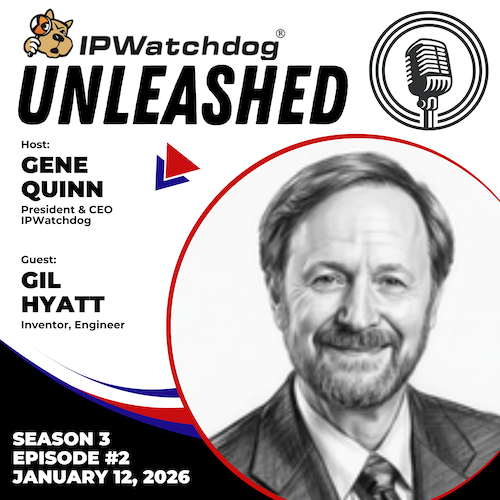
Pioneering AI Innovations and Legacy: A Conversation with Inventor Gil Hyatt / IPWatchdog Unleashed
This week on IPWatchdog Unleashed, I sat down with prolific inventor Gil Hyatt, exploring his innovative journey and aspirations to leave a lasting legacy. One of the key highlights of the conversation was Gil’s creation of a non-profit Pioneering AI Foundation, which is aimed at advancing AI technology and bolstering U.S. economic interests. This non-profit organization is set to hold Gil’s substantial portfolio of AI patent applications, which cover his pioneering work dating back to the 1980s, and includes groundbreaking claims in artificial intelligence that could revolutionize sectors like education, manufacturing, and trade.
Why Petrella and SCA Hygiene Protect Against Equitable Defenses of Prosecution Laches
The Supreme Court rejected equitable defenses of laches in infringement suits, reasoning that by enacting a statute of limitation, Congress left no statutory “gap” for equitable judgments on timeliness. See Petrella v. Metro-Goldwyn-Mayer (2014), and SCA Hygiene Prods. v. First Quality Baby Prods (2017). These precedential holdings should have also governed U.S. Court of Appeals for the Federal Circuit (CAFC) decisions on prosecution laches in Hyatt v. Hirshfeld (2021) and in Hyatt v. Stewart (2025), particularly after the multiple briefings in the Hyatt case on the binding effect of such holdings. Yet, nowhere in these decisions can one find any reasons why the principles in SCA Hygiene and Petrella should be inapplicable for precluding prosecution laches.
The Top 10 Patents of 2025: Ubiquitous 6G Connections, Auditable Blockchain Transactions and Pest-Resistant Transgenic Corn
This year, the U.S. Patent and Trademark Office (USPTO) granted several important patents claiming important innovations in 6G networks, generating reliable map data for autonomous vehicles and pest-resistant genetically modified crops. With a new year just days away, we hope the following list of the top 10 patents of 2025 sparks interest in the state of global innovation as we reach the final stages of the year.
Patent Reset: 2025’s Pivotal Moments and What Comes Next
As we wind down 2025 it is time to reflect on the year that was, and what the future will bring. This year was punctuated by a structural reset for the U.S. patent system. What unfolded was not just incremental reform, but a coordinated shift driven by leadership change, policy realignment, economic pressure, and accelerating adoption of AI—all converging to reshape how patents are examined, challenged, monetized, and managed. This week on IPWatchdog Unleashed we explore the monumental changes and the biggest trends that impacted the patent and innovation industry during 2025, and which will play an important role in defining 2026.
USPTO Reminds Examiners, Applicants to Consider and Use Eligibility Declarations Wisely
The United States Patent and Trademark Office (USPTO) today released two memos meant to provide additional guidance around the use of patent subject matter eligibility declarations (SMEDs) for examiners, applicants and practitioners, particularly with respect to “applied technologies” in areas like artificial intelligence and medical diagnostics. The memos do not alter existing procedures and are effective immediately.
The Case for an Open Source Patent Search System
Something important happened at the U.S. Patent and Trademark Office (USPTO) last month, and it did not get nearly the attention it deserved. The Office rolled out its Artificial Intelligence Search Automated Pilot (ASAP) Program, and for the first time, AI is now part of the pre-examination process, rather than operating around it. Given where things stand, this move almost feels inevitable. Filings keep climbing, examiners are stretched thin, and first office action pendency reached an all-time high of 22.6 months in FY 2025. Anyone who has spent time in prosecution knows the system needs help. AI can absolutely make the early search phase faster and more consistent.
Prosecution Laches Is Illegitimate—And SAWS Proves It
One of the ways judges typically evaluate whether a ruling makes sense is to game out the logical consequences of the ruling to see whether it will lead to absurd results. There is little doubt that the U.S. Court of Appeals for the Federal Circuit’s prosecution laches doctrine isn’t just doctrinally off-base—it leads to absurd results, which makes the doctrine structurally unworkable. The Federal Circuit’s presumption that any patent taking more than six years to prosecute is presumptively unenforceable places the burden on patent owners to demonstrate as a threshold matter that the length of prosecution was reasonable. But the brutal, inconvenient truth is that the United States Patent and Trademark Office (USPTO) itself has twice operated secret programs that froze applications for years while telling the outside world nothing.
Cool AI Patents of the Month: Spotting Chatbots and Stopping Bullies
Welcome to the very first installment of Cool AI Patents of the Month. Each month, we’ll look at some of the more eye-catching and creative ways Artificial Intelligence (AI) is showing up in innovations that themselves wind up represented in patents or patent applications. The goal isn’t to get overly technical, but to highlight technology that’s genuinely cool and thought-provoking — the kind of inventions that make you say, “Wow, that’s clever.”
Squires Emphasizes AI, Dubs Inherited Backlog ‘An Absolute Dumpster Fire’ and a ‘Betrayal’
U.S. Patent and Trademark Office (USPTO) Director John Squires delivered his first public remarks on Friday, addressing a number of key issues he has been focused on during his first five weeks in office. With respect to the Office’s backlog, he told attendees of the American Intellectual Property Law Association (AIPLA) Annual Meeting that his administration “inherited an unexamined patent application backlog that was an absolute dumpster fire.”
Agentic AI Meets Patent Search: A New Paradigm for Innovation
For decades, inventors, practitioners, and researchers alike have faced the same tradeoff. Free tools surface only the most obvious references, missing decisive prior art. Professional platforms offer depth, but require significant training and demand five-figure subscriptions. The patent system promises to promote innovation by making knowledge accessible. But to fully realize this vision, patent knowledge must be available on tap to everyone who needs it, in whichever form best serves each individual user. Today’s AI technology has unlocked the possibility of universal access to professional-grade patent intelligence.
From Boring to Brilliant: How Reimagining USPTO Fee Structure Is Central to U.S. Economic Security
Howard Lutnick has been universally criticized by industry for his reported proposal to tax patent values and revenue share with universities. Howard Lutnick is absolutely right about the problem. Here’s why. The patent system was designed for individual inventors. Thomas Edison, the Wright brothers—these were lone entrepreneurs securing temporary monopoly rights in exchange for disclosing their inventions to the public. But sometime after World War II, corporations and universities completed a quiet takeover of the patent office. Today’s patent landscape is dominated by patent oligarchs: systematic corporate R&D programs filing thousands of applications annually, not individuals pursuing personal innovation.
USPTO Launches Streamlined Claim Set Pilot Program to Expedite Patent Examination
The U.S. Patent and Trademark Office (USPTO) published a Federal Register Notice today launching the Streamlined Claim Set Pilot Program, an initiative designed to expedite patent examination by assessing how a limited number of claims affects pendency and examination quality. The USPTO stated that it “anticipates that focusing examination resources on already-filed, unexamined applications that have a streamlined claim set will enhance efforts to reduce the USPTO’s inventory and pendency.” Applications accepted into the pilot program will be “advanced out of turn (i.e., accorded special status) for examination until a first office action is issued.” After the first office action, the application will no longer be treated as special during examination.
Patent Prosecution’s Fatal Asteroid: Why Law Firms Shouldn’t Wait for AI’s Full Impact
Given the recent proliferation of artificial intelligence (AI) patent drafting technology, some in the legal services industry are asking whether AI is the patent profession’s “ultimate bad day,”on par with the dinosaurs’ ultimate bad day posited by Nobel Prize-winning physicist Luis Alvarez in 1980. Like the asteroid thought to cause a mass extinction of the dinosaurs, will AI be a formidable impactor that renders patent prosecution an unprofitable practice area in law firms and alternative legal service providers (ALSPs)? Will AI decimate patent prosecution as a viable career?
USPTO Will Launch Pilot to Evaluate Results of New AI Search Tool for Patent Applications
The U.S. Patent and Trademark Office (USPTO) will launch an AI search pilot program for utility patents and will begin accepting petitions to participate in the program as of October 20, according to a draft Federal Register Notice (FRN) published today. The official notice will be published tomorrow, October 8. Petitions will be accepted through April 20, 2026, or the date that each tech center (TC) is docketed at least 200 applications accepted, whichever comes first.
From Duck Hunt to VR: A Brief History of Gun-Like Peripherals for Video Games (and Their Patents)
When Duck Hunt landed in living rooms in 1984, it brought with it one of gaming’s most iconic peripherals: the NES Zapper. But the magic behind aiming a plastic gun at a screen and hitting an 8-bit duck was more than a gimmick. It was the product of pioneering technology—the likes of which have led to a stream of patents for each new generation of game hardware.
Varsity Sponsors
![[Advertisement]](https://ipwatchdog.com/wp-content/uploads/2026/02/Junior-AI-Feb-10-2026-sidebar-CLE-700x500-1.jpg)
![[Advertisement]](https://ipwatchdog.com/wp-content/uploads/2026/02/Anaqua-Feb-12-2026-sidebar-700x500-1.jpg)
![[Advertisement]](https://ipwatchdog.com/wp-content/uploads/2025/12/LIVE-2026-sidebar-regular-price-700x500-1.jpg)

Latest IPW Posts
CAFC Agrees Content Sharing Patents are Ineligible in Win for Walmart
February 5, 2026 @ 01:32 pmFederal Circuit Affirms Noninfringement Finding in Ladder Patent Dispute
February 5, 2026 @ 12:15 pmCAFC Affirms Summary Judgment Ruling in Patent Suit Against NASA Mars Helicopter Subcontractor
February 4, 2026 @ 03:15 pmJudge Wolson Issues Key Summary Judgment Ruling on Eve of Trial in Arbutus v. Moderna
February 4, 2026 @ 01:15 pm
Latest Podcasts

IPWatchdog Events
CLE Webinar: How to Prompt AI – A Hands-On Workshop for Patent Prep and Pros
February 10 @ 12:00 pm - 1:00 pm ESTWebinar: IP at Risk – Avoiding Costly Compliance Mistakes in Export Controls
February 12 @ 12:00 pm - 1:00 pm ESTWebinar: Optimizing the Chemistry Drafting Process – Where AI Actually Helps
February 17 @ 12:00 pm - 1:00 pm ESTWebinar: Resurrecting Antibody Genus Protection – Allowed Claims Through CDR-Scanning
March 5 @ 12:00 pm - 1:00 pm ESTIPWatchdog LIVE 2026 at the Renaissance Arlington Capital View
March 22 @ 1:00 pm - March 24 @ 7:00 pm EDT
Industry Events
From IPWatchdog
![[Advertisement]](https://ipwatchdog.com/wp-content/uploads/2021/12/WEBINAR-336-x-280-px.png)
![[Advertisement]](https://ipwatchdog.com/wp-content/uploads/2021/12/Ad-4-The-Invent-Patent-System™.png)