
![[IPWatchdog Logo]](https://ipwatchdog.com/wp-content/themes/IPWatchdog%20-%202023/assets/images/temp/logo-small@2x.png)

 2
2 “From the scanlines of CRTs to AI-powered light guns, the evolution of gun-like peripherals has followed a rich lineage of patent-backed innovation.”
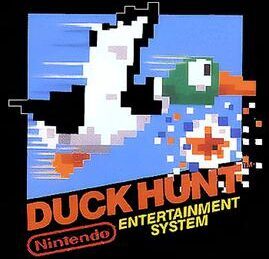
Image Source: Wikipedia
When Duck Hunt landed in living rooms in 1984, it brought with it one of gaming’s most iconic peripherals: the NES Zapper. But the magic behind aiming a plastic gun at a screen and hitting an 8-bit duck was more than a gimmick. It was the product of pioneering technology—the likes of which have led to a stream of patents for each new generation of game hardware.
With this in mind, below is a brief, non-exhaustive history of gun-like peripherals and their patents. As we’ll see, these peripherals go well beyond the traditional gamepad and have made weapons tracking much more precise and immersive as the industry has continued to evolve.
CRT-Based Light Gun Technology (1980s-1990s)
Game/Peripheral Example: Duck Hunt (1984) – NES Zapper
Core Technology: CRT light-sensing photodiode
Example Patent: U.S. Patent No. 4,813,682 — “Video target control and sensing circuit for photosensitive gun” (1989) — Nintendo
Initially designed to resemble a revolver, the NES Zapper is remembered fondly by many Gen-Xers and older Millennials who were introduced to the hobby on games like Duck Hunt.
USPN 4,813,682 describes how the NES Zapper’s photodiode detects rapidly flashing white boxes on a cathode ray tube (CRT) display to determine if a target was hit. Crucially, this method relied on the refresh behavior unique to CRT displays—a limitation that would eventually require new innovation with the advent of LCDs.
Competitors to the NES Zapper included the Menacer (Sega) and the Mad Catz Blaster (cross-compatible). Many old-school gamers might also remember the NES Super Scope, which was the successor to the NES Zapper and also used light gun technology.
Infrared and Sensor Bar Systems (2000s)
Game/Peripheral Example: Call of Duty (2008) – Wii Remote
Core Technology: Infrared emitters on the console sensor bar, motion and optical sensors on the peripheral
Example Patents: U.S. Patent No. 7,927,216 — “Video game system with wireless modular handheld controller” (2011); Also U.S. Patent No. 8,267,786 — “Game controller and game system” (2012) — Nintendo
When LCDs replaced CRTs, the previous generation of light-sensing peripherals like the NES Zapper no longer worked. Nintendo responded with the Wii Remote, which contained an image sensor that detected infrared LEDs on a “sensor bar” located on the console. The system would then use IR position to triangulate the gun’s direction. The Wii Remote also included motion sensors for gesture recognition.
Nintendo also developed an add-on to the add-on: The Wii Nunchuck, which was a wired addition to the Wii Remote. The Nunchuck added an analog joystick, providing even more input capability.
Both the Wii Remote and Wii Nunchuck could then be affixed to a gun-like hardware shell called the Wii Zapper.
In the end, Nintendo received a ton of patents on these technologies – not just the ones listed above, but also through a host of divisionals, continuations, CIPs, and even a reissue. Game on.
Camera and Motion-Based Controllers (2010s)
Game/Peripheral Example: Arizona Sunshine (2016) – PlayStation Move, PS VR Aim Controller & PS Move Sharp Shooter
Core Technology: Motion sensors, cameras, ultrasonic communication
Example Patents: – U.S. Patent No. 8,062,126 — “System and method for interfacing with a computer program” (2011); Also U.S. Patent No. 10,279,254 — “Controller having visually trackable object for interfacing with a gaming system” (2019) — Sony Interactive Entertainment (PlayStation)
As the games themselves became increasingly sophisticated, so did the hardware requirements. Plus, VR for the masses was on the horizon.
Enter Sony and its PlayStation Move controller, which served as the basis for both the PS VR Aim Controller and the PlayStation Move Sharp Shooter. The Move controller uses both motion sensing and an LED-based sphere on the peripheral itself for detection by dual RGB cameras on the console.
In the end, Sony received nearly 20 patents on this tech (at least), including several that were filed as continuations and CIPs.
Sony would also pursue additional IP to add ultrasonic communication to its sensor suite for even greater precision in its location tracking. Unfortunately this aspect never made it into a product, but the feature itself was captured in additional PlayStation patents like U.S. Patent No. 8,784,203 (“Determination of controller three-dimensional location using image analysis and ultrasonic communication”).
AI-Based Peripherals (Present Day)
You guessed it—there’s an *AI* for that. Or to adapt another famous phrase – Out with the old, in with the…older?
Yep—light guns are making a comeback. But since no one has a CRT anymore, modern light guns use artificial intelligence and high-res cameras built into the guns themselves. This allows ultra-precise location tracking so long as the LCD remains within view.
The Sinden Light Gun and the G’AIM’E Gun are two examples of these.
Sinden’s peripheral uses a built-in camera and computer vision to pick up on LCD pixel coordinates on the screen, enabling high-fidelity in-game shooting. U.S. Pat. No. 11,314,339 covers this tech (“Control device for detection”). And interestingly enough, the Sinden Light Gun is crowdsourced.
The G’AIM’E Gun appears to use similar tech, but unfortunately no U.S. patents could be affirmatively identified. However, the G’AIM’E Gun is licensed by Bandai Namco Entertainment, which also owns U.S. Pat. No. 10,661,174 for an arcade-style game in which the user sits inside an enclosure and shoots a mounted gun at a screen. That patent uses a projector and camera to calculate emission direction and calculate hits.
In addition, our research turned up another patent Sinden has acquired on a tricked-out, modern light gun that mimics the recoil effect of a real-world firearm. It does so by sending a pulse of current through a solenoid responsive to a trigger pull, increasing game immersion even further. This tech is outlined in U.S. Pat. No. 12,005,347 (“In or relating to gaming controllers”).
A Sharper Future
From the scanlines of CRTs to AI-powered light guns, the evolution of gun-like peripherals has followed a rich lineage of patent-backed innovation. As XR and spatial computing continue to grow, the future of gun-like peripherals looks sharper, smarter, and more immersive than ever.
![[Advertisement]](https://ipwatchdog.com/wp-content/uploads/2026/07/IP-Author-Aug-13-2026-sidebar-700x500-1.jpg)
![[Advertisement]](https://ipwatchdog.com/wp-content/uploads/2026/08/LexisNexis-Aug-18-2026-banner-1500x500-1.jpg)
![[Advertisement]](https://ipwatchdog.com/wp-content/uploads/2026/08/Junior-Aug-20-2026-sidebar-700x500-1.jpg)
![[Advertisement]](https://ipwatchdog.com/wp-content/uploads/2026/07/Womens-IP-Forum-2026-sidebar-register-early-bird-now-700x500-1.jpg)
![[Advertisement]](https://ipwatchdog.com/wp-content/uploads/2026/07/ClearstoneIP-Varsity-Ad-2026-Ad-1.jpg)
![[Advertisement]](https://ipwatchdog.com/wp-content/uploads/2026/07/Juristat-Varsity-Ad-2026-IPW-ad-FreeTrial_2-UPDATED-on-Jul-15-2026.png)
![[Advertisement]](https://ipwatchdog.com/wp-content/uploads/2024/09/Patent-Prosecution-Training-sidebar-700x500-2025-03-27.jpg)








![[Advertisement]](https://ipwatchdog.com/wp-content/uploads/2021/12/WEBINAR-336-x-280-px.png)
![[Advertisement]](https://ipwatchdog.com/wp-content/uploads/2021/12/Ad-4-The-Invent-Patent-System™.png)






Join the Discussion
2 comments so far.
John Rogitz
September 26, 2025 01:35 pmI agree Gene, but the old school games were still the best!
Gene Quinn
September 25, 2025 04:08 pmA walk down memory lane!
An AI enhanced light gun would be awesome! I never found the light guns to be usable. As TVs got larger and larger they became worse and worse, and it just wasn’t anything like the arcade experience. Would be worth checking out if they have games like Buck Hunter, although that is probably too simplistic these days, but more my speed!