


 0
0 “The campaign against so-called bad patents and patent trolls isn’t just misleading. It is intentionally undermining confidence in the very property rights our patent system was created to protect.”
 There’s a curious double standard in the way we talk about intellectual property (IP) in America.
When someone copies a copyrighted work without permission, we recognize that the creator has rights. Copyright infringement can even carry criminal penalties. When someone steals another person’s property, we call it theft, and criminal penalties can follow. But when a company uses someone else’s patented invention without permission, the patent owner who tries to stop it is often portrayed as the villain.
The strategy is remarkably simple. When a patent owner asserts its rights, attack the patent. If that isn’t enough, attack the owner. Call the patent “bad,” call its owner a “troll,” and portray any effort to enforce it as an abuse of the legal system. Even a Patent Trial and Appeal Board (PTAB) decision canceling a patent claim becomes ammunition in a broader campaign to suggest that the patent never deserved protection in the first place.
It’s all very convenient. Instead of asking whether someone has infringed a valid patent, we are encouraged to question whether the patent owner deserves protection. The strategy is to blame the victim, discredit the property right, and excuse the conduct of the party accused of violating it.
This campaign has been remarkably effective in shaping the national debate over patents. Its influence extends beyond public opinion and legislation to the institutions and judges responsible for administering patent law.
I’ve spent almost 12 years working inside the U.S. Patent and Trademark Office (USPTO), including serving as Acting Director, and have seen firsthand the care, expertise, and judgment that go into examining patent applications and administering our patent system. I’ve also seen how easily the complexity of patent law gets reduced to political slogans that bear little resemblance to how the system actually works. That experience has convinced me that the campaign against so-called bad patents and patent trolls isn’t just misleading. It is intentionally undermining confidence in the very property rights our patent system was created to protect.
False Narrative #1: America Has a Problem With “Bad Patents.”
We hear a lot about so-called bad patents. The argument usually goes something like this: The USPTO issues too many patents that never should have been granted, and those patents impose enormous costs on businesses and consumers.
Of course, patents must satisfy the requirements established by Congress. Inventions must be new, useful, and nonobvious, and patent applications must satisfy other statutory requirements. But that’s not necessarily what critics mean when they talk about “bad patents.”
Too often, a bad patent is simply one that someone would prefer not to respect. A patent becomes “bad” because it covers technology a large company wants to use without paying for it. Or because the patent owner seeks damages. Or because the patent owner doesn’t manufacture a competing product. Or because defending an infringement lawsuit is expensive.
None of those things makes a patent invalid.
A patent is a property right granted in exchange for disclosing an invention to the public. The inventor must explain the invention in sufficient detail to satisfy the law, and in return receives a limited period of exclusive rights. That bargain has helped make America the world’s leading innovation economy.
Congress recognized the importance of protecting issued patents. Under Section 282 of the Patent Act, a patent is presumed valid. In federal district court, invalidity must be established by clear and convincing evidence. That doesn’t mean every patent is valid. It means the government has already examined the invention, determined that it meets the statutory requirements, and issued a property right that should not be casually taken away.
We should ask who benefits when patents are routinely characterized as defective. It certainly isn’t the independent inventor whose patent is their most valuable asset, the startup trying to attract investors, or the university seeking to license a breakthrough discovery.
The beneficiaries are the companies with the financial resources to use patented technologies, defend infringement lawsuits, and outlast smaller patent owners. For a large company, years of litigation are a manageable business expense. For an independent inventor, the same litigation consumes the value of the invention and threatens their financial future.
Calling the patent “bad” doesn’t resolve that imbalance. It helps perpetuate it.
False Narrative #2: PTAB Challenges Prove That the Patent Office Issues Bad Patents.
Critics point to patent claims canceled by the PTAB as proof that the USPTO issues too many bad patents. But that ignores how the PTAB works.
Congress created a system in which issued patent claims can be canceled under legal standards that are far less protective of patent owners than those applied in federal district court.
First, the threshold for instituting an inter partes review is relatively low: a reasonable likelihood that the challenger will prevail on at least one challenged claim.
Second, the burden of proving unpatentability is only a preponderance of the evidence—essentially, more likely than not. In district court, invalidity must be established by clear and convincing evidence.
Third, on appeal, the U.S. Court of Appeals for the Federal Circuit reviews the PTAB’s factual findings under the highly deferential substantial-evidence standard, although legal conclusions are reviewed independently.
The consequences are significant. A patent claim can be canceled at the PTAB even though the same evidence would not have been sufficient to invalidate it in district court. And that cancellation can be affirmed on appeal even when the evidence supports a different factual conclusion.
A PTAB cancellation does not prove that the USPTO issued a bad patent. It establishes that the challenged claims failed under a different, far less demanding evidentiary standard.
We should stop treating PTAB cancellation statistics as proof of a bad-patent epidemic when the system itself was designed to make patents easy to challenge.
False Narrative #3: Patent Owners Who Don’t Make Products Are “Patent Trolls.”
Few terms have done more damage to public understanding of the patent system than “patent troll.” It’s a clever insult, conjuring an image of someone lurking under a bridge, waiting to demand money from innocent travelers.
But who exactly qualifies as a patent troll? An inventor who develops a breakthrough technology but doesn’t have the resources to manufacture it? A university that patents discoveries made in its laboratories and licenses them to companies that can turn them into commercial products? A small business that sells its patents to raise capital? An investor who purchases patents from a struggling inventor? Or a company that acquires patents and licenses the technology to others?
None of these activities is abusive. They are essential parts of the innovation economy.
Not every inventor can or should become a manufacturer. We don’t expect every songwriter to own a record label, every author to operate a publishing house, or every architect to own a construction company. Why would we expect every inventor to own a factory?
Inventing something and manufacturing it are two very different undertakings, requiring different skills, resources, and investments. Our patent system recognizes that distinction. An inventor can develop a new technology, disclose it to the public, obtain a patent, and license the invention to someone better positioned to commercialize it.
That’s not a defect in the system. It’s one of its greatest strengths.
Calling someone a patent troll tells us nothing about whether their patent is valid, whether it has been infringed, or whether their enforcement conduct is improper. Those are the questions that actually matter.
Blame the Patent Owner. Excuse the Infringement.
There is a common thread running through the narratives about “bad patents,” “patent trolls,” and supposedly defective patents canceled by the PTAB. They all shift the focus away from the conduct of those accused of using patented inventions without permission and onto the patent owners seeking to protect their rights.
If a patent owner can be dismissed as a troll, why worry about whether its patent has been infringed? If a patent can be characterized as bad, why worry about the consequences of weakening its protection? And if a PTAB decision can be portrayed as proof that the government issued a worthless patent, why question the lower evidentiary burden and deferential appellate review that helped produce that result?
The accusation becomes the defense. The patent owner becomes the problem. And the alleged infringer becomes the victim of an unfair system. It’s a remarkable reversal.
America should have a patent system that issues valid patents, resolves disputes fairly, and discourages abusive litigation. But we should stop confusing the enforcement of property rights with the abuse of those rights.
And we should recognize the campaign against “bad patents” and “patent trolls” for what it is: a convenient way to blame patent owners and excuse infringement.
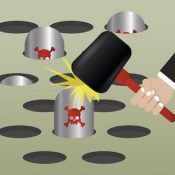
Image Source: Deposit Photos
Image ID: 328877234
Author: lightsource
![[Advertisement]](https://ipwatchdog.com/wp-content/uploads/2026/10/IP-Copilot-Oct-13-2026-sidebar-700x500-1.jpg)
![[Advertisement]](https://ipwatchdog.com/wp-content/uploads/2026/10/Junior-Oct-15-2026-sidebar-700x500-1.jpg)
![[Advertisement]](https://ipwatchdog.com/wp-content/uploads/2026/10/BlackBox-IP-Oct-20-2026-sidebar-700x500-1.jpg)
![[Advertisement]](https://ipwatchdog.com/wp-content/uploads/2026/10/Questel-Oct-22-2026-sidebar-700x500-1.jpg)
![[Advertisement]](https://ipwatchdog.com/wp-content/uploads/2026/09/WE-BUY-PATENTS-SIM-IP-Ad-1-revised-on-Sep-28-2026-700x500-1.jpg)
![[Advertisement]](https://ipwatchdog.com/wp-content/uploads/2026/09/Life-Sciences-2026-sidebar-early-bird-date-corrected-700x500-1.jpg)
![[Advertisement]](https://ipwatchdog.com/wp-content/uploads/2024/09/Patent-Prosecution-Training-sidebar-700x500-2025-03-27.jpg)





![[Advertisement]](https://ipwatchdog.com/wp-content/uploads/2021/12/WEBINAR-336-x-280-px.png)
![[Advertisement]](https://ipwatchdog.com/wp-content/uploads/2021/12/Ad-4-The-Invent-Patent-System™.png)



Join the Discussion
No comments yet. Add my comment.
Add Comment