
![[IPWatchdog Logo]](https://ipwatchdog.com/wp-content/themes/IPWatchdog%20-%202023/assets/images/temp/logo-small@2x.png)

 1
1 “[E]ven if the court had agreed to correct the alleged typo…[it] could simply have applied the reasoning of Ruschig and found that the original filing provided no ‘blaze marks’ for the proposed narrowed genus.”
 Enanta Pharmaceuticals v. Pfizer has been widely characterized as a case that turns on the acceptance or rejection of an alleged typographical error in a provisional patent application. That characterization is inaccurate. The alleged typographical error is a distraction that obscures the fact that the U.S. Court of Appeals for the Federal Circuit analyzed the case under the wrong legal framework. Properly understood, Enanta is not about a typo at all; rather, the dispositive question is whether the inventors possessed the invention prior to the public disclosure of the allegedly infringing compound.
The History
To summarize the history leading up to Enanta’s action against Pfizer, Enanta filed a provisional patent application in November of 2020 claiming an extremely broad genus. The specification described dozens of subgenera, including Formula VI-6a: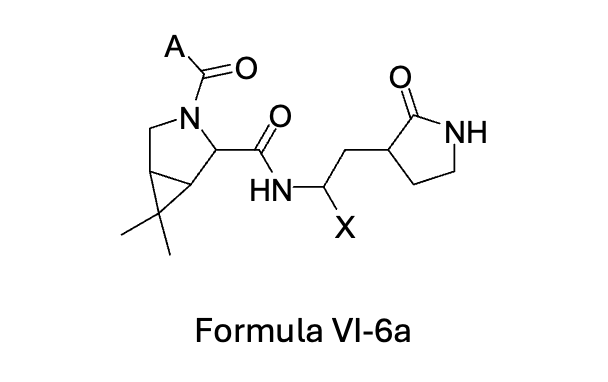
Substituent A is disclosed as optionally substituted C1-C8 alkyl; optionally substituted C3-C12 cycloalkyl; optionally substituted 3- to 12-membered heterocycloalkyl; optionally substituted aryl; or optionally substituted heteroaryl. Substituent X is disclosed optionally substituted C1-C8 alkyl; CN, C(O)R15; C(O)NR13R14; or C(O)C(O)NR13R14. R13 and R14 are each independently selected from a wide variety of substituents. The possibilities for groups A and X, therefore, are enormous. Formula VI-6a was not claimed in the originally submitted claims and none of the 54 specifically disclosed compounds within the scope of this subgenus include the case where A = substituted C1-C8 alkyl, much less a C1-C6 alkyl group substituted with -NHC(O)CF3.
On April 6, 2021, Pfizer publicly disclosed nirmatrelvir, characterized by the following structure: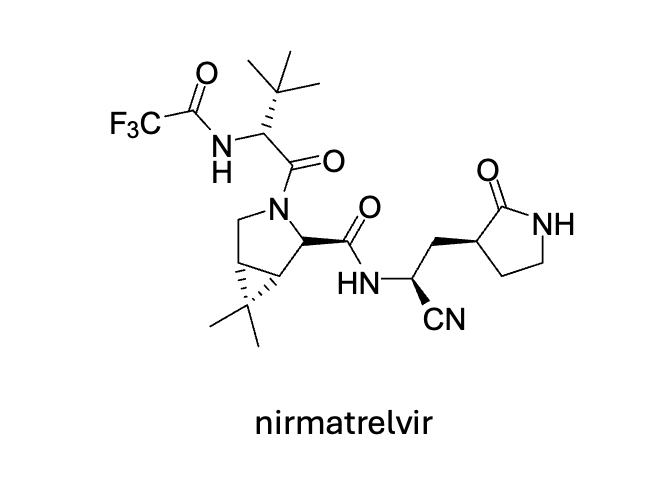
Three months later, Enanta realized its provisional application contained a typographical error (or so they alleged): C2-C16 alkyl should have been C1-C16 alkyl in the description of “substituted” in the Definitions section. Ten days later, Enanta filed a non-provisional application that published as U.S. 2022/0073499 A1 (the ‘499 publication) with the correction in para [0135]. In addition to amending C2-C16 to C1-C16 in the specification, this second filing included a new set of claims directed to Structure VI-6a where X = CN and A = optionally substituted C1-C8-alkyl or optionally substituted heteroaryl. The issued patent, U.S. 11,358,953 (the ‘953 patent) included claim 9 limiting group A to optionally substituted C1-C8, which Enanta presumably relied on to capture A = -C(t-butyl)NHC(O)CF3 in nirmatrelvir.
The following June, Enanta filed suit alleging infringement, and Pfizer counterclaimed that the ‘953 patent was invalid. The Massachusetts district court, having found no typographical error as alleged by Enanta, granted Pfizer’s motion for summary judgment, and Enanta appealed. Enanta argued summary judgment was inappropriate because the provisional application contained an inconsistency that created a genuine dispute of material fact. The alleged error – that C2-C12 was obviously meant to read C1-C12 – arises from the description of “alkyl” in the provisional application:
The term “alkyl” as used herein, refers to saturated, straight- or branched- chain hydrocarbon radicals. “C1-C4 alkyl,” “C1-C8 alkyl,” “C1-C8 alkyl ,” “C2-C12 alkyl,” “C2-C4 alkyl ,” or “C3-C6 alkyl, ” refer to alkyl groups containing from one to four, one to six, one to eight, one to twelve, 2 to 4 and 3 to 6 carbon atoms respectively. (Italics added.)
The inconsistency, Enanta submitted, is between the phrases “C2-C12 alkyl” and “one to twelve carbon atoms.” Enanta’s expert argued that a person of ordinary skill in the art would conclude that the numeral is likely to contain the error, but the Federal Circuit disagreed. The court found that the definition of “alkyl” was not the same as the specific definition of “substituent”, which included -NHC(O)-C2-C12 alkyl, not -NHC(O)-C1-C12 alkyl.
“The ’048 provisional did not disclose -NHC(O)-C1-alkyl. It therefore provided no written description support for the ’953 patent, so the ’953 patent cannot be afforded the ’048 provisional’s priority date. The district court therefore properly granted summary judgment that the ’953 patent claims were anticipated by Pfizer’s disclosure of nirmatrelvir.”
What the Federal Circuit Said
Curiously, the Federal Circuit found the claims to be anticipated, not infringed. Putting aside the fact that the claims that carved out optionally substituted heteroaryl for the A group (claims 3, 4, and 6) were clearly novel over the disclosure of nirmatrelvir, the court presumably subscribed to the view that the disclosure of nirmatrelvir anticipated the claims because it would have infringed them but for Pfizer’s pre-empting publication: that which anticipates if before, infringes if after. But if this was the reasoning the Federal Circuit used, its reasoning was faulty. Consider the definition of the term “substituted.”
“The term ‘substituted’ refers to substitution by independent replacement of one, two, or three or more of the hydrogen atoms with substituents, including, but not limited to….” (italics added.)
What does “the hydrogen atoms” refer to? If the court decided, sensibly in my view, that the term refers to one or more hydrogens on the optionally substituted alkyl groups, the claim is not infringed. Now, consider the following substructure:
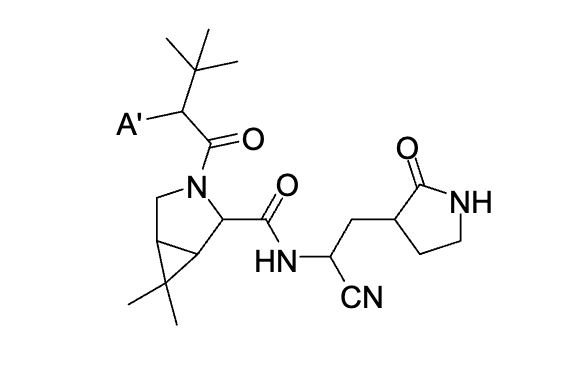
where A’ is the substituent attached to the alkyl group. If Enanta attempted to rely on the disclosure of -NHC(O)-C1-C12 alkyl, now the problem is that the specification does not disclose substitution of the C1-C12 alkyl group. In other words, CF3 is not the same thing as CH3. If CF3 is not the same as CH3, there is no anticipation, though the court could have found the claims where A included optionally substituted C1-C8 alkyl obvious. Moreover, the term “substituted” is open-ended by virtue of the phrase “but not limited to.” Thus, the claims of interest are invalid under Section 112 (for a variety of reasons) and Section 103; they are not anticipated, however, and not infringed even if the claims were valid.
The Federal Circuit distinguished the written description problem in Enanta from that of Ruschig (In re Ruschig, 379 F.2d 990 (CCPA 1967); nevertheless, the two cases are quite similar. In both instances, applicants tried to capture a compound that was published prior to the submission of an amendment claiming priority from an earlier filed application that arguably provided support, but for an intervening publication. In Ruschig, applicants’ attempt to provoke an interference failed because the CCPA found that too many selections were required to arrive at N-(4-chlorobenzenesulfonyl)-N-n-propyl urea, the subject compound of the interference, even though Ruschig had disclosed the homologous compound, N-(4-chlorobenzenesulfonyl)-N’-n-butyl urea. In Enanta, applicants narrowed the scope of their broadest claim to Formula (VI-6a) – one of 36 subgenera appearing in the originally submitted claims – and limited group A to optionally substituted C1-C8 alkyl or optionally substituted heteroaryl, and X to CN to capture nirmatrelvir. One can only imagine how the prosecution of Enanta’s application would have proceeded in the absence of Pfizer’s publication, but it is highly likely that a much narrower genus that would not have subsumed nirmatrelvir would have granted. As I’ve demonstrated, even the claims that were allowed with the foreknowledge of nirmatrelvir do cover this compound.
Correcting the Typo Would Not Have Changed the Outcome
This precise selection of the claims that issued was undoubtedly a direct result of the Pfizer publication. The fact that none of the compounds of Formula (VI-6a) disclosed in the application contain a group A substituent remotely close to C(t-butyl)NHC(O)CF3 belies any credible assertion of possession of the invention prior to Pfizer’s publication date; in fact, the specific selection of formula (VI-6a), A = optionally substituted C1-C8 alkyl or heteroaryl, and X = CN is the exact kind of picking and choosing that Ruschig cautions against. Accordingly, even if the court had agreed to correct the alleged typo, and even if -NHC(O)-C1-C12 alkyl were interpreted to include substituted C1-C12 alkyl, thereby capturing CF3, the court could simply have applied the reasoning of Ruschig and found that the original filing provided no “blaze marks” for the proposed narrowed genus.
![[Advertisement]](https://ipwatchdog.com/wp-content/uploads/2026/09/MarqVision-Oct-8-2026-sidebar-700x500-rev.jpg)
![[Advertisement]](https://ipwatchdog.com/wp-content/uploads/2026/10/IP-Copilot-Oct-13-2026-sidebar-700x500-1.jpg)
![[Advertisement]](https://ipwatchdog.com/wp-content/uploads/2026/10/Junior-Oct-15-2026-sidebar-700x500-1.jpg)
![[Advertisement]](https://ipwatchdog.com/wp-content/uploads/2026/09/WE-BUY-PATENTS-SIM-IP-Ad-1-revised-on-Sep-28-2026-700x500-1.jpg)
![[Advertisement]](https://ipwatchdog.com/wp-content/uploads/2026/09/Life-Sciences-2026-sidebar-early-bird-date-corrected-700x500-1.jpg)
![[Advertisement]](https://ipwatchdog.com/wp-content/uploads/2024/09/Patent-Prosecution-Training-sidebar-700x500-2025-03-27.jpg)




![[Advertisement]](https://ipwatchdog.com/wp-content/uploads/2021/12/WEBINAR-336-x-280-px.png)
![[Advertisement]](https://ipwatchdog.com/wp-content/uploads/2021/12/Ad-4-The-Invent-Patent-System™.png)





Join the Discussion
One comment so far. Add my comment.
Feng Tian
July 20, 2026 08:46 amThis reminds me of the patent disputes between Pfizer and Alnylam regarding U.S. Pat. Nos. 11,246,933 and 11,590,229. Similar “legal” strategies when the $ becomes bigger.
Add Comment