
![[IPWatchdog Logo]](https://ipwatchdog.com/wp-content/themes/IPWatchdog%20-%202023/assets/images/temp/logo-small@2x.png)
Posts in Patents
CAFC Reverses Indefiniteness Ruling, Revives Preliminary Injunction in Firearm Magazine Patent Dispute
The U.S. Court of Appeals for the Federal Circuit (CAFC) issued a decision today reversing in part and vacating in part a series of district court rulings that had invalidated a patent covering a firearm cartridge magazine housing. Chief Judge Moore wrote for the court, joined by Circuit Judges Stoll and Stark, finding the U.S. District Court for the District of Wyoming erred by treating certain claim terms as indefinite.
Federal Circuit Affirms PTAB Win for Samsung Invalidating Signal Transmission Patent
The U.S. Court of Appeals for the Federal Circuit (CAFC) on Thursday affirmed a Patent Trial and Appeal Board (PTAB) ruling for Samsung Electronics, finding the Board did not violate the Administrative Procedures Act (APA) and that substantial evidence supported its findings. Samsung filed for inter partes review (IPR) of claims 1–5, 7–9, 14, and 20 of G+ Communications’ U.S. Patent No. 10,736,130, which is titled “Method and device for uplink control signal transmission, user terminal, and storage medium.” The PTAB ultimately found that U.S. Patent No. 10,615,925 (“Kwak”) anticipated all of the challenged claims, and G+ Communications appealed.
‘Settled Expectations’ Challenges Heat Up at SCOTUS as Doctrine’s Author Exits USPTO
Kahoot AS! filed a petition for writ of certiorari on July 24 asking the U.S. Supreme Court to consider whether the U.S. Patent and Trademark Office’s (USPTO’s) “settled expectations” doctrine for denying inter partes review (IPR) requests is authorized under the patent statute. The petition also asked the High Court whether 35 U.S.C. § 314(d) bars judicial review of that question.
Outdated Protective Orders are Impeding Software Code Analysis in Copyright and Trade Secret Cases
As an expert witness on intellectual property litigations, I have noticed over the past few years parties with poor arguments in software copyright and software trade secret cases, both plaintiffs and defendants, have been taking advantage of technologically outdated protective orders to gain an unfair advantage. The U.S. District Court for the Northern District of California, where probably the majority of software IP cases take place, has a Model Protective Order for Litigation Involving Patents, Highly Sensitive Confidential Information and/or Trade Secrets that has become a de facto standard for software IP cases around the country. It is antiquated and needs to be updated.
Global AI Patent Grants Top 100,000 for First Time as Agentic AI Filings Accelerate
On Tuesday, IFI CLAIMS Patent Services released its annual report on artificial intelligence patenting, IFI Insights: Inventing AI. According to the report, worldwide AI patent grants reached 107,279 in 2025, marking the first time the total has surpassed 100,000 in a single year. The figure also represents an 83% increase over the past three years. Globally, AI patent applications reached 209,518 in 2025, of which 23% related to generative AI and 9% related to agentic AI, which is up from 5% in IFI’s previous study.
UK Supreme Court Revives Tesla’s Claims That Avanci 5G Vehicle Pool License Doesn’t Satisfy FRAND Obligations
Yesterday, the UK Supreme Court issued a ruling in Tesla, Inc. v. InterDigital Patent Holdings, Inc. representing the latest development in UK jurisprudence surrounding fair, reasonable and non-discriminatory (FRAND) obligations on standard-essential patents (SEPs). Applying the reasoning of its landmark SEP decision in Unwired Planet, the UK Supreme Court revived Tesla’s claims that InterDigital’s SEPs to 5G vehicle communications technologies are not being offered on FRAND terms through Avanci’s patent pool and further upheld the jurisdiction of UK courts to decide global FRAND terms.
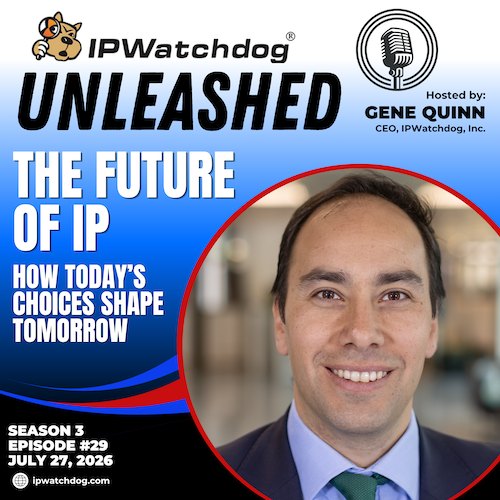
The Greatest Threat to IP Is Misunderstanding What It Does | IPWatchdog Unleashed
This week on IPWatchdog Unleashed, I speak with Martin Correa. Correa, who leads foresight work at the World Intellectual Property Organization (WIPO). Correa’s job is not to predict the future of IP, but to consider what futures are possible so WIPO and Member States can be better prepared for whatever eventuality does materialize. And since there is no data about the future—as he puts it—his work uses signals of change, horizon scanning and competing scenarios to expose assumptions and identify the decisions that could push the IP system in one direction or another.
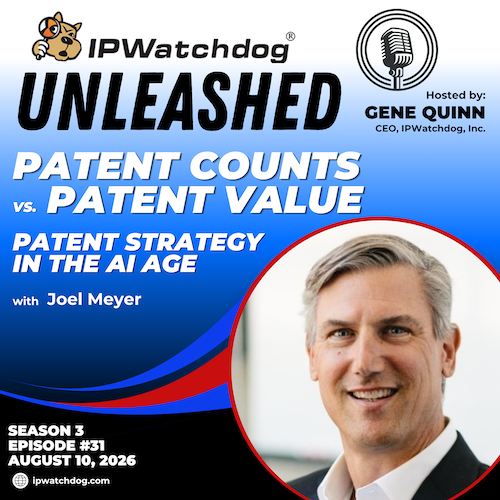
Are Your Patent Assets Monetizable or Merely Countable?
Patent count is often the first thing people notice about a portfolio. It should not be the last. A portfolio with 500 patents may have little monetization value if the claims are difficult to understand, the infringing products are unclear, the damages are weak, the strongest assets are expired or expiring soon, or there are no pending applications. Conversely, a smaller portfolio with well-supported claims, identifiable infringing products, meaningful damages, remaining patent life, and pending applications in both the U.S. and Europe may be far more valuable.
Coke Stewart Leaving USPTO to Return to Private Sector
IPWatchdog has learned that U.S. Patent and Trademark Office (USPTO) Deputy Director Coke Morgan Stewart sent an email to USPTO executive staff today informing them that she will be leaving the Office to return to the private sector. Stewart reportedly told Secretary of Commerce Howard Lutnick and USPTO Director John Squires earlier today that she will be leaving by the end of this week.
CAFC Reverses Infringement Verdict, Finds Patent Owner’s Stent Coating Patent Invalid as Anticipated
The U.S. Court of Appeals for the Federal Circuit (CAFC) issued a precedential decision today reversing a jury verdict from the U.S. District Court for the District of Delaware that had found Boston Scientific Corporation (BSC) liable for infringing a patent owned by the Board of Regents of the University of Texas System (UT) covering drug-releasing biodegradable polymer fibers. The Federal Circuit concluded that BSC was entitled to judgment as a matter of law (JMOL) on both invalidity and non-infringement.
The Inventorship Squeeze: Invalidity, Unenforceability, and Why Prosecution Just Got More Expensive
In the space of a few months, the U.S. Court of Appeals for the Federal Circuit and the U.S. District Court for the District of Massachusetts delivered two decisions that, read together, change how patent applicants and their counsel should approach the deceptively simple question of who invented what. Fortress Iron, LP v. Digger Specialties, Inc., No. 2024-2313 (Fed. Cir. Apr. 2, 2026), holds that if an inventorship error cannot be corrected under 35 U.S.C. § 256, the patent is invalid — full stop, no intent required. Inline Plastics Corp. v. Lacerta Group, Inc., No. 1:18-cv-11631 (D. Mass. Nov. 13, 2025), holds that if an inventorship omission was intentional, the entire patent family is unenforceable for inequitable conduct — the Therasense penalty at full weight.
CAFC Partially Reverses Ineligibility Ruling on Digital Picture Frame Patents, Reviving Suit Against Amazon
The U.S. Court of Appeals for the Federal Circuit (CAFC) issued a decision today affirming in part and reversing in part a district court ruling that had found four patents covering digital picture frame technology ineligible under 35 U.S.C. Section 101. The court remanded one patent claim to the U.S. District Court for the Central District of California for further proceedings and affirmed the ineligibility finding as to the remaining three patents at issue.
Federal Circuit Says Expired Patent Warrants Vacatur of ITC Determination
The U.S. Court of Appeals for the Federal Circuit (CAFC) on Thursday granted motions to dismiss as moot two appeals from an International Trade Commission (ITC) determination in which the ITC found Cartessa Aesthetics LLC violated Section 337 via infringement of Hydrafacial LLC’s patent, but suspended enforcement of an exclusion order because the patent was about to expire. The CAFC also vacated the underlying ITC determination.
USPTO Proposes Rule to Require Statement of RPIs for All Ex Parte Reexam Requests
The U.S. Patent and Trademark Office (USPTO) today published a Federal Register Notice proposing to amend the rules of practice to require that third-party requests for ex parte reexamination of a patent must include a statement identifying all real-parties-in-interest (RPIs) to the proceeding. According to the proposed rule, statements identifying RPIs would be kept confidential upon request and “would provide the Office with a mechanism to evaluate statutory estoppel provisions” as well as “enhance the Office’s ability to respond to false certifications, misrepresentations, and fraud.”
Federal Circuit Affirms Dissolution of Preliminary Injunction in Split Decision Over Foldable Fan Design Patent
The U.S. Court of Appeals for the Federal Circuit (CAFC) issued a decision today affirming a district court’s dissolution of a preliminary injunction (PI) and denial of a temporary restraining order (TRO) in a Schedule A design patent dispute over foldable fans. Circuit Judge Hughes wrote for the majority, joined by Circuit Judge Prost, while Circuit Judge Stoll dissented from the portion of the opinion addressing the merits of the design patent analysis.
Varsity Sponsors
![[Advertisement]](https://ipwatchdog.com/wp-content/uploads/2026/08/Anaqua-Aug-25-2026-sidebar-700x500-1.jpg)
![[Advertisement]](https://ipwatchdog.com/wp-content/uploads/2026/08/Solve-Intelligence-Aug-27-2026-sidebar-700x500-rev1.jpg)
![[Advertisement]](https://ipwatchdog.com/wp-content/uploads/2026/07/Womens-IP-Forum-2026-sidebar-register-early-bird-now-700x500-1.jpg)
![[Advertisement]](https://ipwatchdog.com/wp-content/uploads/2026/07/Juristat-Varsity-Ad-2026-IPW-ad-FreeTrial_1-UPDATED-on-Jul-15-2026.png)
![[Advertisement]](https://ipwatchdog.com/wp-content/uploads/2026/07/ClearstoneIP-Varsity-Ad-2026-Ad-2.jpg)
![[Advertisement]](https://ipwatchdog.com/wp-content/uploads/2026/08/OneTransform_700x500_v1.png)
From the IPWatchdog Institute
![[Advertisement]](https://ipwatchdog.com/wp-content/uploads/2024/09/Patent-Prosecution-Training-sidebar-700x500-2025-03-27.jpg)

Latest IPW Posts
Latest Section 101 Cert Petition Before SCOTUS Says CAFC Answered Two-Step Test with Single Inquiry
August 20, 2026 @ 02:15 pmWhen the Quantum-AI Invention Stack Speeds Up Discovery, Patent Practice Has to Move Upstream
August 20, 2026 @ 12:15 pmThe ‘Captain Obvious’ Approach: What the Nielsen Decision Reveals About the U.S. Obviousness Inquiry
August 20, 2026 @ 11:15 amFresenius Says to Congress, ‘Do as I Say Not as I Do’ on Drug Patents
August 19, 2026 @ 04:28 pmCAFC Says NPE Must Show Licensees Complied with Patent Marking Provision
August 19, 2026 @ 02:15 pm
Latest Podcasts

Industry Events
Webinar: AI for Lean IP Teams – Doing More with Less While Empowering the Next Generation
August 25 @ 12:00 pm - 1:00 pm EDTWebinar: AI Capabilities and the Future in Life Sciences Patent Practice
August 27 @ 12:00 pm - 1:00 pm EDTWebinar: Building an IPO-Ready Patent Strategy – What the C-Suite and Board Need from IP Leaders
September 1 @ 12:00 pm - 1:00 pm EDTWebinar: Before the Draft – Deciding What Is Worth Patenting in the AI Era
September 3 @ 12:00 pm - 1:00 pm EDT
Industry Events
Webinar: AI for Lean IP Teams – Doing More with Less While Empowering the Next Generation
August 25 @ 12:00 pm - 1:00 pm EDTWebinar: AI Capabilities and the Future in Life Sciences Patent Practice
August 27 @ 12:00 pm - 1:00 pm EDTWebinar: Building an IPO-Ready Patent Strategy – What the C-Suite and Board Need from IP Leaders
September 1 @ 12:00 pm - 1:00 pm EDTWebinar: Before the Draft – Deciding What Is Worth Patenting in the AI Era
September 3 @ 12:00 pm - 1:00 pm EDTFrom IPWatchdog
![[Advertisement]](https://ipwatchdog.com/wp-content/uploads/2021/12/WEBINAR-336-x-280-px.png)
![[Advertisement]](https://ipwatchdog.com/wp-content/uploads/2021/12/Ad-4-The-Invent-Patent-System™.png)