
![[IPWatchdog Logo]](https://ipwatchdog.com/wp-content/themes/IPWatchdog%20-%202023/assets/images/temp/logo-small@2x.png)
Posts in USPTO
Patent litigation returning to pre-2013 levels, says Lex Machina
During 2016’s second quarter, plaintiffs filed a total of 1,282 patent infringement cases in U.S. district court. This is a 33 percent increase in the 958 patent cases filed during the first quarter but data suggests that the second quarter tends to see the highest level of infringement cases over all other quarters according to Lex Machina data scientists Brian Howard. “We would expect a jump up from the first quarter,” he said. The first quarter was also a trough for patent infringement cases after last November’s massive number of 847 patent cases, just more than 100 cases less than the entire docket for this year’s first quarter. “The rise we’ve seen puts this year on track with 2011 or 2012 rather than the last two years,” Howard said.
The Anatomy of a Bogus Alice Rejection
First, this type of circular “logic” is at the heart of virtually all Alice rejections. Here the examiner concludes there is nothing significantly more than the judicial exception (which in this case is an abstract idea) because the additional elements add no more than the abstract idea. In other words, the examiner says there is nothing significantly more than the abstract idea because there is nothing more than the abstract idea. The Alice equivalent of this “how dare you ask me, I’m your mother” simply says what you’ve claimed is abstract because it is abstract, period. Clearly, a conclusory rejection like this without any real explanation does not satisfy the examiner’s prima facie burden to articulate a valid reason to reject. After all “because” is not a reason.
Alice Experts and the Return of Second Pair of Eyes to the PTO
In every art unit examiners confirm that there is an examiner within the Art Unit who is the Alice expert and that examiners have said that even if they are ready to allow a case, nothing can be allowed without the approval of that Alice expert. This sounds quite similar to second pair of eyes review, which wreaked enormous havoc on the patent system over a decade ago. Second pair of eyes review was one of the primary reasons why patent pendency got out of control and the backlog of patent applications grew to well over 1 million unexamined patent applications. It seems to have returned under the guise of Alice.
After Cuozzo, Congress Must Take Back the Ball
While the Supreme Court spoke clearly and unanimously on the issue in Cuozzo, this hardly means the standard to be applied to claim construction in IPRs has been settled. Rather, it means only that the solution to the problem lies outside the courts. Because the Patent Office has adopted, by regulation, an unsatisfactory standard, Congress should step in. In the context of IPR proceedings, the Patent Trial and Appeal Board (PTAB) should be instructed to give claim terms their plain and ordinary meaning to one of skill in the art, just as the courts are instructed to do.
Message from the USPTO: It’s Patent Prosecution, not Persecution
Examiners are not supposed to think about the nebulous areas of 101, 102, or 103, nor are they to interpret case law from judicial opinions. Instead, the USPTO has already determined how they intend to interpret these sources, and has distilled these decisions into memos for their examiners to follow. To the examiners, an attorney putting forth arguments on such grounds is arguing issues that have already been settled. There are appropriate periods in the pursuit of patent protect for attorneys to argue the grey areas of law, but the exchange with the examiner is not the time to do that advocacy to any great extent. Arguing those grey areas in prosecution wastes clients’ resources and everyone’s time.
Prosecution reopened: Examiners stop applicants from appealing
Due to a bizarre jurisdictional “feature,” the Board does not actually get jurisdiction over a case until either a Reply Brief has been filed or the time to file a Reply Brief has run. See 37 CFR 41.35(a). What this means is the patent examiner, in order to frustrate the applicant’s ability to have the Board hear a case, can simply refuse to file an Examiner’s Answer and instead reopen prosecution. This happens all too frequently in some Art Units.
Administrative Purgatory: Waiting 14 months and counting for action after Board reverses examiner
Delay, frustrate, harass and ignore patent applicants. Issue frivolous rejections if necessary, but reject at all costs. If the Board issues a complete reversal just reopen prosecution. Eventually the patent applicant will get the idea and abandon the application. TC 3600 seems to be fighting a very successful and coordinated war of attrition against applicants.
Are patent examiners instructed to issue frivolous rejections?
So an applicant waits years on appeal to get relief from frivolous rejections, achieves a complete and total victory, and their reward is another bogus rejection from the same examiner who has been harassing them for years. It is no wonder many applicants just give up. If this were happening anywhere else in the world we would ridicule the system as fixed or rigged… How ironic, and sad, is it that the PTAB has the authority to invalidate issued patents in post grant proceedings but has no implementing authority with respect to its decisions completely reversing even frivolous examiner rejections. This is yet another reason the PTAB is appropriately characterized a death squad. The only power the PTAB seems to have is to take rights away from property owners (i.e., patent owners).
Immersion Corp v. HTC Corp: CAFC affirms filing continuation on day parent issues
In large part, the CAFC was concerned with the possible disruption of overturning long-standing PTO practice and the reliance placed on it by practitioners, and this respect and concern for practice is to the court’s credit. And to its credit, the CAFC said as much: the “Supreme Court has long recognized that a ‘longstanding administrative construction,’ at least one on which reliance has been placed, ‘provides a powerful reason for interpreting a statute to support the construction…[h]ere, HTC’s position would disturb over 50 years of public and agency reliance on the permissibility of same-day continuations. We see no basis for denying the existence of a facially large disruptive effect were we now to repudiate the same-day-continuation policy.”
The Impotence of the Patent Trial and Appeal Board
What is happening in TC 3600 is prosecution is being re-opened for the purpose of issuing Alice rejections. With the help of readers, so far I’ve found eleven (11) separate cases over the last 10 months where prosecution was re-opened by Greg Vidovich, Director of TC 3600, after the Board issued a decision completely reversing the examiner on every rejection of every claim. In each case the Vidovich authorized re-opening of prosecution simply to issue Alice rejections… What good is an appeal when the TC Director has demonstrated that even if the appeal is successful prosecution can be re-opened and more bogus rejections made? What good is going back into prosecution with the same unreasonable examiner that has just has each and every rejection of each and every claim reversed? There is no relief for applicants, which is not how the system is supposed to work.
E-Commerce Art Units: Where Patent Applications Go to Die
Upon closer review things are much, much worse than I previously reported. The problem is also far more widespread. Using LexisNexis Patent Advisor®, I looked at the E-commerce Art Units, this time focusing on what has happened over the past 18 months. Focusing on this segment of post-Alice prosecution the allowance picture is utterly atrocious… Only 12 patents were issued by Art Unit 3689 in 2015, while 365 applications went abandoned, which corresponds to an allowance rate of 3.2%. So far in 2016 there have been only 3 patents issued by Art Unit 3689, while 232 patent applications have gone abandoned, which corresponds to an allowance rate of 1.3%.
Evolution of Tech: Willis Carrier helps us beat the summer heat with the invention of air conditioning
In 1902, shortly after joining the Buffalo Forge Company, Willis Carrier had a momentary insight while standing on a train station in Pittsburgh, which would lead him to develop his first air conditioner system. The oft-repeated story of this discovery involves something of a paradox: Carrier, surrounded by fog, realized that he could dry air by adding water to warm, humid air to create fog. He realized that if he saturated the air with water, he could control the temperature of that saturated air by passing it through a cool water spray that caused the moisture of hot, humid air to condense and leave the air stream. Although the cooling of air had been demonstrated by Gorrie, Franklin and others, Carrier solved the problem of removing humidity from the air.
What the Patent Office Refuses to Understand
This new post-prosecution pilot program feels a lot like rearranging the chairs on the Titanic. Unless and until the Patent Office does something about recalcitrant patent examiners this effort may wind up being much ado about nothing… If you look at Art Unit 3622, which handles applications dealing with incentive programs and coupons, and compare it with Art Unit 3688 and Art Unit 3682, both of which also handle patent applications relating to incentive programs and coupons, you see the same alarming trend. These three Art Units that handle the same type of patent application yet have allowance rates of 9.5%, 29.2% and 63.2%. Something seems seriously wrong and is screaming for investigation.
Patent Office announces Post-Prosecution Pilot Program
The Patent Office hopes that by giving the applicant the opportunity to provide an oral presentation to the panel during a conference with the examiners, as well as providing written explanation, issues can be resolved without need for an appeal. Indeed, the goal for this Post-Prosecution Pilot Program is to hopefully reduce the number of appeals take to the Patent Trial and Appeal Board (PTAB), or at the very least reduce the number of issues that are appealed. It is also believed that the program will impact the number of request for continued examination (RCE) filings as well.
Reinventing our Climate Future
On Wednesday, June 29th, the United States Patent and Trademark Office hosted a panel titled Innovation to Power the Nation (and the World): Reinventing our Climate Future. This panel featured several important players involved in climate change within the United States. USPTO Director Michelle Lee delivered the keynote address while the panel was moderated by Amy Harder of the Wall Street Journal, who posed interesting and through provoking questions to the panelists. The panel comprised, Dr. Kristina Johnson, Chief Executive Officer of Cube Hydro Partners, Dr. Bantval Jayant Baliga, Director of the Power Semiconductor Research Center at North Carolina State University, Bob Perciasepe, President of the Center or Climate Change and Energy Solutions, and Nathan Hurst, Chief Sustainability & Social Impact Officer at Hewlett Packard, Inc.
Varsity Sponsors
![[Advertisement]](https://ipwatchdog.com/wp-content/uploads/2026/03/NLPatent-Apr-2-2026-sidebar-700x500-1.jpg)
![[Advertisement]](https://ipwatchdog.com/wp-content/uploads/2026/02/Junior-Apr-7-2026-sidebar-700x500-1.jpg)

Latest IPW Posts
The USPTO is Trying—But the Most Abusive Practices to Kill Patents Are Still in Play
April 1, 2026 @ 05:58 pmAs ‘Pro Codes Act’ is Reintroduced, Opponents Warn of Threats to Standards Development System
April 1, 2026 @ 02:15 pmUSPTO Solves U.S. Patent Eligibility Problems
April 1, 2026 @ 01:19 pmMainstream Media Attention for Judge Newman Suspension Grows as Saga Continues
April 1, 2026 @ 11:15 amHow to Draft AI Patents That Survive the Next Guidance Cycle, and the One After That
April 1, 2026 @ 07:15 am
Latest Podcasts



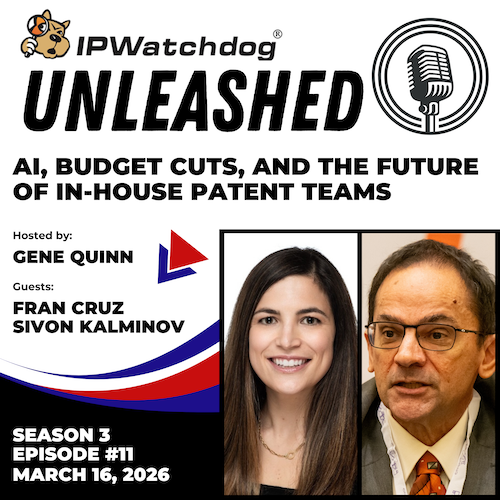

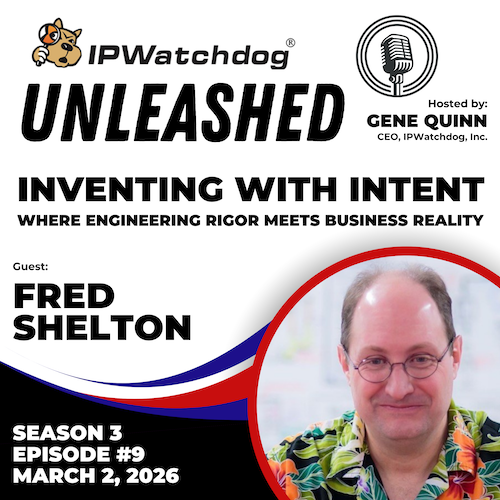
IPWatchdog Events
Webinar: Unlocking New Capabilities – The Real ROI of AI in Patent Practice
April 2 @ 12:00 pm - 1:00 pm EDTCLE Webinar: All in the Prompt – Crafting AI Prompts for Precision Outputs
April 7 @ 12:00 pm - 1:00 pm EDTWebinar: From Patent Tools to AI Agents – The Next Evolution of Patent Practice
April 14 @ 12:00 pm - 1:00 pm EDT
Industry Events
24th Annual Rocky Mountain Intellectual Property & Technology Law Institute
May 28 @ 8:30 am - May 29 @ 4:30 pm MDTFrom IPWatchdog
![[Advertisement]](https://ipwatchdog.com/wp-content/uploads/2021/12/WEBINAR-336-x-280-px.png)
![[Advertisement]](https://ipwatchdog.com/wp-content/uploads/2021/12/Ad-4-The-Invent-Patent-System™.png)