


 0
0 “Trying to shoehorn claims to align with the most recent guidance is a recipe for headache.” — Thara Russell, Capital One
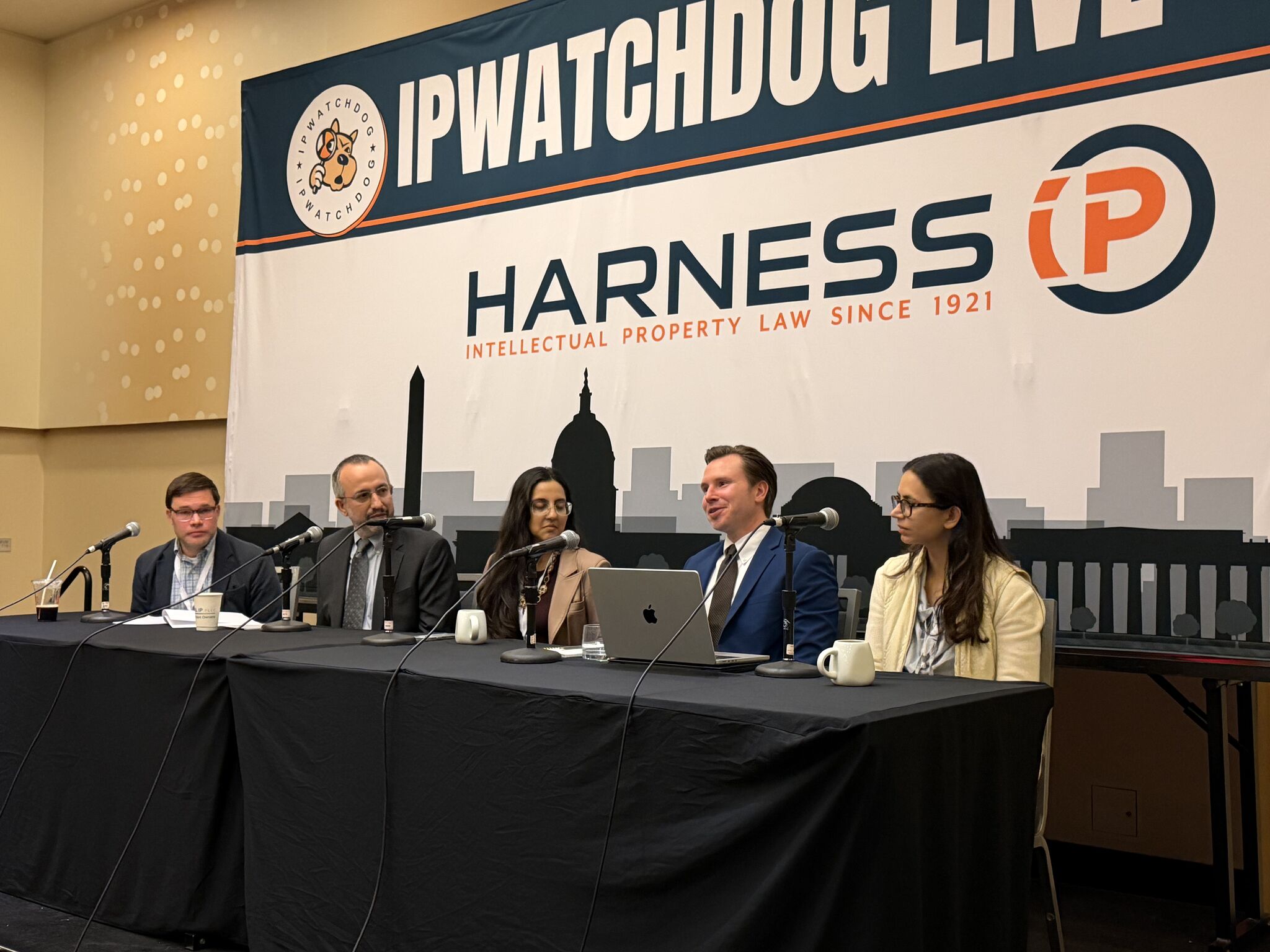 Since 2024, the U.S. Patent and Trademark Office (USPTO) has issued multiple AI?specific guidance documents on inventorship and subject?matter eligibility, including the February 2024 Inventorship Guidance, the July 2024 Subject Matter Eligibility Update, and the November 2025 memo rescinding the February 2024 guidance. The pace of change has created a prosecution environment where the strategies that worked 18 months ago may actively undermine a patent application filed today. The inverse is true; applications drafted for today’s guidance may be structurally unprepared for the next revision.
The session, AI Patents Under the Microscope: Drafting and Prosecuting for the Long Game, on Day Three of IPWatchdog LIVE 2026 did not pretend otherwise. The panel, featuring Jason Harrier (Salesforce), Robert Plotkin (Blueshift IP), Thara Russell (Capital One), Jonathan Hummel (Ballard Spahr), and Giulia Toti (Ankar AI), offered practitioners something more durable than compliance tips: a prosecution philosophy built to outlast the guidance that triggered it.
The Guidance-to-Practice Gap Runs Both Ways
Harrier opened by naming the structural problem that makes AI patent prosecution uniquely difficult: the guidance-to-practice gap. New memos from the USPTO do not instantly reshape examiner behavior. “How long does it take for guidance to trickle down?” Harrier’s question drew immediate recognition from the room. Patent examiners working AI-adjacent dockets frequently apply interpretive frameworks that predate the office’s most recent position, and practitioners who have built their arguments around the current memo may find themselves responding to an examiner operating on last year’s instructions.
Hummel noted that the gap runs in the opposite direction as well. Practitioners face their own version of the same problem with clients. Inventors using generative AI tools to produce disclosures, claim drafts, and prior art searches often do not understand the scope of what they have created, or how much of it is genuinely patentable. “It used to be inventors would give us a two-sentence description,” he said. “Now we’re receiving 40 pages, and finding out how to turn it back into two sentences.” The AI Gold Rush has made inventors more prolific and the practitioner’s analytical function more essential, not less.
Invert the Claim Strategy, Expand the Specification
Plotkin described a continuation strategy he has deliberately reversed from prior practice. Previously, he filed broad patent claims first and narrowed in continuations. He has inverted that sequence entirely. The initial patent application now carries the narrowest, most defensible claims. Broader claims follow through continuations.
The rationale is partly psychological and entirely practical. “Someone who’s allowed a first claim is psychologically more likely to allow a slightly broader continuation,” he said. Securing early patent allowance on a narrow set of claims changes the examiner’s orientation toward the portfolio as a whole. The prior allowance functions as a strategic anchor that makes the path to broader protection a matter of incremental expansion rather than a fresh eligibility fight from a blank slate.
Word choice amplifies or undermines this strategy. Plotkin noted that terms like “analyzing” and “determining” consistently anchor examiners in the mental step category and invite Section 101 rejections. Practitioners who understand this choose terminology deliberately, steering the examination framing before the first office action is written.
On the patent specification side, Plotkin has been systematically beefing up disclosures to create fallback positions for future eligibility arguments. He plans not only for the current rejection, but for the one that arrives after the next guidance revision. For AI-generated inventions that use off-the-shelf models, he pushes back hard at the inventor level: “I push back on the inventor to describe how the system does something that is not just a use of the existing model.” The distinction between implementing a tool and genuinely improving on it is what separates a defensible machine learning patent from an application waiting for a 101 rejection.
The Invention Story Is the Only Durable Foundation
Russell provided the panel’s clearest strategic framework, and it begins before any claim language is drafted. “There’s a need to truly understand the invention story behind every specification we draft,” she said.
That clarity is what makes strategic continuations viable. Start with the clearest version of what the inventor actually did and why it represents a genuine improvement on what existed before. Then use current guidance to position the prosecution approach. Starting with the guidance and fitting the invention into it produces brittle applications that lose their coherence the moment the guidance changes. “Trying to shoehorn claims to align with the most recent guidance is a recipe for headache,” Russell said.
The AI Gold Rush has made this discipline harder to maintain. Inventors arrive with disclosures shaped by generative tools and genuine enthusiasm, convinced they have produced something patentable because it is complex and novel-feeling. The practitioner’s job, Russell argued, is clinical. She described the intake process as analogous to a doctor asking “tell me where it hurts.” If the answer is everywhere, the work of identifying the actual inventive contribution has only just started.
AI Tools in Prosecution: Use Them, But Return to the Source
Toti brought a platform perspective to the discussion. AI tools are increasingly being used to structure patent applications around how the patent examiner will receive them. She sees practitioners front-loading best practices into the drafting process rather than retrofitting them during prosecution. The efficiency gain is genuine. The risk is equally real. “There’s a great need to go back to the source material,” she said. AI-generated output that appears accurate and well-organized is not a substitute for a specification grounded in what the inventor actually built. Hallucinations in patent drafting are not an abstract risk. They are prosecution liabilities that inevitably emerge during examination or, worse, in litigation.
The question of how much to delegate to AI tools is, as Toti framed it, a question of where practitioners choose to spend their time. Mechanical tasks (e.g., proofreading, formatting, sifting through AI-generated prior art that is itself growing at pace) are legitimate candidates for delegation. However, the invention story itself is not delegable. Plotkin noted that an AI-assisted international search is increasingly necessary for AI inventions, where that 80 to 90 percent of relevant prior art is now in Chinese-language filings.
Sometimes the Best Move Is Not Filing
Russell closed the panel’s most strategic thread with a point that experienced patent portfolio counsel will recognize and newer practitioners need to hear: sometimes the right advice is not to file.
For AI inventions where the achievable claim scope is too narrow to be commercially meaningful, or where patentability cannot be established without claims that will not survive post-grant review, the full range of options deserves serious evaluation. “Look at the whole scope of options to identify what is the best choice to achieve the client’s objective,” Russell said. A filed application that cannot be defended is not an asset. It is a future problem disguised as a deliverable.
The panel’s consensus held throughout: durable AI patent protection is not built by tracking guidance cycles. It begins with understanding inventions completely, drafting specifications with layered fallback architecture, and educating clients thoroughly enough that the genuine inventive contribution can be identified. These components build patent portfolios that can be defended regardless of whatever examination environment comes next.
![[Advertisement]](https://ipwatchdog.com/wp-content/uploads/2026/10/Questel-Oct-22-2026-sidebar-700x500-1.jpg)
![[Advertisement]](https://ipwatchdog.com/wp-content/uploads/2026/10/ClaimHit-Oct-28-2026-sidebar-700x500-1.jpg)
![[Advertisement]](https://ipwatchdog.com/wp-content/uploads/2026/09/Life-Sciences-2026-sidebar-early-bird-ends-Oct-25-700x500-1.jpg)
![[Advertisement]](https://ipwatchdog.com/wp-content/uploads/2026/09/WE-BUY-PATENTS-SIM-IP-Ad-1-revised-on-Sep-28-2026-700x500-1.jpg)
![[Advertisement]](https://ipwatchdog.com/wp-content/uploads/2024/09/Patent-Prosecution-Training-sidebar-700x500-2025-03-27.jpg)



![[Advertisement]](https://ipwatchdog.com/wp-content/uploads/2021/12/WEBINAR-336-x-280-px.png)
![[Advertisement]](https://ipwatchdog.com/wp-content/uploads/2021/12/Ad-4-The-Invent-Patent-System™.png)





Join the Discussion
No comments yet.