
![[IPWatchdog Logo]](https://ipwatchdog.com/wp-content/themes/IPWatchdog%20-%202023/assets/images/temp/logo-small@2x.png)
Posts in Government
Federal Circuit Affirms PTAB Finding that Centripetal Patent Claims are Unpatentable as Anticipated
The U.S. Court of Appeals for the Federal Circuit (CAFC) issued a decision today in Centripetal Networks, LLC v. Keysight Technologies, Inc., affirming a final written decision of the Patent Trial and Appeal Board (PTAB) and holding that the Board correctly construed a limitation of one independent claim of Centripetal’s patent and properly found that a prior art reference anticipated the claim.
The USPTO is Trying—But the Most Abusive Practices to Kill Patents Are Still in Play
In modern Patent Trial and Appeal Board (PTAB) practice, aggressive procedural strategy is no longer the exception—it is the operating norm. As the U.S. Patent and Trademark Office (USPTO) has increasingly relied on discretionary denials to constrain inter partes review (IPR), petitioners have adapted. One emerging tactic is the strategic use of ex parte reexamination as a fallback mechanism—deployed either after discretionary denial or, after an unfavorable IPR, or after the petitioner sees the handwriting on the wall and before a final written decision (FWD) is issued in an IPR.
As ‘Pro Codes Act’ is Reintroduced, Opponents Warn of Threats to Standards Development System
Opponents of the “Pro Codes Act” are speaking out this week following its recent reintroduction in the U.S. Senate. The Protecting and Enhancing Public Access to Codes (Pro Codes) Act of 2026, S. 4145, was reintroduced on March 19 by Senators Jon Cornyn, Chris Coons, Mazie Hirono, and Thom Tillis. According to the bill’s sponsors, the legislation “ensures safety standards do not lose copyright protection when they are incorporated into law by name so long as they are accessible for free on a publicly available website.”
USPTO Solves U.S. Patent Eligibility Problems
The U.S. Patent and Trademark Office (USPTO) announced today that it is deploying an artificial intelligence (AI) tool that will finally solve the problem of patent eligibility analysis for examiners.
How to Draft AI Patents That Survive the Next Guidance Cycle, and the One After That
Since 2024, the U.S. Patent and Trademark Office (USPTO) has issued multiple AI-specific guidance documents on inventorship and subject matter eligibility, including the February 2024 Inventorship Guidance, the July 2024 Subject Matter Eligibility Update, and the November 2025 memo rescinding the February 2024 guidance. The pace of change has created a prosecution environment where the strategies that worked 18 months ago may actively undermine a patent application filed today. The inverse is true; applications drafted for today’s guidance may be structurally unprepared for the next revision.
Tesla Partially Succeeds at CAFC with Ruling Finding Some EV Charging Claims Obvious
The U.S. Court of Appeals for the Federal Circuit (CAFC) issued a decision today in Tesla, Inc. v. Charge Fusion Technologies, LLC, affirming in part, reversing in part, and vacating in part a final written decision of the United States Patent and Trademark Office’s Patent Trial and Appeal Board (PTAB). The CAFC determined that the PTAB improperly construed a limitation of one independent claim but correctly construed limitations of other independent claims. The court reversed the finding of non-obviousness for claim 1, vacated the judgment regarding its dependent claims, and affirmed the finding of non-obviousness for the remaining claims.
WIPO in Focus: Beyond Treaties, Toward a Market-Driven IP System | IPWatchdog Unleashed
This week on IPWatchdog Unleashed, I spoke with Lisa Jorgenson, who is Deputy Director at the World Intellectual Property Organization (WIPO). Jorgenson had just attended IPWatchdog LIVE 2026 and spoke on our final panel along with former U.S. Patent and Trademark Office (USPTO) Director David Kappos, former USPTO Director Andrei Iancu, and former International Trade Commission (ITC) Commissioner Scott Kieff. She joined me immediately following the conference at IPWatchdog Studios for a wide-ranging discussion that pulled back the curtain on an institution many in the IP community think they understand—but often do not really appreciate.
Amicus, Sanofi Urge USPTO Appeals Panel to Uphold Ex Parte Baurin’s Approach to ODP Analysis
Amicus briefs in the U.S. Patent and Trademark Office’s (USPTO’s) review of issues raised by a 2025 Patent Trial and Appeal Board (PTAB) rehearing decision regarding the judicially-created doctrine of obviousness-type double patenting (ODP) were due on Friday, March 27. At least one amicus is urging the Office to affirm the decision’s holding and clarify that the focus should be on “whether there is any unjustified extension of term when determining if an ODP rejection is appropriate” in order to create more consistent outcomes in examination and to harmonize the approaches of the PTAB and examining corps.
PTAB Upholds Priority Win for Broad Institute in CRISPR Patent Case
On remand from the U.S. Court of Appeals for the Federal Circuit (CAFC), the Patent Trial and Appeal Board (PTAB) on Thursday reaffirmed its decision that The Broad Institute, Inc., Massachusetts Institute of Technology, and President and Fellows of Harvard College (“Broad”) were the first inventors of the use of CRISPR-Cas9 gene editing in eukaryotic cells.
U.S. Government Says SCOTUS Should Skip Pharma Companies’ Challenge to Medicare Negotiation Program
The U.S. government filed its brief in opposition yesterday to Janssen Pharmaceuticals and Bristol Myers Squibb Company’s (BMS) petition for writ of certiorari challenging the government’s Medicare Drug Price Negotiation Program. A split U.S. Court of Appeals for the Third Circuit decision in September 2025 affirmed a grant of summary judgment to the government that the imposition of the Program via the Inflation Reduction Act (IRA) does not violate the companies’ constitutional rights.
Contentious House USPTO Oversight Hearing Centers on PTAB Reforms, Trump’s Political Influence
Today, the U.S. House of Representatives Judiciary Committee’s Subcommittee on Courts, Intellectual Property, Artificial Intelligence, and the Internet conducted its first oversight hearing of the U.S. Patent and Trademark Office (USPTO) during the second Trump Administration. The harshest lines of questioning for USPTO Director John Squires during the hearing were reserved for the agency’s notice of proposed rulemaking (NPRM) to reform rules of practice at the Patent Trial and Appeal Board (PTAB) as well as President Trump’s political influence at the agency. During the hearing, Squires also confirmed that the agency’s Patent Public Advisory Committee (PPAC) would soon be revived, following an offer to join PPAC extended last night to an undisclosed independent inventor.
IPWatchdog LIVE Day Three: Coke Stewart Says Reexam Surge is on Office Radar; Rep. Kiley Talks Innovation Education on the Hill; and Meet the 2026 IPWatchdog Masters Hall of Fame Inductees
In the final session of IPWatchdog LIVE 2026 on Tuesday, March 24, U.S. Patent and Trademark Office (USPTO) Deputy Director Coke Morgan Stewart had a conversation with IPWatchdog Founder and CEO Gene Quinn in which she confirmed the Office is paying attention to the recent surge in ex parte reexamination filings and also said she is “optimistic” that the pending Notice of Proposed Rulemaking (NPRM) will be finalized.
SCOTUS Denies Pro Se Inventor Challenge to Conflicting, Unexplained Section 101 Rejections
Today, the U.S. Supreme Court issued an order list denying a petition for writ of certiorari filed by inventor Noah Healy to challenge rulings upholding a patent examiner’s subject matter eligibility rejection under 35 U.S.C. § 101 at the U.S. Patent and Trademark Office (USPTO). Healy’s pro se petition challenged the U.S. Court of Appeals for the Federal Circuit’s decision to affirm the examiner’s rejection as violating the meaningful review requirements of the Administrative Procedures Act (APA) due to conflicting statutory theories on patentability that were never sufficiently explained by the agency.
IPWatchdog LIVE 2026: Judge Newman and Michel Present Awards, Panelists Outline Uphill Battle for Global IP and Drug Patents
On day one of IPWatchdog LIVE 2026, panelists discussed the global IP landscape, the economics of patent portfolios, patent dealmaking and the ins and outs of drug patent critiques, before U.S. Court of Appeals for the Federal Circuit (CAFC) Judge Pauline Newman and Retired CAFC Judge Paul Michel introduced the recipients of their respective eponymous awards for 2026.
The Problem of Abusive Serial Challenges Using Reexaminations Needs to Be Addressed by the USPTO
The current U.S. Patent and Trademark Office (USPTO) leadership has made its position on serial patent challenges crystal clear. USPTO Director Squires warned that “even extremely strong patents” cannot survive repeated rounds of review. See NPRM Comments (10/16/2025)…. Once again, Director Squires and Deputy Director Stewart are right on the mark. Allowing excessive serial challenges to patents is unfair to patent owners and undermines the patent system.
Varsity Sponsors
![[Advertisement]](https://ipwatchdog.com/wp-content/uploads/2026/05/Ankar-AI-May-26-2026-sidebar-700x500-1.jpg)
![[Advertisement]](https://ipwatchdog.com/wp-content/uploads/2026/05/Protege-in-PatentSight-spotlight-350x250-Ad-B.png)
![[Advertisement]](https://ipwatchdog.com/wp-content/uploads/2026/05/Juristat-May-28-2026-sidebar-700x500-1.jpg)
![[Advertisement]](https://ipwatchdog.com/wp-content/uploads/2026/05/Patent-Masters-2026-sidebar-700x500-1.jpg)

Latest IPW Posts
Re-Spacing Cursor in the AI Stack: The Antitrust Implications of a SpaceX-Cursor Collab
May 21, 2026 @ 08:15 amThe USPTO’s AI Agenda: Examining the Office’s AI Tools and Guidance for Practitioners
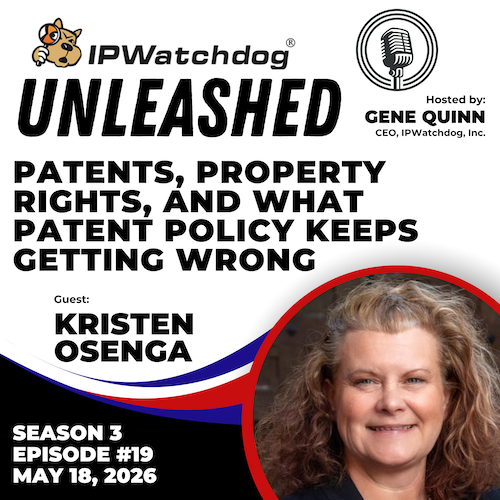
May 21, 2026 @ 07:15 amPatents, Property Rights, and What Patent Policy Keeps Getting Wrong | IPWatchdog Unleashed
May 20, 2026 @ 01:21 pm
Latest Podcasts


IPWatchdog Events
Webinar: Structuring Biological Sequences Data for Patent Drafting – AI Workflows for ST.26 Sequence Listings
May 26 @ 12:00 pm - 1:00 pm EDTWebinar: AI That Works in Patent Practice – Practical Use Cases That Reduce Work Without Increasing Risk
May 28 @ 12:00 pm - 1:00 pm EDTPatent Masters™ 2026 – Portfolios, Licensing and Enforcement
June 8 @ 8:00 am - June 10 @ 5:00 pm EDTWebinar: How AI Is Transforming IP Strategy Across the Patent Lifecycle
June 11 @ 12:00 pm - 1:00 pm EDT
Industry Events
24th Annual Rocky Mountain Intellectual Property & Technology Law Institute
May 28 @ 8:30 am - May 29 @ 4:30 pm MDTFrom IPWatchdog
![[Advertisement]](https://ipwatchdog.com/wp-content/uploads/2021/12/WEBINAR-336-x-280-px.png)
![[Advertisement]](https://ipwatchdog.com/wp-content/uploads/2021/12/Ad-4-The-Invent-Patent-System™.png)