


 2
2 “A favorable ruling on trade dress would give Smucker leverage against the entire field of crustless sandwich competitors, not just Trader Joe’s.”
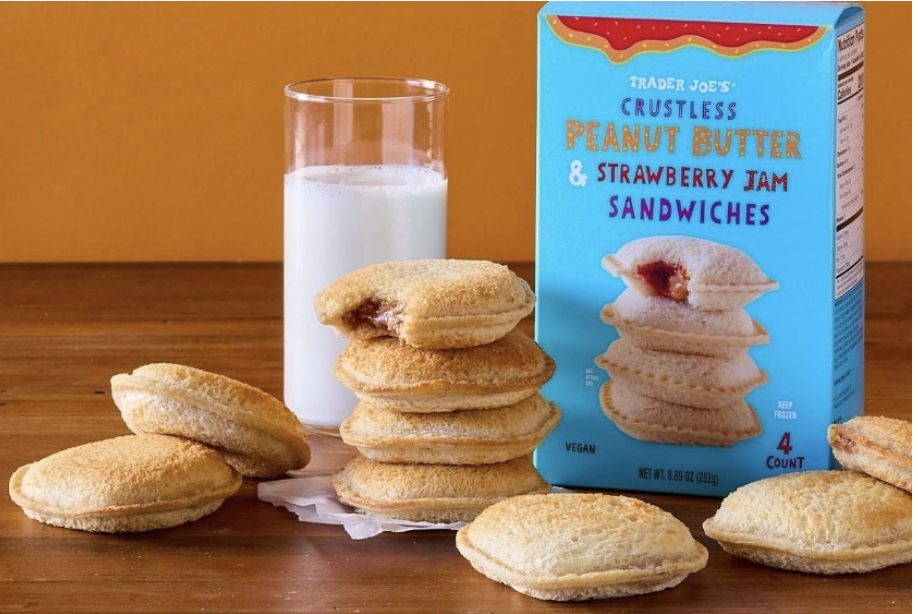
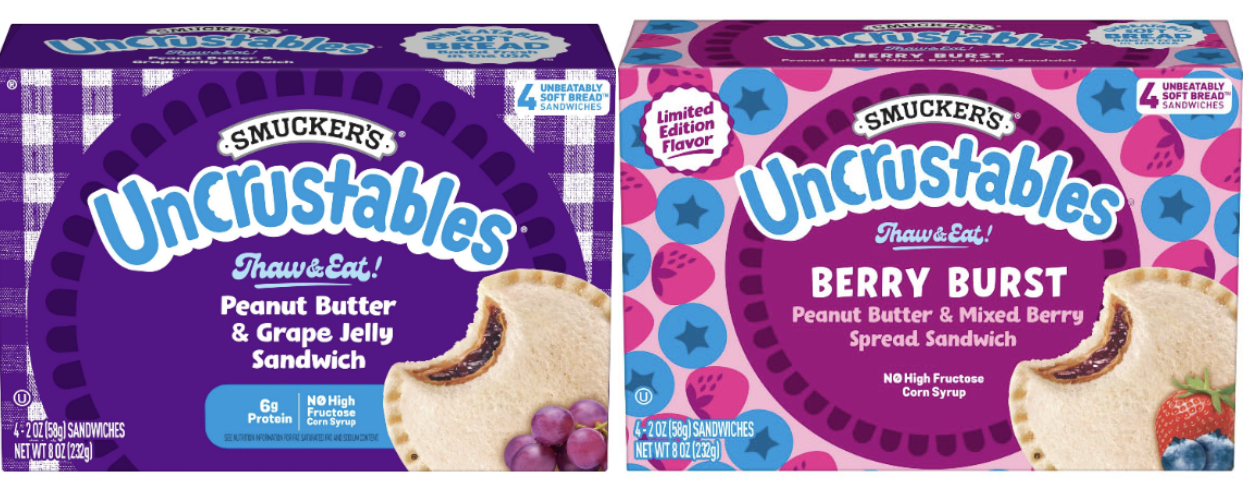
Images from court documents
On September 1, a federal judge in the Northern District of Ohio denied Trader Joe’s motion to dismiss J.M. Smucker Co.‘s trademark and trade dress claims over its crustless, crimped-edge peanut butter and jelly sandwiches. The ruling allows Smucker’s suit that was filed last October against Trader Joe’s private-label “Crustless Peanut Butter & Strawberry Jam Sandwiches” to proceed to discovery and, potentially, a merits determination on whether a sealed, circular sandwich shape can function as a protectable trademark.
The order is a modest procedural development, but it arrives at a moment when trade dress law, private-label retail strategy, and the broader “dupe culture” conversation are colliding in ways worth unpacking for brand owners and their counsel.
The Doctrinal Stakes: Can a Sandwich Shape Be a Trademark?
Smucker’s complaint rests on federal trademark registrations and trade dress covering the Uncrustables’ round, crustless, “peripheral undulated crimping” design, along with packaging elements including a bitten-sandwich graphic and blue typography. To prevail, Smucker will eventually need to establish the three pillars of any trade dress claim: (1) non-functionality, (2) distinctiveness (inherent or acquired), and (3) a likelihood of consumer confusion.
Each element carries real risk for Smucker. Under Wal-Mart Stores, Inc. v. Samara Bros., Inc., 529 U.S. 205 (2000), product design trade dress can never be inherently distinctive; Smucker will have to prove secondary meaning. This means consumers associate the crimped, sealed shape specifically with Smucker’s rather than with the generic concept of a crustless sandwich. Two decades of marketing and a claimed $1 billion in investment give Smucker a plausible case here, but proving that consumers connect the shape itself, independent of the Smucker/Uncrustables name, to a single source is a considerably higher bar than showing brand recognition generally.
 Functionality is the thornier issue. Under the TrafFix Devices, Inc. v. Marketing Displays, Inc., 532 U.S. 23 (2001) framework, a feature is functional, and therefore ineligible for trade dress protection, if it is essential to the product’s use or affects its cost or quality such that exclusive rights would put competitors at a significant, non-reputation-related disadvantage. Trader Joe’s will likely argue that sealing a sandwich’s edges to prevent filling leakage, and rounding the shape to accommodate a hand-held, crustless format, are utilitarian choices dictated by the product category itself, and not source-identifying ornamentation. Smucker’s counter will need to show that other shapes and sealing methods could achieve the same function, undercutting any claim that the design is essential rather than merely one option among many.
The court’s refusal to dismiss at the pleading stage does not resolve either question. It simply means Smucker’s allegations were sufficient to proceed—a low bar relative to what discovery and summary judgment will demand.
The Dupe Culture Angle
This case lands squarely inside the private-label “dupe” conversation. Retailers like Trader Joe’s have built entire business models on store-brand products that evoke, without directly copying, established national brands, which is a practice that has largely lived in a legal gray zone bounded by copyright’s thin protection for useful articles and design patents’ comparatively high bar for novelty.
Trade dress occupies a different, potentially more dangerous space for retailers pursuing that strategy because it protects consumer perception of source rather than the underlying design’s originality. If Smucker’s claims survive summary judgment, it would suggest that sufficiently distinctive product configurations, not just logos or packaging graphics, can serve as a live enforcement tool against private-label lookalikes, even where the imitator has changed the brand name and packaging text entirely. That is a meaningfully different risk profile than the copyright and design patent gray zones dupe sellers have relied on to date.
Conversely, a functionality-based dismissal down the line would reinforce the opposite lesson: that shape and configuration choices dictated by a product’s basic category (a hand-held sandwich with a crustless format), remain fair game for competitors, regardless of how closely a first mover’s design has become associated with its brand.
The Market Pressure Context
The litigation is unfolding as Smucker’s competitive position in the crustless sandwich category faces pressure from more than one direction. Beyond Trader Joe’s private-label entry, May 2026 brought a new competitor: Jams, a frozen PB&J startup backed by current and former NFL players, which struck an exclusive partnership with the NFL Players Association to place its product in team facilities. Uncrustables have been sold since 1990, and the underlying utility patents that once gave Smucker’s exclusivity over its sealing method have long since expired, leaving trademark and trade dress as Smucker’s remaining tools to control the product category it created.
Read together, the private-label competition and the branded new entrant illustrate why Smucker’s has an incentive to litigate this dispute all the way through rather than settle quickly: a favorable ruling on trade dress would give Smucker’s leverage against the entire field of crustless-sandwich competitors, not just Trader Joe’s.
What to Watch
The case now moves into discovery, where consumer survey evidence will likely become decisive on both distinctiveness and likelihood of confusion. Courts have increasingly scrutinized survey methodology in trade dress disputes, penalizing surveys that fail to isolate the trade dress itself from other confusion-driving factors. Brand owners watching this case should pay particular attention to how the court eventually treats functionality, since that finding, more than distinctiveness, will determine whether product configuration trade dress remains a viable check on private-label imitation in the food and beverage space.
![[Advertisement]](https://ipwatchdog.com/wp-content/uploads/2026/10/Questel-Oct-22-2026-sidebar-700x500-1.jpg)
![[Advertisement]](https://ipwatchdog.com/wp-content/uploads/2026/10/ClaimHit-Oct-28-2026-sidebar-700x500-1.jpg)
![[Advertisement]](https://ipwatchdog.com/wp-content/uploads/2026/10/Patsnap-Oct-29-2026-sidebar-700x500-1.jpg)
![[Advertisement]](https://ipwatchdog.com/wp-content/uploads/2026/09/Life-Sciences-2026-sidebar-early-bird-ends-Oct-25-700x500-1.jpg)
![[Advertisement]](https://ipwatchdog.com/wp-content/uploads/2026/09/WE-BUY-PATENTS-SIM-IP-Ad-1-revised-on-Sep-28-2026-700x500-1.jpg)
![[Advertisement]](https://ipwatchdog.com/wp-content/uploads/2024/09/Patent-Prosecution-Training-sidebar-700x500-2025-03-27.jpg)








![[Advertisement]](https://ipwatchdog.com/wp-content/uploads/2021/12/WEBINAR-336-x-280-px.png)
![[Advertisement]](https://ipwatchdog.com/wp-content/uploads/2021/12/Ad-4-The-Invent-Patent-System™.png)






Join the Discussion
2 comments so far. Add my comment.
kotodama
September 9, 2026 12:13 amIn other words, Smucker’s is making some progress on its claim for uncrust enrichment?
Don’t forget to tip your server!
Pro Say
September 8, 2026 08:45 pmWell . . . at least one thing’s for sure.
A PB&J sandwich without crust . . . just isn’t a PB&J sandwich.
Add Comment