


 1
1 “We…reject Woodway’s attempt to recast a factual dispute as a claim construction issue to obtain de novo review.”
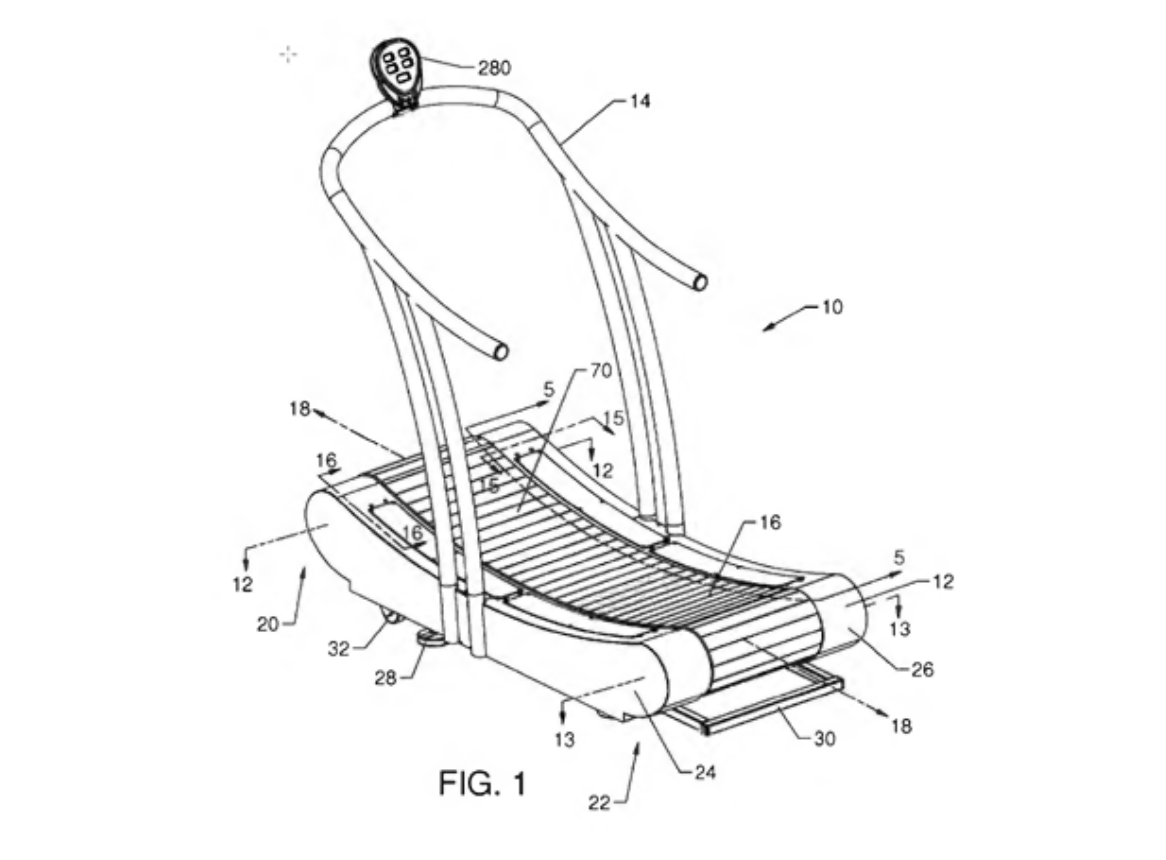 On Friday, the U.S. Court of Appeals for the Federal Circuit (CAFC) affirmed a Patent Trial and Appeal Board (PTAB) decision invalidating claims of Woodway’s treadmill patent after rejecting the patentee’s central argument that the Board had improperly construed the claim term ‘running surface.’
Woodway owns U.S. Patent No. 10,561,884 (the ‘884 patent), which is directed to manually operated treadmills and mechanisms for controlling the motion of the treadmill’s running belt, comprising a curved running surface and safety mechanisms. LifeCore Fitness petitioned for inter partes review (IPR) of several claims, arguing that the claims would have been obvious over prior art references U.S. Patent No. 5,538,489 (“Magid”), U.S. Patent No. 3,637,206 (“Chickering”), and portions of Mechanisms & Mechanical Devices Sourcebook (“Sclater”).
LifeCore argued that Chickering’s single-belt treadmill disclosed the claimed ‘curved running surface’ because the running belt followed the contour of rollers arranged in upward- and downward-sloping planes, creating a curved central portion where the planes met. Woodway disagreed, arguing that the claimed ‘running surface’ referred only to the treadmill belt portion where a user’s feet would ordinarily make contact during normal use. Woodway therefore stated that the Chickering reference did not disclose the claimed limitation.
The PTAB agreed with LifeCore and held the challenged claims unpatentable as obvious. The Board rejected Woodway’s expert testimony and found that Chickering disclosed the claimed ‘curved running surface’ and concluded that the challenged claims would have been obvious in view of Chickering, Magid, and Sclater. This finding by the Board ultimately framed the central issue on appeal.
Federal Circuit Rejects Woodway’s Characterization of the Dispute
Woodway, on appeal, mainly argued that the Board erred by construing the claim term ‘running surface’ to include portions of the treadmill belt where a user would not normally place their feet while running or walking. Woodway argued that under its proposed construction, the Chickering prior art reference did not disclose the claimed ‘curved running surface,’ and the Board therefore lacked substantial evidence for its obviousness determination. Additionally, Woodway challenged the Board’s findings on motivation to combine the prior art references and secondary considerations of nonobviousness.
The Federal Circuit disagreed with Woodway’s claim construction argument, concluding that Woodway had “mischaracterize[d] the Board’s obviousness analysis.” The panel explained that neither party had asked the PTAB to construe the term ‘running surface,’ and the Board did not expressly or implicitly adopt a construction. Rather, the Board rejected Woodway’s expert testimony regarding the term’s plain and ordinary meaning while making a factual finding that Chickering disclosed the claimed curved running surface. The panel explained that “determining the ‘differences between the prior art and the claims at issue’ is a fact question under 35 U.S.C. § 103.”
The Federal Circuit rejected “Woodway’s attempt to recast a factual dispute as a claim construction issue to obtain de novo review” because the Board had only compared the prior art to the challenged claims rather than construing the claim language itself. The court, in reaching its conclusion, cited its decision in Restem, LLC v. Jadi Cell, LLC, where it similarly held that a patentee could not transform factual findings underlying an anticipation analysis into an implicit claim construction challenge. The court declined to disturb the Board’s factual findings regarding the ‘curved running surface’ limitation, having concluded that Woodway’s principal argument centered on a faulty premise.
Proposed Construction Conflicted with the Specification
The court went on to say that Woodway’s appeal would fail even if the Board’s analysis were construed as an implicit claim construction. According to the court, Woodway’s proposed construction improperly imported a limitation into the claims by restricting the ‘running surface’ to portions of the treadmill belt where users would ordinarily place their feet.
The opinion explained that “nothing in claim 30 limits the claimed ‘running surface’ to surfaces on which users would be expected to place their feet.” Rather, it found that the specification consistently describes the running surface as a continuous surface that can include various regions with different geometric configurations, including both curved and linear portions.
Because the plain claim language and specification supported a broader reading, the court concluded that the claimed ‘running surface’ encompasses the treadmill belt’s continuous surface, “whether or not it includes portions typically contacted by a runner’s feet.”
![[Advertisement]](https://ipwatchdog.com/wp-content/uploads/2026/10/ClaimHit-Oct-28-2026-sidebar-700x500-1.jpg)
![[Advertisement]](https://ipwatchdog.com/wp-content/uploads/2026/10/Patsnap-Oct-29-2026-sidebar-700x500-1.jpg)
![[Advertisement]](https://ipwatchdog.com/wp-content/uploads/2026/09/Life-Sciences-2026-sidebar-last-chance-early-bird-ends-TODAY-700x500-1.jpg)
![[Advertisement]](https://ipwatchdog.com/wp-content/uploads/2024/09/Patent-Prosecution-Training-sidebar-700x500-2025-03-27.jpg)








![[Advertisement]](https://ipwatchdog.com/wp-content/uploads/2021/12/WEBINAR-336-x-280-px.png)
![[Advertisement]](https://ipwatchdog.com/wp-content/uploads/2021/12/Ad-4-The-Invent-Patent-System™.png)







Join the Discussion
One comment so far.
Curious
July 20, 2026 04:23 pmThis is BS.
You cannot make findings of fact (e.g., whether a particular piece of prior art disclosed a particular limitation) without first construing the limitation at issue.
The Board wrote “nothing in claim 30 limits the claimed ‘running
surface’ to surfaces on which users would be expected to
place their feet,” which is a nonsensical statement. Essentially, they are reading the term “running” out of the phrase “running surface.”
That being said, I looked at the Chickering reference, and it arguably includes (Fig. 3) a running surface with a curved portion. And while Fig. 1 of Chickering discloses a different embodiment, the illustrated foot appear to land where the curved portion in Fig. 3 would be.
If so, the Federal Circuit appears to have arrived at the right result for the wrong reason.
I don’t like decisions like this. Don’t mangle the law to get at a predetermined (albeit likely correct) decision.