
![[IPWatchdog Logo]](https://ipwatchdog.com/wp-content/themes/IPWatchdog%20-%202023/assets/images/temp/logo-small@2x.png)

 6
6 “According to the Office’s recent Notice of Proposed Rulemaking (NPRM) on Setting and Adjusting Patent Fees, the present backlog is predicted to increase to 820,200 by FY 2026 before decreasing to 780,000 by FY 2029.”
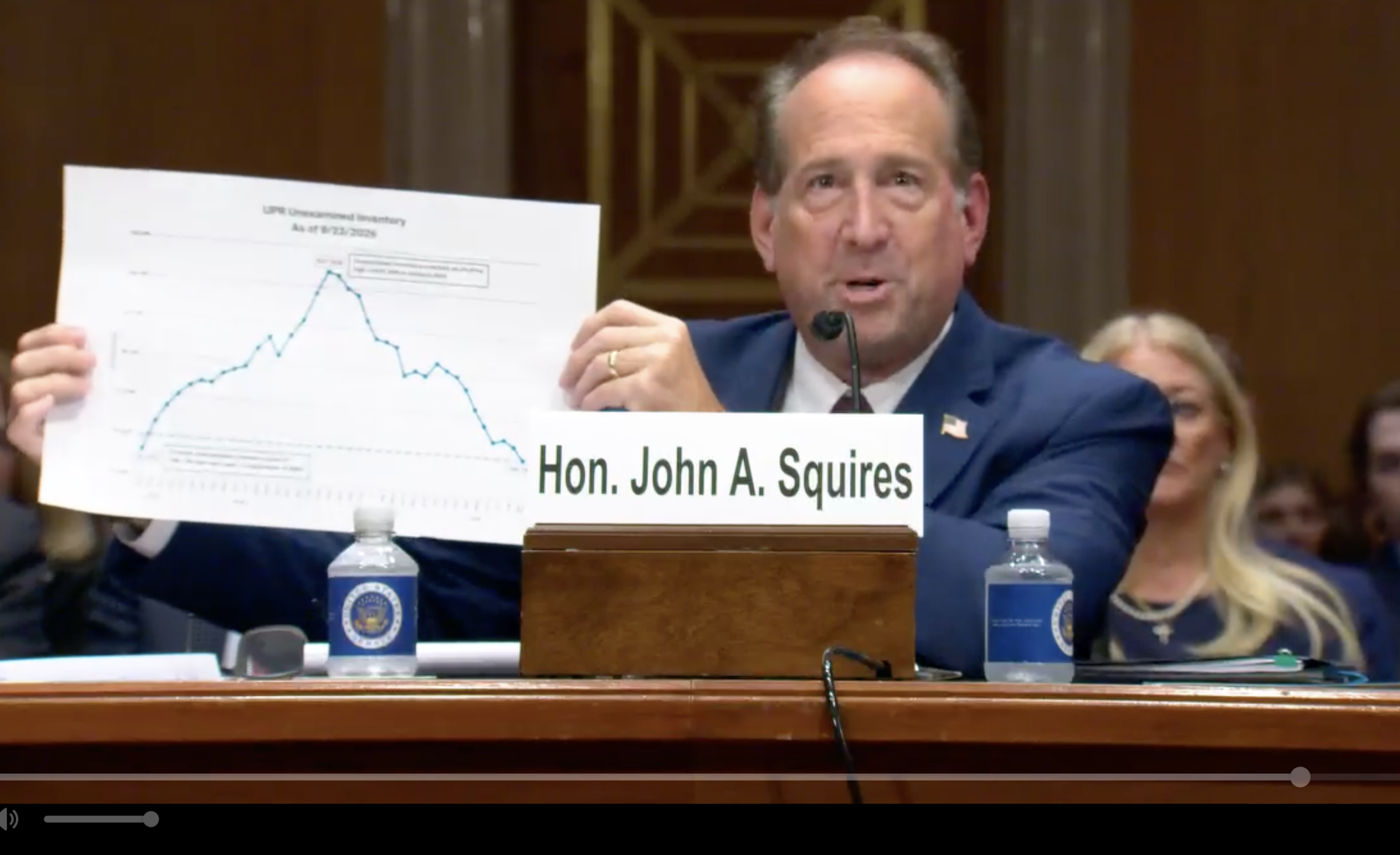
 U.S. Patent and Trademark Office (USPTO) Director Kathi Vidal published a Director’s blog post today addressing the Office’s current backlog of patent and trademark applications, which the latest USPTO data shows to be 785,387 unexamined applications/ 25.6 months total pendency for patents and 14.5 months total pendency for trademarks.
Vidal said in her blog post that “unpredictable macro effects, including a pandemic that had an outsized impact on our application inventories, have created an ‘inherited backlog’ of both patent and trademark applications.”
She added that the predicted slowdown in patent filings for 2020 and 2021 turned out to be “more modest and short-lived than expected” and this contributed to the backlog, since hiring targets were reduced.
According to the Office’s recent Notice of Proposed Rulemaking (NPRM) on Setting and Adjusting Patent Fees, the present backlog is predicted to increase to 820,200 by FY 2026 before decreasing to 780,000 by FY 2029. Sources have told IPWatchdog that the current 785,387 total backlog may be near or at an all-time high, though the USPTO could not confirm that by the time of publication.

Source: USPTO
Total pendency for patents as of May 2024 was 25.6 months and 20 months for a first office action.
Vidal wrote that, in response to examiner suggestions, the Office began routing patent applications in 2022 “to increase the likelihood that a patent application would be assigned to an examiner with the right technical background in the first instance,” has extended working hours, and recently secured an increase in the special rate table that applies to nearly 9,000 patent professionals. “Moreover, we made adjustments in our award structures to better attract and reward employees who make meaningful contributions to our pendency and quality goals,” wrote Vidal.
The Office also hired 644 patent examiners in FY 23 and is on target to exceed its goal of hiring 850 examiners in FY 24, she said. This push will continue through FY 25.
As for trademarks, Vidal said that during the pandemic “more people started their own companies, launched new products, increased cross-border e-commerce, and filed trademark applications to improve their brand protection.” This led to “unprecedented” application levels for those years. Additionally, some of the applications filed in 2020 and 2021 were fraudulent; the Office has since addressed this by shifting its fraud-related work to the Register Protection Office in June 2023.

Source: USPTO
In FY 23, average annual first action pendency for trademarks was 8.5 months; as of Q2 2024, first action pendency was at 8.2 months and total pendency was 14.5 months. But Vidal said in her post that “average annual first action pendency has decreased to 7.85 months and is dropping.” She attributed this to three key changes: 1) IT improvements, 2) shifting the “exceptional office action standard” from first action to final action, and 3) new incentives for first action productivity for examiners.
Total trademarks inventory as of Q2 2024 was 1,354,718.

Source: USPTO
Vidal outlined a number of other efforts the Office is undertaking to address the backlogs, including recent and upcoming IT updates. She suggested stakeholders should send ideas for reducing pendency to her directly.
In 2007, due to concerns about the USPTO backlog of 730,000 unexamined patent applications at the time, the Government Accountability Office (GAO) presented a report to Congress that found the Office’s hiring efforts were not sufficient to reduce the backlog. The backlog subsequently decreased over time, after various new approaches to hiring were implemented.
Image source: Deposit Photos
Author: iqoncept
Image ID: 88446362
![[Advertisement]](https://ipwatchdog.com/wp-content/uploads/2026/09/ClaimHit-Oct-1-2026-sidebar-700x500-1.jpg)
![[Advertisement]](https://ipwatchdog.com/wp-content/uploads/2026/09/MarqVision-Oct-6-2026-sidebar-700x500-1.jpg)
![[Advertisement]](https://ipwatchdog.com/wp-content/uploads/2026/09/Life-Sciences-2026-sidebar-early-bird-date-corrected-700x500-1.jpg)
![[Advertisement]](https://ipwatchdog.com/wp-content/uploads/2026/09/WE-BUY-PATENTS-SIM-IP-Ad-1-revised-on-Sep-28-2026-700x500-1.jpg)
![[Advertisement]](https://ipwatchdog.com/wp-content/uploads/2024/09/Patent-Prosecution-Training-sidebar-700x500-2025-03-27.jpg)




![[Advertisement]](https://ipwatchdog.com/wp-content/uploads/2021/12/WEBINAR-336-x-280-px.png)
![[Advertisement]](https://ipwatchdog.com/wp-content/uploads/2021/12/Ad-4-The-Invent-Patent-System™.png)


Join the Discussion
6 comments so far.
Julie Burke
July 16, 2024 02:58 amI see some serious disconnects here.
While Director Vidal asserts, “[I]n 2022, the USPTO began implementing processes for routing patent applications to increase the likelihood that a patent application would be assigned to an examiner with the right technical background in the first instance”, two days ago, US patent examiners expose being seen as “interchangeable widgets” and being assigned patent applications outside their areas of technical expertise.
The August 2023 OIG report exposes significant patent classification and application routing process errors, with initial classification errors rates averaging 19% and 27%. How does this help get the applications to the right examiner in the first place?
More disturbing, the OIG’s Valentine’s Day letter to Director Vidal reports 29.9% of patent examiners are assigned applications that conflict with their financial disclosure reports. That is, applications assigned to patent examiners who own stock in that technical area. This practice imposes serious potential conflicts of interest and ethical issues on patent examiners. And shreds more of the precious little goodwill between the USPTO and us “stakeholders.”
High time patent examiners were assigned applications that matched their technical backgrounds and did not conflict with their confidential financial disclosure reports!
https://www.linkedin.com/posts/julie-burke-492264120_working-together-to-tackle-patent-and-trademark-activity-7218862048640688128-s0eS?utm_source=share&utm_medium=member_desktop
Lab Jedor
July 14, 2024 08:16 pmAnon: Right on the mark, as usual. That is what we effectively have. A very expensive registration system. But at an exorbitant cost. And basically you pay for an over 50% chance to lose your expensive registration. With an even greater chance of invalidation as an invention is more valuable.
The total US market in patent prosecution (USPTO fees, professional services and the like) is perhaps over $ 10 Billion annually. That is just to have a patent system, with half of it for the USPTO. It seems that as a community we only extract a fraction of that annual cost in benefits to inventors, with perhaps Big Pharma as exception.
The US patent system looks like an oversized self-perpetuating bureaucracy with leadership not knowing how to defend (let alone implement) its benefits, a SCOTUS which doesn’t get it, and an oversized dominance of interest groups.
Spending more money on it will NOT improve it. Whatever people say: this is not about quality of patents. I do not believe for a moment that infringers are willing to pay royalties or licenses “if only the patent quality was better.”
Anon
July 13, 2024 08:01 pmLab – what is the difference between your suggestion and a pure registration system?
If you want what you want, one can immediately save about FOUR Billion dollars (I have not looked in a little while) by GREATLY cutting the USPTO budget (paid by innovators) to the bone.
Jess
July 13, 2024 07:00 amI applied in this last round. I hope I get hired.
Lab Jedor
July 12, 2024 12:25 pmTough times require tough measures. Just allow most of the pending applications without examination, perhaps except for spelling, so ChatGPT can do it for you. Just let applicants pay the fees. And invalidate them wholesale again at the PTAB.
See, problem solved and not unlike current procedure (well except for the willy-nilly allowance. But practically with the same result).
Pro Say
July 11, 2024 09:28 pmOh, Kathi, Kathi, Kathi.
Such the politician you are . . . just like all the rest . . . blaming current problems on their predecessor instead of taking responsibility for their own actions which at a minimum materially contributed to the problem.
Politicians gonna politician, right?
. . . and talk about a backlog. If you go through with your illegal, Big-Tech and infringer-loving, innovation-killing TD changes (on the off chance they actually stand up in court — which they won’t), let me tell you what’s going to happen to the backlog in 5 words:
YOU AIN’T SEEN NOTHING YET.