


 0
“Unsafe medicines are a global problem, but they are also a solvable one.” – Bradd Watts, GIPC
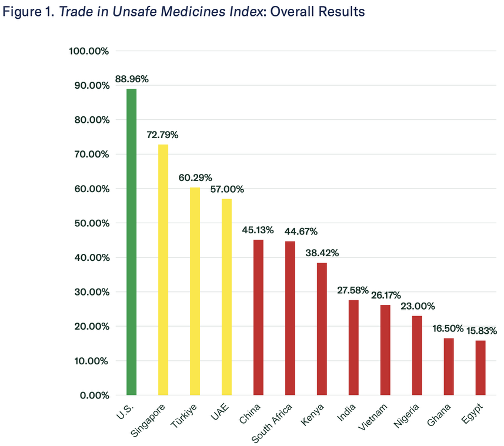 The U.S. Chamber of Commerce’s Global Innovation Policy Center (GIPC) released the first edition of its Trade in Unsafe Medicines Index today, a report prepared with Pugatch Consilium that benchmarks 12 economies on their propensity to contribute to trade in unsafe and illicit medicines and their ability to deter it. Eight of the 12 economies scored below 50%, and the overall mean score was 43.03%.
According to the report, unsafe and illicit medicines cause hundreds of thousands of preventable deaths every year. The World Health Organization (WHO) estimated that the annual consumption of counterfeit medicines alone results in the deaths of up to 169,000 children from pneumonia and more than 100,000 from malaria, and that spending on counterfeit and substandard medicines in low- and middle-income economies exceeds $30 billion. The Pharmaceutical Security Institute (PSI) tracked more than 7,000 pharmaceutical crime incidents in 2025, which it described as “the highest annual total on record and an 11% increase year-over-year.”
The report stated that no standardized and universally accepted international definition of an unsafe or illicit medicine exists, since most international institutions and national drug regulators focus primarily on counterfeit products. The report grouped unsafe and illicit medicines into counterfeit or falsified products, substandard products that were legally authorized but failed quality or safety requirements, and diverted or grey-market products removed from a legitimate pharmaceutical supply chain. The WHO defines counterfeit medicines as those “deliberately and fraudulently mislabeled with respect to identity and/or source.”
The Index averages four factors, each weighted at 25%. Factor 1 measures national intellectual property (IP) enforcement capacity through six indicators from the Chamber’s International IP Index, and Factor 2 relies on Transparency International’s Corruption Perceptions Index. Factor 3 measures propensity for trade-related counterfeit pharmaceuticals, and Factor 4 assesses whether an economy has regulatory controls for the safety and quality of imported medicines, including parallel imports. The sample included China, Egypt, Ghana, India, Kenya, Nigeria, Singapore, South Africa, Türkiye, the United Arab Emirates (UAE), the United States, and Vietnam.
Scores ranged from roughly 16% to 89%, and the United States was the only economy to score significantly above 75%. The five African economies in the sample, Egypt, Ghana, Kenya, Nigeria, and South Africa, each scored 50% or below. The report said the results suggest that “not enough is being done to deter and prevent” the trade.
On Factor 1, only the United States scored above 75%, at 97.83%, while nine of the 12 economies scored below 40%. Nigeria, Egypt, Kenya, India, and Ghana each scored below 25%, and the report identified border enforcement as “a critical issue” in those economies.
Factor 3 averaged 25.33%, and half of the sampled economies scored 0% or 5%. Ghana, Kenya, and Nigeria had estimated prevalence rates of 45.65%, 10.72%, and 14.31%, respectively, for counterfeit and substandard medicines in the pharmaceutical supply chain, according to a 2018 meta-analysis published in the Journal of the American Medical Association (JAMA), compared with the WHO’s average estimate of 10.5% for low- and middle-income economies.
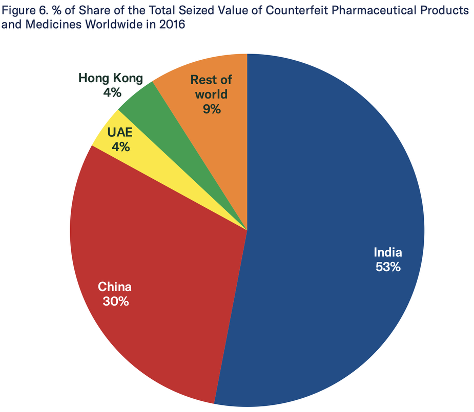
Data from the Organization for Economic Co-operation and Development (OECD) and the European Union Intellectual Property Office (EUIPO) showed that India accounted for 53% and China for 30% of the worldwide seized value of counterfeit pharmaceutical products in 2016. The report said the combined share of India and China, including Hong Kong, has remained constant over the past decade, and that unsafe and illicit medicines are transshipped through economies such as Singapore, Egypt, and the UAE.
Half of the sampled economies scored 100% on Factor 4, though the report noted that the factor measures only whether standards exist in primary or secondary legislation and not how they are applied. A comparison of Factor 4 and Factor 3 results for Kenya and Nigeria suggested a discrepancy between the legal environment and practice, since both had a high estimated prevalence of unsafe and illicit medicines, much of which the report said was imported. Ghana, which also had a high prevalence, had no equivalent regulatory standards for imported products.
The report recommended expanding national and international definitions of unsafe and illicit medicines to cover all types. It also called for stronger IP enforcement in most of the economies sampled, particularly at borders and in transit. Additionally, the report recommended that Sub-Saharan African economies in the sample address legal and enforcement gaps in drug regulatory standards and sanitary registration requirements.
In a press release issued today, Brad Watts, Senior Vice President of the GIPC, said that the report will help economies to identify the source of the problems. “Unsafe medicines are a global problem, but they are also a solvable one,” Watts said. “With a more comprehensive understanding of the sources of unsafe medicines and smarter enforcement, economies can protect patients, reinforce trust in healthcare systems, and support the innovation needed to deliver the next generation of medicines.”










Join the Discussion
No comments yet. Add my comment.
Add Comment