


 1
1 “The United States, home to 20 top 100 innovation clusters, trailing behind China’s total of 25, saw its highest ranking handed out to the San Jose-San Francisco area.”
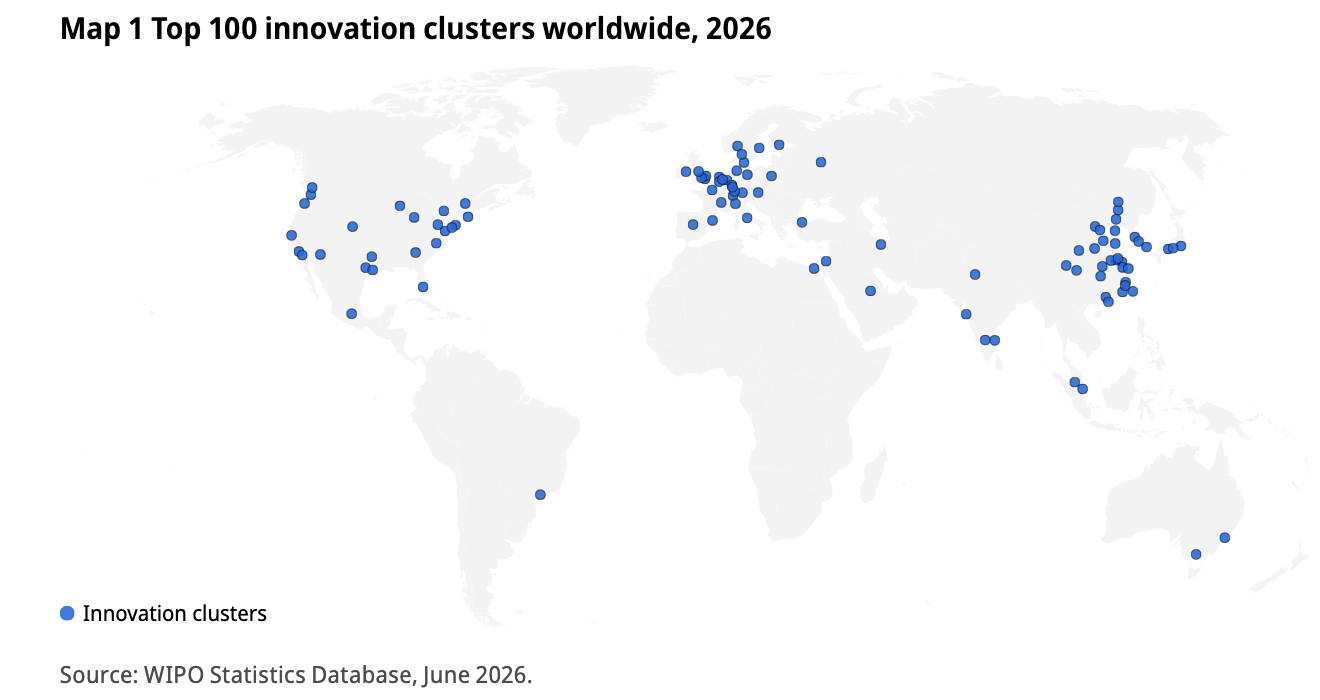
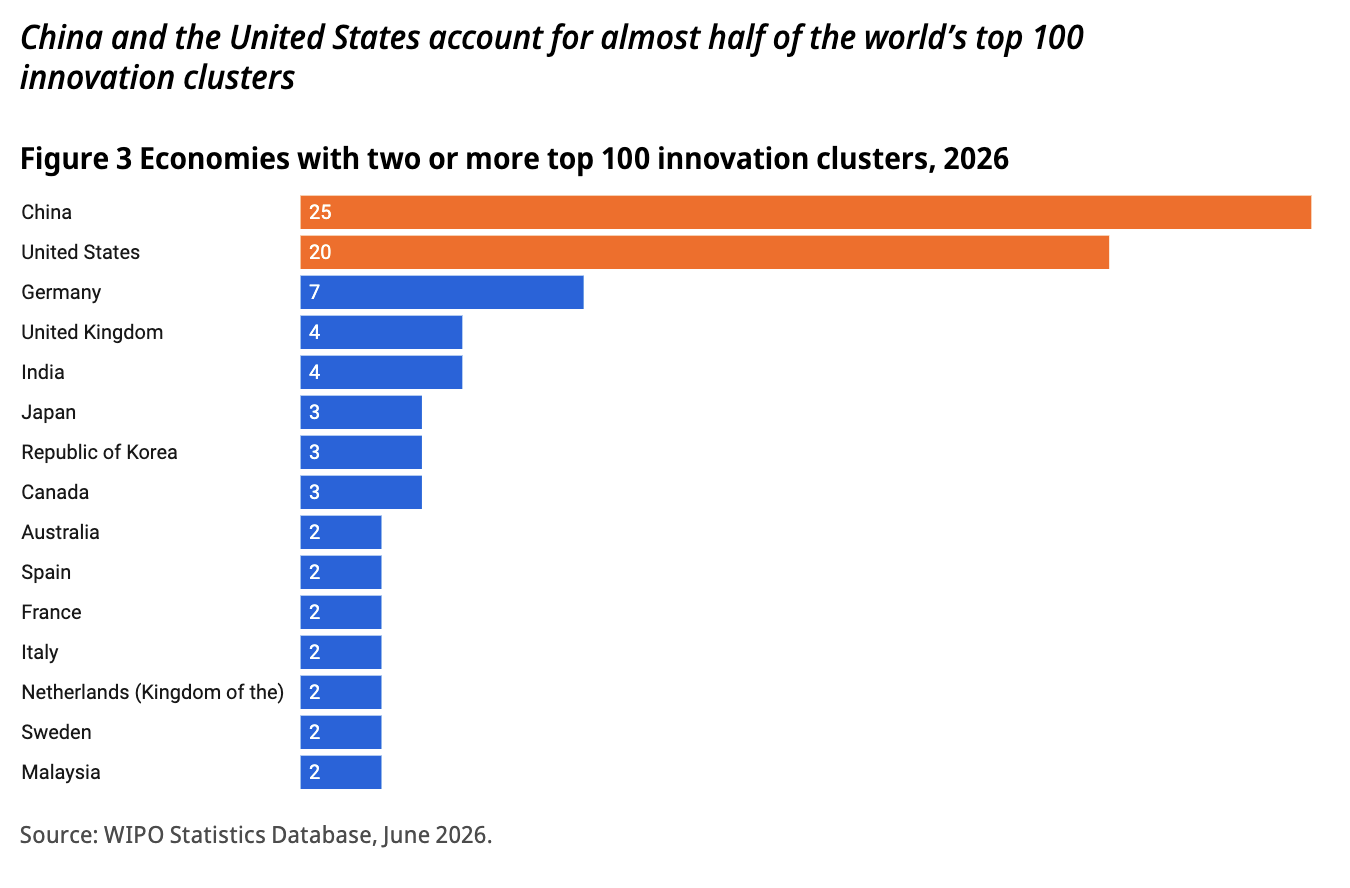 Yesterday, the World Intellectual Property Organization (WIPO) released its 2026 Global Innovation Index (GII) identifying metropolitan clusters around the world seeing the highest levels of innovation activity as judged by publications and R&D investments. This year’s Index underscores the growing tech dominance of China, which accounted for one-quarter of the top 100 innovation clusters in this year’s survey of top tech and innovation hubs around the world.
Shenzhen-Hong Kong-Guangzhou is Top Innovation Cluster for Second Straight Year
WIPO’s Global Innovation Index differs from several other annual surveys of innovation activity as measured by patent filings and other metrics, employing a methodology that goes beyond national borders to assess the entire innovation activity for a specific region. WIPO notes that its annual Index is an important tool for policymakers with a 2026 survey showing that 93 of 120 responding WIPO member states reported using the GII to assess and improve their domestic innovation policies.
For the second year in a row, the Shenzhen-Hong Kong-Guangzhou cluster scored as the top innovation cluster in the GII as measured by Patent Cooperation Treaty (PCT) patent application filings, scientific publications and venture capital investment. Huawei drove a great deal of innovation activity in this hub, filing more than 31,000 PCT patent applications over five years representing 26% of the cluster’s total filings during that time. The cluster, which sits across both China and Hong Kong, exhibits a great deal of scientific collaboration with 74% of scientific articles written by local authors being published in collaboration with authors from other clusters.
Following in second place in this year’s GII was the Japanese city cluster made up of Tokyo and nearby Yokohama. Outpacing Shenzhen-Hong Kong-Guangzhou in terms of total PCT filings over the past five years, Tokyo-Yokohama saw its activity more evenly spread out between top filers Mitsubishi Electric (10,362 PCT filings), NTT (8,625 PCT filings) and NEC (5,853 PCT filings). Scientific article publications from this cluster are driven by the University of Tokyo, which was responsible for 10,837 such articles over the past five years.
The United States, home to 20 top 100 innovation clusters, trailing behind China’s total of 25, saw its highest ranking handed out to the San Jose-San Francisco area (third place), which also ranks as the top cluster in terms of innovation density. Across the rest of the top 10 innovation clusters, New York City and Boston-Cambridge were the other two entries coming from the United States. China is home to two other clusters in the top 10: Beijing (fifth place) and Shanghai-Suzhou (sixth place), with Seoul, South Korea (fourth place), London, United Kingdom (eighth place) and Paris, France (tenth place) rounding out the top 10.
Southeast Asia Outpaces Europe, North America for Most Top Innovative Clusters
Germany ranked third behind China and the United States as the home to seven innovation clusters ranked in the top 100, led by 28th-place Munich. Tied for fourth place among nations home to top innovation clusters was the UK and India, the latter of which is led by Bengaluru, the capital of the southern India state Karnataka. Conversely, Cairo was the lone city among the top 100 innovation clusters in this year’s GII that hails from the entire continent of Africa. Regionally, South-eastern Asia, Eastern Asia and Oceania, which includes China, hosted the most innovation clusters with 36 metropolitan areas ranking in the top 100, followed by Europe (30 clusters) and North America (23 clusters).
While the main GII rankings measure total innovation activity over a five-year period, the Index also tracks innovation density measured as innovation activity compared to population size. Following San Jose-San Francisco as the top clusters by innovation density were Cambridge, UK; Ningde, China; Boston-Cambridge, United States; and Oxford, UK. Moving into the top 10 clusters for innovation density for the first time this year was Daejeon, South Korea, rounding out the list at number 10. Ningde claimed honors as the swiftest riser in this year’s main GII rankings, with that Chinese city moving up 24 spots to rank 75th overall.
Several cities improved their rankings relative to last year’s Index including the U.S. city of Philadelphia, which moved up to 20th place based on the last five years of innovation activity, and Stockholm, Sweden, which improved its ranking up to 30th place. Also rising in the standings was Miami, U.S., which increased its position to 60th, as well as the Indian cities of Mumbai (43rd) and Chennai (79th).
Key findings from the full 19th edition of the GII will be unveiled by WIPO during a hybrid event on September 29 at the agency’s headquarters in Geneva, Switzerland. Along with discussion of the GII, the event will also include a panel discussion on how entrepreneurship helps to turn scientific breakthroughs into deep science startups and spinouts.
![[Advertisement]](https://ipwatchdog.com/wp-content/uploads/2026/10/Questel-Oct-22-2026-sidebar-700x500-1.jpg)
![[Advertisement]](https://ipwatchdog.com/wp-content/uploads/2026/10/ClaimHit-Oct-28-2026-sidebar-700x500-1.jpg)
![[Advertisement]](https://ipwatchdog.com/wp-content/uploads/2026/09/Life-Sciences-2026-sidebar-early-bird-ends-Oct-25-700x500-1.jpg)
![[Advertisement]](https://ipwatchdog.com/wp-content/uploads/2026/09/WE-BUY-PATENTS-SIM-IP-Ad-1-revised-on-Sep-28-2026-700x500-1.jpg)
![[Advertisement]](https://ipwatchdog.com/wp-content/uploads/2024/09/Patent-Prosecution-Training-sidebar-700x500-2025-03-27.jpg)




![[Advertisement]](https://ipwatchdog.com/wp-content/uploads/2021/12/WEBINAR-336-x-280-px.png)
![[Advertisement]](https://ipwatchdog.com/wp-content/uploads/2021/12/Ad-4-The-Invent-Patent-System™.png)





Join the Discussion
One comment so far. Add my comment.
Model 101
September 10, 2026 07:06 amGet a good look Congress!
Everybody knows!
Add Comment