
![[IPWatchdog Logo]](https://ipwatchdog.com/wp-content/themes/IPWatchdog%20-%202023/assets/images/temp/logo-small@2x.png)

 2
2 “China is not applying U.S. doctrine more rigorously. China starts from a different premise about what an “invention” is in the first place.”
 In 2025, a patent dispute between Chinese companies in the camera-module space drew close attention across the industry — SUNNY v. AAC [Patent Reexamination and Invalidation Department Decision No. 566288, et al.]. The case ended with 11 patents invalidated, four of them in their entirety. There was a single reason: the claims were not supported by the specification. In an entirely unrelated case, the Supreme People’s Court of China considered a claim to a numerical range for a lithium-ion battery and held it valid — even though the claimed range exceeded what the specification disclosed — because it did not require a person skilled in the art to undertake undue experimentation [Supreme People’s Court of China, (2020) Zui Gao Fa Zhi Xing Zhong No. 406, 407]. And in yet another case, Sensormatic Electronics Corporation lost its claims to an electronic article surveillance marker because the scope of the claims exceeded what the invention had actually contributed to the art [Supreme People’s Court of China, (2016) Zui Gao Fa Xing Shen No. 19].
Three cases, three very different fact patterns — if you are a U.S. patent attorney, these three outcomes probably do not feel like they belong to the same doctrinal category. At least one of them — the secondary-battery materials case, where the court reasoned from “undue experimentation” by a person skilled in the art — looks, from a U.S. perspective, more like an enablement issue. Yet in China, all three sit under a single doctrine: Article 26(4) of the Chinese Patent Law, the requirement that “the claims shall be supported by the specification” (the “support requirement”).
This pattern shows up even where most patent attorneys would never think to look — standard-essential patent (SEP) pools. As of July 2026, in Access Advance’s HEVC patent pool, Huawei’s U.S. and Chinese patent families sit at a near 1:1 ratio — 117 to 125. Google’s ratio tilts toward the U.S. side by roughly 3:1. Microsoft’s is closer to 10:1 [Source: Access Advance HEVC Patent List, as of July 2026, authors’ own count, based on standard-essential claims]. No single cause fully explains this gap, but one contributing cause is not seriously disputed: specifications drafted for the U.S. Patent and Trademark Office (USPTO) repeatedly lose scope — or lose the patent altogether — once they reach Chinese examination and litigation.
For a long time, the conventional explanation for cases like these was a convenient one-liner: “China just applies Written Description more strictly.” The authors thought so too, for a while. But after three years at a Chinese law firm, and nearly 15 years since then watching how the Supreme People’s Court of China actually decides these cases, the authors have come to believe that “stricter” is not the right word. China is not applying U.S. doctrine more rigorously. China starts from a different premise about what an “invention” is in the first place. That premise has almost nothing to do with whether the inventor already possessed what is claimed at the time of filing, and everything to do with whether the scope of the claim matches what the invention actually contributed to the art. Chinese patent law calls this premise the “Technical Solution.” Understanding it is the single most important thing for not losing rights in China.
Before proceeding, one clarification is worth making at the outset: the Chinese Patent Law separately provides for an enablement requirement for inventions under Article 26(3). This article addresses Article 26(4) — the support requirement — commonly referred to as China’s counterpart to Written Description. The authors flag this distinction up front because, as the Amgen comparison below will show, the same set of facts can fall under different statutory provisions depending on which country’s classification framework is applied.
Technical Solution
(1) The Three Elements of a Technical Solution
Under Article 2 of the Chinese Patent Law, the invention protected by a claim is a “Technical Solution.” Under the Patent Examination Guidelines, a Technical Solution has three elements: the Technical Problem, the Technical Means, and the Technical Effect. Of these, the technical problem stated in the background of the invention and the technical effect demonstrated in the embodiments are decisive in fixing the boundary of the Technical Solution — because the China National Intellectual Property Administration
(CNIPA) and the Chinese courts confine the scope a claim may protect to what the invention actually contributed to the advance of the art.
The contrast with the U.S. Written Description approach makes this easier to grasp. U.S. courts ask whether the inventor already possessed the claimed invention as of the filing date. If the elements recited in the claim are explicitly disclosed in the specification, a person of ordinary skill in the art will generally find that the inventor already possessed the claim as of the filing date, and Written Description is unlikely to be an issue.
Chinese courts, by contrast, ask whether the scope of the claim corresponds to the invention’s “technical contribution.” An invention is entitled to protection commensurate with what it contributed to the advance of the art — and no more. This was made explicit in the Supreme People’s Court of China’s decision on the support-requirement violation by Sensormatic Electronics Corporation [(2016) Zui Gao Fa Xing Shen No. 19]:
“The scope of protection defined by the claims should correspond to the technical contribution of the patent concerned and the scope disclosed in the specification. This is to prevent an overbroad scope of protection from impeding scientific and technological progress. The requirement that ‘the claims shall be supported by the specification’ exists to balance the interests of the patentee against the interests of the public, and to keep open the space in which the patent right does not encroach on the public domain, so that new inventions and creations can still be made.”
In short, one must first understand that in China, the invention a claim protects is a “Technical Solution,” and that the technical problem stated in the specification and the technical effect that solves it define its boundary.
(2) Technical Effect
On the technical effect — the crux of the support-requirement analysis — the Supreme People’s Court of China has long framed the standard as one of “doubt” as to whether the same technical effect can be achieved. In the case in which Eli Lilly and Company’s Chinese patent was ultimately invalidated for violating the support requirement (Supreme People’s Court of China, (2009) Zhi Xing Zi No. 3), the court’s language was as follows:
“If there is reason to doubt that one or more of the sub-concepts or alternatives encompassed by a generic or Markush-type claim can solve the technical problem the invention is intended to solve and achieve the same technical effect, then the claim should be found not to be supported by the specification.”
This standard from the Supreme People’s Court of China has, in effect, lowered the bar for applying the support requirement — and given it a basis for reaching nearly every technical field.
To help U.S. readers, let’s compare two roughly contemporaneous decisions: the U.S. Amgen case and the Chinese SUNNY v. AAC case.
In Amgen, the U.S. Supreme Court denied validity to claims that covered not only the 26 well-known antibody sequences but, broadly, “all antibodies that perform the same function,” on the ground that the specification alone could not enable the full scope of the claim without undue experimentation. In other words, U.S. law focuses on whether a person of ordinary skill in the art can make the claimed-but-undisclosed territory without undue experimentation (Enablement).
In SUNNY v. AAC, by contrast, some of the claims did not specify the concrete shape (convex or concave) of the first lens. The Chinese tribunal held that, in that circumstance, “the first lens” was construed as a generic concept encompassing both a “convex shape” and a “non-convex shape.” And because it could not be predicted that a “non-convex shape” would achieve the same technical effect as what the specification described, the claim was found unsupported by the specification (a support-requirement violation) and invalidated.
Both cases collapsed because the claim scope was drawn too broadly, but the underlying inquiry differs fundamentally: the U.S. asked “can it be made?” (Enablement), while China asked “can we be confident it produces the same effect?” (Support).
(3) Expansion Across Technical Fields
In practice, this produces a significant difference in which technical fields are affected.
In the United States, a strict Enablement requirement tends to bite hardest in “unpredictable arts” such as chemistry and biotechnology.
In China, the inquiry is not about reproducibility but about doubt as to whether the same effect is achieved. As a result, the support requirement is applied rigorously not only in “unpredictable arts” such as biotech and chemistry, but also in “predictable arts” such as mechanical and electrical engineering.
An Example — Same Embodiment, Different Outcomes
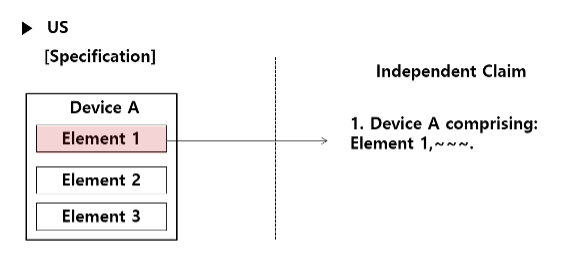
Let’s walk through an example. Suppose the specification discloses Device A, comprising Element 1, Element 2, and Element 3, and that Device A achieves the technical effect of “improved speed.” Suppose further that the core of the invention is Element 1, and the applicant claims only Element 1.
(1) United States
In the United States, a Written Description rejection is unlikely. Because Element 1 is explicitly disclosed, it is likely to be recognized that the inventor possessed it as of the filing date.
(2) China
In China, the same claim is likely to be rejected for failing the support requirement — or, if granted, likely to be invalidated later.
For example, CNIPA or a Chinese court would reason as follows: “The invention disclosed in the specification is Device A, and Device A’s technical contribution is ‘improved speed.’ Reference to the specification shows that Elements 1, 2, and 3 are all necessary for Device A to achieve that technical effect. Yet Claim 1 omits Elements 2 and 3, which are necessary to achieve the technical effect. A claim that fails to recite an essential technical feature does not satisfy the support requirement and must be rejected or invalidated.”
Here we encounter the concept of the “essential technical feature” — something that rarely matters in U.S. practice. The essential-technical-feature requirement is set out in Rule 20(2) of the Implementing Regulations of the Patent Law, which appears at first glance to be distinct from Article 26(4), the statutory basis for the support requirement. In practice, however, the two provisions converge on the same analysis: the Supreme People’s Court of China has itself held that an independent claim that fails Rule 20(2) will generally also fail Article 26(4) ((2014) Xing Ti Zi No. 13). In the authors’ experience, essential-technical-feature issues arise mainly in predictable arts such as electronics and mechanical engineering.
On the other hand, in a less predictable field such as biotech or chemistry, CNIPA or a Chinese court may instead rely on whether undue experimentation is required. In the secondary-battery case mentioned earlier, the Supreme People’s Court of China held that Claim 1’s numerical range satisfied the support requirement because it did not require “undue experimentation” [(2020) Zui Gao Fa Zhi Xing Zhong No. 406, 407]. The actual language of the decision was as follows:
“A claim that uses two or more distinct numerical ranges as technical features to jointly define the scope of protection should be found to be supported by the specification if a person skilled in the art, upon reading the specification, can establish the correspondence between the technical features of each numerical range, can obtain, through a limited number of experiments, specific embodiments consistent with the purpose of the invention, and can immediately exclude any technical solution that cannot achieve the purpose of the invention without undue labor.”
In short, when claim scope exceeds the disclosed embodiments, the United States approaches the question from the standpoint of Enablement, while China approaches it from the standpoint of the support requirement — because Chinese courts view the invention through the lens of the Technical Solution.
Korea and Japan
As Korean patent attorneys, the authors regard Korea and Japan as sitting somewhere between these two extremes — judging Written Description more strictly than the United States, but more leniently than China and Europe.
Korea and Japan each once had a statutory requirement similar to China’s essential-technical-feature requirement, but each deleted it — in 2014 and 1994, respectively. As a result, today neither country will reject an independent claim solely because it fails to recite every essential technical feature.
That said, even after the statutory provision was deleted, the authors do not believe practice has loosened to the same degree of flexibility as in the United States — the historically strict approach to Written Description has not fully receded. For example, on whether a boundary value of a numerical range is supported by the specification, the U.S. Federal Circuit held, in RAI Strategic Holdings, Inc. v. Philip Morris Products S.A., 92 F.4th 1085 (Fed. Cir. 2024), that even a new numerical range constructed by combining different boundary values from separate disclosed embodiments can satisfy the support (written description) requirement. In the authors’ experience, Korean examination practice does not go so far as to accept this degree of recombination, nor does Japan’s (Japan, Heisei 26 (2014) (Gyo-Ke) No. 10155).
Responding to a Support-Requirement Violation, and the Consequences
(1) At the Examination Stage
If the specification was not drafted with the support requirement in mind, an applicant facing a support-requirement rejection during examination will typically have no choice but to amend as follows:
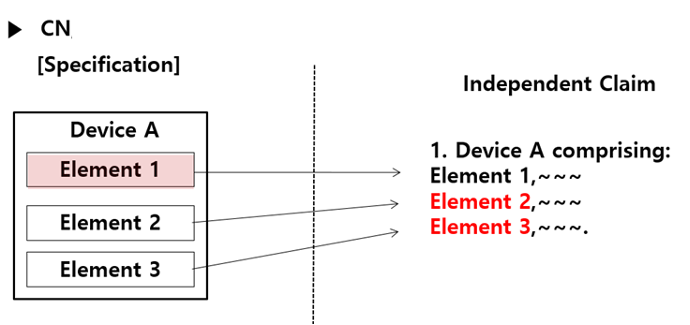
Such an amendment is rarely the outcome the applicant wanted — the resulting claim scope is often too narrow to be commercially meaningful, and if the goal was a clearly targeted standard-essential patent, a claim amended this way — even if it ultimately grants — will likely be regarded as a strategic failure.
(2) At the Invalidation Stage
If an examiner did not scrutinize the support requirement closely during examination (the Office Action, or “OA,” stage) and the patent granted, is that good luck? Not necessarily. It may instead mean the granted patent carries a latent defect. In Chinese invalidation proceedings, the support requirement is a perennial ground of attack, and the scope of amendment permitted at the invalidation stage is far narrower than at the examination stage. If the claims were not designed with an eventual invalidation challenge in mind, the necessary amendment may simply not be available — and the claim stands a high chance of being invalidated.
Recall the Sunny v. AAC case discussed earlier. Had the examiner raised a support-requirement objection to “the first lens” during examination (OA), the applicant could have amended to something like “a first lens having a convex shape” — and since competitors’ first lenses are nearly identical in shape, enforcement would not have been an issue. But at the invalidation stage, the patentee, having failed to prepare in advance, could not make that amendment, and ultimately lost the claim altogether.
Prepare Your Specification for Asia
For these reasons, the authors believe that for any application filed with the Asian market — China in particular — in mind, a U.S.-style specification should be reinforced before filing so that it can withstand Asian examination standards.
Image Source: Deposit Photos
Vector ID: 76008441
Copyright: jpgon

![[Advertisement]](https://ipwatchdog.com/wp-content/uploads/2026/09/MarqVision-Oct-8-2026-sidebar-700x500-rev.jpg)
![[Advertisement]](https://ipwatchdog.com/wp-content/uploads/2026/10/IP-Copilot-Oct-13-2026-sidebar-700x500-1.jpg)
![[Advertisement]](https://ipwatchdog.com/wp-content/uploads/2026/10/Junior-Oct-15-2026-sidebar-700x500-1.jpg)
![[Advertisement]](https://ipwatchdog.com/wp-content/uploads/2026/09/WE-BUY-PATENTS-SIM-IP-Ad-1-revised-on-Sep-28-2026-700x500-1.jpg)
![[Advertisement]](https://ipwatchdog.com/wp-content/uploads/2026/09/Life-Sciences-2026-sidebar-early-bird-date-corrected-700x500-1.jpg)
![[Advertisement]](https://ipwatchdog.com/wp-content/uploads/2024/09/Patent-Prosecution-Training-sidebar-700x500-2025-03-27.jpg)






![[Advertisement]](https://ipwatchdog.com/wp-content/uploads/2021/12/WEBINAR-336-x-280-px.png)
![[Advertisement]](https://ipwatchdog.com/wp-content/uploads/2021/12/Ad-4-The-Invent-Patent-System™.png)





Join the Discussion
2 comments so far. Add my comment.
KI-SUNG LEE
August 27, 2026 10:38 pmThanks for your comment. China seems to have borrowed a lot from Europe when it comes to support requirements, but the two systems can be quite different at the invalidation stage.
In the next article we’re preparing, we discuss a related Chinese patent owned by a European company. I think it will be interesting to compare the European and Chinese approaches, and I’m looking forward to hearing your thoughts on it.
Max Drei
August 27, 2026 06:08 amHow very interesting, at least for a European patent attorney reader. Thank you.
The writers of the European Patent Convention in 1973, for good reasons, expressly decided to exclude “support for the claims” (Article 84, EPC) from the grounds for revocation of a patent granted by the EPO. If you want a patent revoked in Europe, you have to find other grounds.
Nevertheless, it seems to me that the courts in China are following European thinking about whether a claim has to be revoked. That is to say, in Europe, for the sake of fairness to both the inventor and the public, the scope of protection shall be “commensurate” with the extent of the inventor’s technical contribution to the art. The obviousness provision, Art 56 EPC, is often the tool of choice. Accordingly, it would be interesting to know how specifications and claims drafted in Europe fare, when they come to be litigated in the courts of China. If they crash, even while their patent family members are upheld in the courts of Europe, that would be disappointing. The Rule of Law is precious but, recently, it seems to be disintegrating, everywhere one looks.
Add Comment