
![[IPWatchdog Logo]](https://ipwatchdog.com/wp-content/themes/IPWatchdog%20-%202023/assets/images/temp/logo-small@2x.png)

 4
4 “According to the USPTO’s web page on the Pilot Program…so far only 169 petitions have been received in total and 76 granted. “
 The U.S. Patent and Trademark Office (UPSTO) announced today that it will be extending the Artificial Intelligence Search Automated Pilot Program (ASAP!) until June 1, 2026, to gather additional information and continue evaluating the program’s effectiveness.
The Pilot was first announced in October 2025 and is meant to “evaluate the impact of sharing the results of an automated search prior to examination of an application.”
The original deadline for petitions was April 20, 2026, or the date that each tech center (TC) is docketed at least 200 applications accepted, whichever comes first.
In March 2026, the Office announced it would increase the number of petitions it is accepting into the Pilot to 3,200 across all TCs that examine utility applications, or 400 per TC, and would also waive the petition fee “in order to alleviate any financial barriers to participate….”
The notice issued today said the Office will now accept petitions through June 1, 2026, or the date that each TC is docketed at least 400 granted applications, whichever occurs first.
According to the USPTO’s web page on the Pilot Program, which was last updated on April 16, so far only 169 petitions have been received in total and 76 granted.
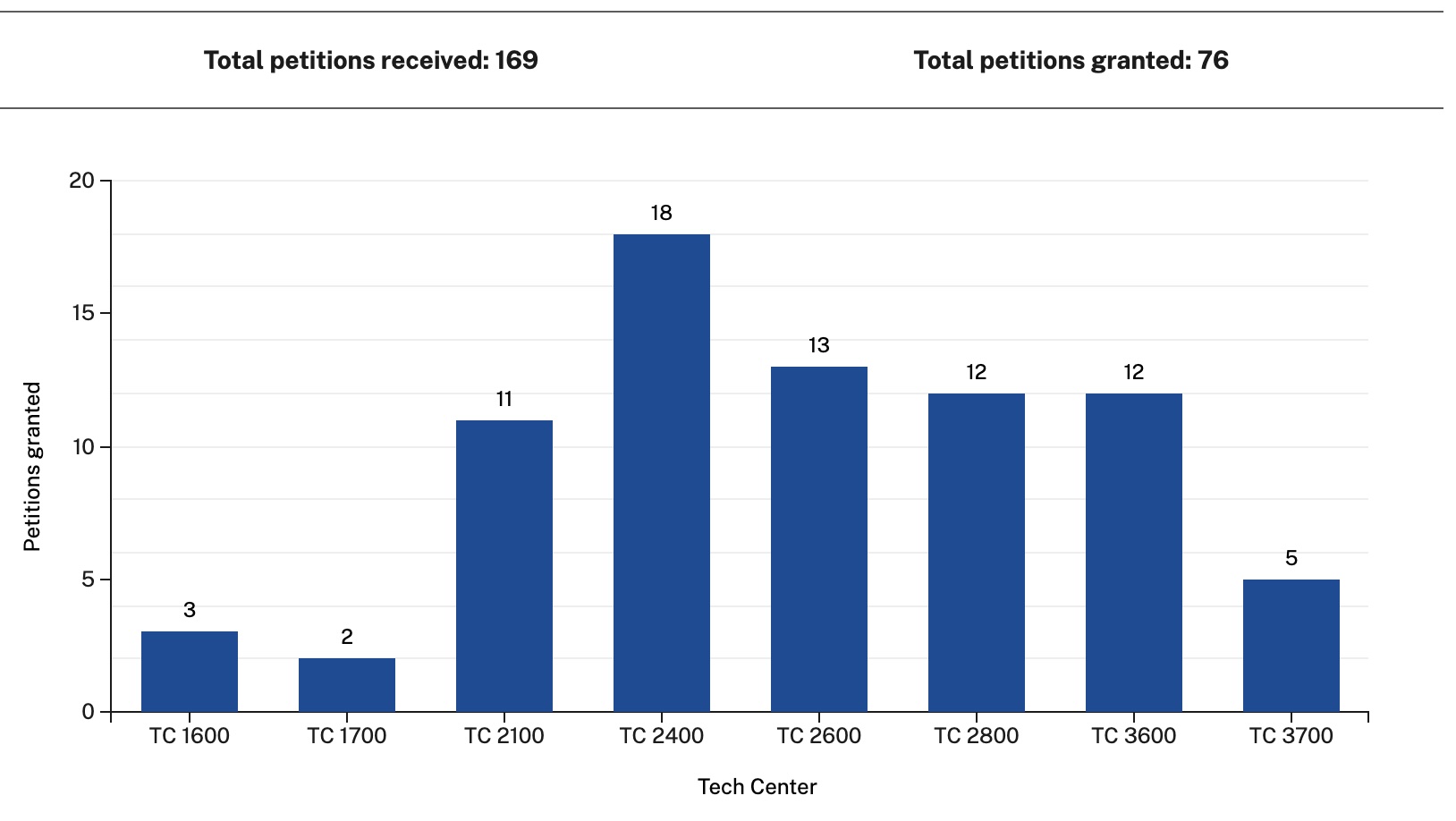
TC assignments are estimated
How ASAP! Works
In the event a petition under ASAP! is granted, the Office uses an AI tool that “uses the classification of the application under the Cooperative Patent Classification (CPC) system, as well as the specification, including the claims and abstract, of the application as contextual information.” Using that information, the tool will then find similar information in public databases including U.S. Patents, U.S. Pre-Grant Publications (PG-Pubs), and Foreign Image and Text (FIT), which “includes publications from a number of foreign patent authorities,” according to the FRN. The results will then be ranked from most to least relevant.
The USPTO will then send an Automated Search Results Notice (ASRN) to the applicant identifying potential prior art issues with the application (up to 10 documents identified by the tool), which the applicant will not be required to respond to, and which is not considered a notification under 35 U.S.C. 132. However, “the results of the automated search may inform a decision on how to proceed with the application,” including a decision by the applicant to file a preliminary amendment, to defer examination, or to file a petition for express abandonment.
Only “original, noncontinuing, nonprovisional utility applications filed under 35 U.S.C. 111(a) on or after October 20, 2025” and—now—on or before June 1, 2026, are eligible to participate in the program. Continuing applications are not eligible, and the application must be filed electronically using the USPTO’s Patent Center. Applicants must also be enrolled in the Patent Center Electronic Office (e-Office).
According to the October 2025 Federal Register Notice, the pilot “is designed to evaluate the impact of sharing the results of an automated search prior to examination of a patent application” and will be an opportunity for the Office to assess the effectiveness of ASRNs in making decisions on patentability in the early stages of examination.
For applicants, the process provides earlier communication regarding potential prior art issues in their application.
AI in the Spotlight
USPTO Director John Squires has made the use of AI in creating efficiencies for the Office a top priority of his administration.
In March 2026, the Office also announced the Trademark Classification Agentic Codification Tool, or “Class ACT” AI assistant, which “can immediately assign international classes to unclassified applications, as well as the design search codes and pseudo marks that make these records searchable.”
“With the development and implementation of AI tools in our workflow, our employees can focus on applying their experienced judgment and reason to the substantive issues in examination, which will benefit our stakeholders,” said Acting Trademark Commissioner Dan Vavonese in a statement issued with the launch of the tool.
Image source: Deposit Photos
Author: roxanabalint
Image ID: 125703412
![[Advertisement]](https://ipwatchdog.com/wp-content/uploads/2026/09/MarqVision-Oct-8-2026-sidebar-700x500-1.jpg)
![[Advertisement]](https://ipwatchdog.com/wp-content/uploads/2026/10/IP-Copilot-Oct-13-2026-sidebar-700x500-1.jpg)
![[Advertisement]](https://ipwatchdog.com/wp-content/uploads/2026/10/Junior-Oct-15-2026-sidebar-700x500-1.jpg)
![[Advertisement]](https://ipwatchdog.com/wp-content/uploads/2026/09/WE-BUY-PATENTS-SIM-IP-Ad-1-revised-on-Sep-28-2026-700x500-1.jpg)
![[Advertisement]](https://ipwatchdog.com/wp-content/uploads/2026/09/Life-Sciences-2026-sidebar-early-bird-date-corrected-700x500-1.jpg)
![[Advertisement]](https://ipwatchdog.com/wp-content/uploads/2024/09/Patent-Prosecution-Training-sidebar-700x500-2025-03-27.jpg)




![[Advertisement]](https://ipwatchdog.com/wp-content/uploads/2021/12/WEBINAR-336-x-280-px.png)
![[Advertisement]](https://ipwatchdog.com/wp-content/uploads/2021/12/Ad-4-The-Invent-Patent-System™.png)




Join the Discussion
4 comments so far.
Anon
April 20, 2026 10:24 amPro Say,
No way to tell – not nearly enough information has been made public about the type/methodology/details of precisely what the USPTO is doing with the use of AI internally.
For whatever reason, operations remain in the shadows.
Pro Say
April 18, 2026 12:05 pmDo the below two comments mean that AI ghosts spouting hallucinations are wandering the halls of the Patent Office?
StakeholderA
April 17, 2026 05:06 pmAnonymous Patent Attorney,
USPTO management has been repeatedly told by examiners that their AI search is ineffective and they don’t seem to care.
I’m sorry they wasted your time with ASAP.
Anonymous Patent Attorney
April 17, 2026 11:00 amSpeaking as one of the five granted petitions in TC 3700, I am completely dissatisfied with the results of the pilot program as it currently stands, or more specifically I think the PTO’s AI needs some work before broader rollout.
With the hope of eliminating one or two Office Actions by making a preliminary amendment to distinguish over the AI’s found art, my client was enthusiastic about the program. However, when we received the 10 prior art citations in the ASRN, three were at best tangentially relevant. The remaining seven references missed the mark by miles. These seven would not make reasonable 102 rejections (structurally very different), and would be completely non-analogous in the 103 context.
While conceptually I like the idea of this pilot program and search, it is my opinion that the PTO has a long way to go in order to make this viable.