
![[IPWatchdog Logo]](https://ipwatchdog.com/wp-content/themes/IPWatchdog%20-%202023/assets/images/temp/logo-small@2x.png)

 2
2 “The era of adopting tools on faith is ending. Practices that cannot articulate what their AI investment has produced are going to find the budget conversation arriving faster than expected.”
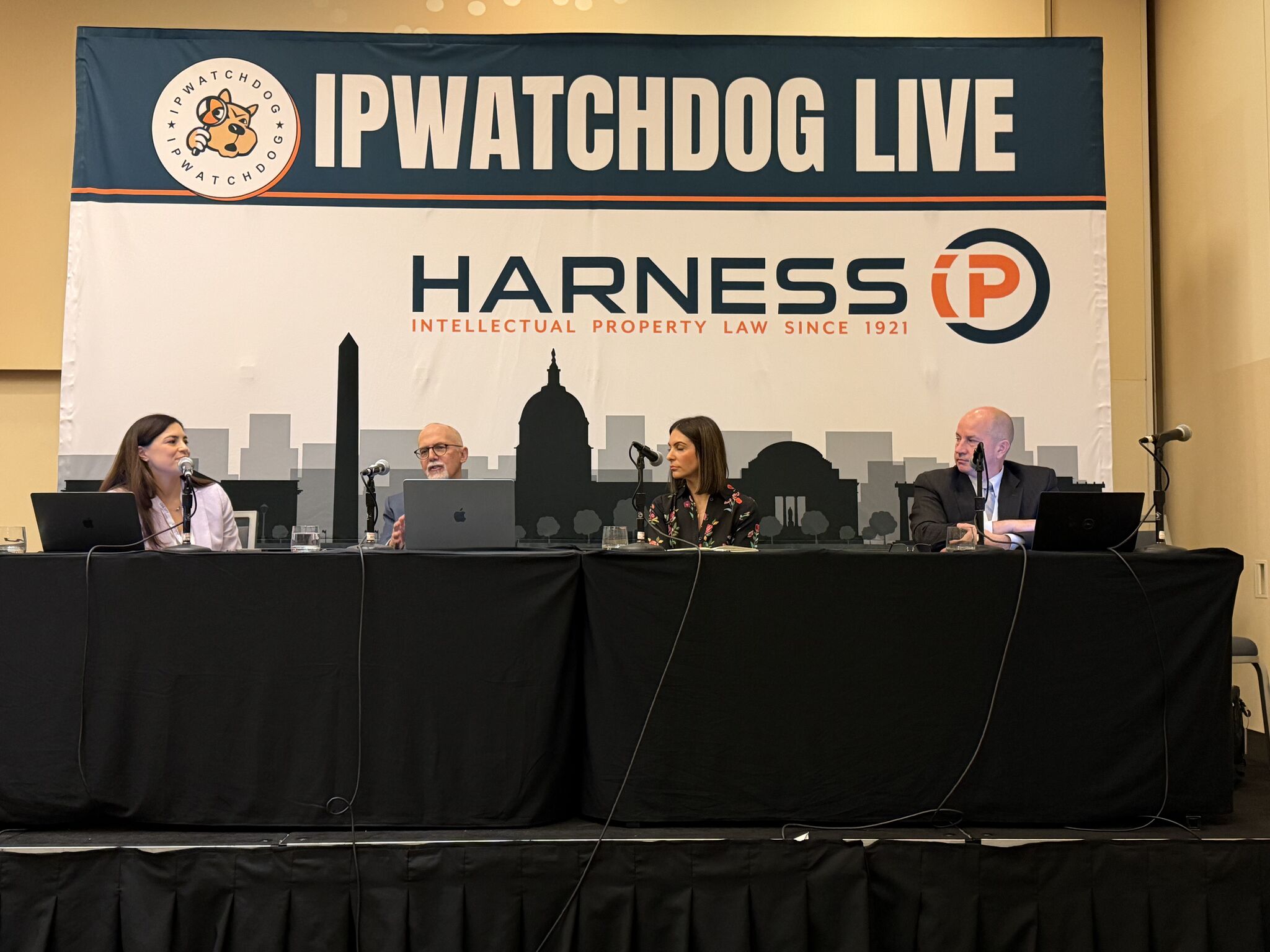
From left: Francesca Cruz, Bruce Berman, Stephanie Curcio and Bernard Tomsa
If 2025 was the year every IP practice rushed to adopt AI, 2026 is the year the bill comes due — and a striking number of organizations are discovering they have no reliable way to read it. That was the organizing message from IPWatchdog LIVE 2026’s session: The Business Impact of AI in Practice: Calculating ROI in the AI Era. The panel featured Stephanie Curcio (NLPatent), Bernard Tomsa (Brooks Kushman), Bruce Berman (The Center for Intellectual Property Understanding), and Francesca Cruz (Juristat). The session was less a celebration of AI capability than a rigorous examination of whether that capability is being converted into measurable professional value, and a frank assessment of where the profession is quietly building a structural problem it has not yet named.
The Adoption Phase Is Over
“We’re past adoption and into implementation,” said Tomsa. For IP practitioners, that shift carries real institutional weight. Adoption was the phase of internal champions, partner-track debates, and pilot programs. Implementation is what comes next: producing evidence that AI tools are generating returns for the firm, the practice, and the clients paying for both.
Cruz supplied the data behind the urgency. According to Clarivate research, AI adoption across IP organizations surged from 50% to 80% in 2025. But only 18% of those organizations are actually measuring ROI — while 98% report increased board-level pressure to demonstrate results. “Many companies will be cutting AI budgets in 2026 if no ROI is identified,” Cruz warned. For patent practitioners, prosecution counsel, and IP portfolio managers, the implication is operational: the era of adopting tools on faith is ending. Practices that cannot articulate what their AI investment has produced are going to find the budget conversation arriving faster than expected.
The Three-Metric Framework: Quantity, Quality, and Quanta
Curcio introduced the session’s most durable contribution: a three-part framework for evaluating AI ROI in professional IP practice quantity, quality, and quanta.
Quantity is the most intuitive measure: is the tool saving time and increasing throughput? Cruz called it “the low-hanging fruit to measure.” But Tomsa flagged the professional risk of treating it as the primary metric. “Quantity is a dangerous metric, it can indicate that you’re not vetting the output.” In patent prosecution, prior art search, and IP due diligence contexts, volume without rigorous human review is not efficiency. It is liability exposure dressed as productivity.
Quality asks the harder question: is AI enabling practitioners to produce better work product than they could have delivered independently? A tool might generate a higher-quality output while taking longer to get there. Alternatively, it might accelerate throughput at the cost of marginal accuracy. Quality and quantity do not move in lockstep, and practices that track only one are measuring an incomplete picture of what their tools are actually doing.
Quanta is the framework’s most strategically important dimension; it measures entirely new categories of work that AI makes possible for the first time. Quanta measures work that goes beyond what a team could have done before. In practical terms this looks like in-house IP counsel running defensible patent searches that previously required outside vendor fees. Prosecution teams generating competitive intelligence analyses that were cost-prohibitive at prior billing rates. Portfolio analytics that were simply unavailable without AI-powered aggregation. This is where durable professional value lives; not in completing existing tasks faster, but in expanding the service envelope to include what was previously inaccessible.
The Efficiency Trap: When AI Rewards Become Punishments
The session’s most pointed exchange addressed a paradox that IP practitioners are encountering with increasing frequency and discussing with decreasing candor. “The costliest thing is to create efficiencies with AI and then reward the person responsible for the efficiency with more work,” said Berman.
The mechanics are straightforward and the outcome predictable. An attorney who completes a deliverable in three hours rather than five cannot bill for five. The efficiency flows to the client. The recovered time is filled with more work. At scale, AI efficiency that is never converted into new client value simply compresses revenue, accelerates burnout, and dissolves the internal incentive to keep building better tools. The practitioner who develops the most effective AI workflow becomes the most loaded member of the team.
The panel documented the macro version of this dynamic. According to Curcio, billable hours across the IP industry declined in 2025, and 90% of firms responded by increasing attorney targets and demanding more output rather than restructuring how value is captured. “There are diminishing returns for doing more work for less money,” Tomsa observed. The firms that navigate this well will not be the ones that squeeze the most throughput from AI. They will be the ones that convert AI efficiency into new categories of billable service.
Quanta as the Answer: Finding the X Factor
The path out of the efficiency trap runs directly through quanta. Curcio’s challenge to practitioners was pointed: “You need to figure out the X factor that you can give clients as these tools proliferate.” Efficiency gains that vanish into reduced invoices generate no lasting competitive value. Efficiency gains converted into new service categories create differentiation that compounds over time.
Berman offered a 10-80-10 framework as an operational model that clarifies where the practitioner’s irreplaceable contribution sits. Ten percent human input such as prompts, context, and framing. Eighty percent AI automation. Ten percent human vetting and review. The model makes clear that AI concentrates the practitioner’s judgment rather than replacing it. Getting the prompts right, providing accurate context, and catching what the model misses is where senior IP expertise remains structurally irreplaceable, and where the profession’s value proposition must be repositioned.
Build vs. Buy: Hidden Costs and Practical Reality
The session closed on a question with direct budget implications for every IP practice: build proprietary tools or deploy commercial products?
Curcio was direct about the appeal and the overhead. Custom-built tools create genuine competitive advantage in patent prosecution and IP management workflows. However, this approach requires a legal engineer, an ongoing engineering team, and the organizational discipline to manage models that continuously evolve. “It’s not something you can simply set and forget,” she said. Cruz agreed, building is only cost-effective for practices with genuine technical infrastructure to sustain it.
Tomsa’s guidance for most firms was pragmatic: start with a prefabricated commercial product where the vendor has already managed model reliability and vetting infrastructure. His candid account of a human-in-the-loop failure illustrated why oversight cannot be optional, “I uploaded the wrong document and the AI wasn’t smart enough to say ‘you gave me the wrong document.'” A human reviewer would have caught it immediately. The final 10% of the 10-80-10 model — experienced human review — is not a legacy habit. It is professional responsibility.
The profession’s AI reckoning is not arriving. It has arrived. The practices that will define the next decade are those that measure what their tools actually deliver, restructure their value proposition around quanta rather than speed, and recognize that the most powerful thing AI does for an IP professional is not making existing work faster, but rather making previously impossible work achievable.
![[Advertisement]](https://ipwatchdog.com/wp-content/uploads/2026/06/IP-Copilot-Jun-30-2026-sidebar-700x500-1.jpg)
![[Advertisement]](https://ipwatchdog.com/wp-content/uploads/2026/06/Womens-IP-Forum-2026-sidebar-700x500-rev2.jpg)







![[Advertisement]](https://ipwatchdog.com/wp-content/uploads/2021/12/WEBINAR-336-x-280-px.png)
![[Advertisement]](https://ipwatchdog.com/wp-content/uploads/2021/12/Ad-4-The-Invent-Patent-System™.png)







Join the Discussion
2 comments so far. Add my comment.
Anon
April 6, 2026 10:01 amby the way, the article fails to mention the huge trap in quanta (think Henry Ford’s “Not a faster horse.”
Many of the listed items merely accord existing business model items – that is, they are tracking a faster horse to ‘do more – of the same.”
Such is not going to address a race to the bottom of commodification.
Anon
April 6, 2026 09:56 amInstant reaction:
“a frank assessment of where the profession is quietly building a structural problem it has not yet named.”
No, it is not (only) what the profession is building that is generating the actual structural problem.
The problem is that the business model of law is being radically disrupted.
All law.
Add Comment