
![[IPWatchdog Logo]](https://ipwatchdog.com/wp-content/themes/IPWatchdog%20-%202023/assets/images/temp/logo-small@2x.png)

 0
0 “Judge Stark did not believe that Acufloor’s representations during prosecution sufficed to overcome clear indications from the specification that mortar is not required to reach the very edge of the tile to meet Acufloor’s asserted claims.”
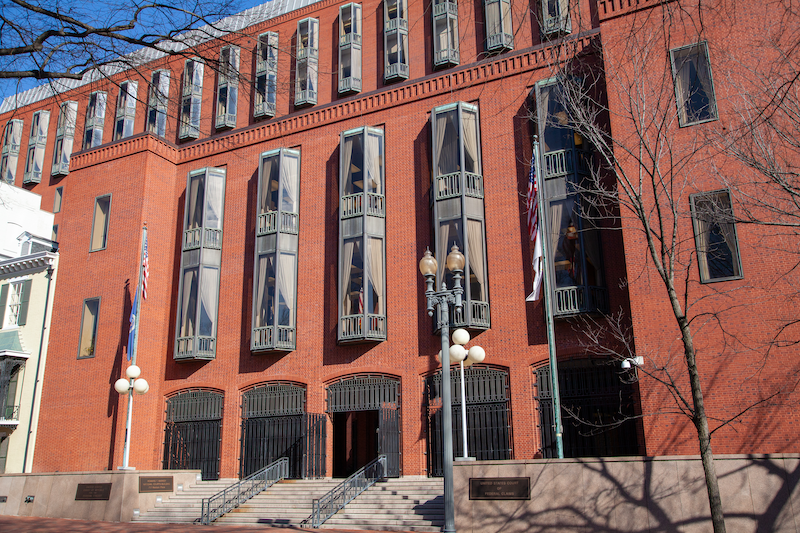 On Wednesday, the U.S. Court of Appeals for the Federal Circuit issued a split ruling in Acufloor, LLC v. EvenTile, Inc. vacating a stipulated judgment of non-infringement by the Middle District of Florida following claim construction in infringement litigation between rivals in the ceramic tile installation industry. Although Judge Leonard Stark concurred with the panel’s vacatur, he dissented from the majority’s narrow construction of the claim term “edge,” arguing that the proper course of action for the appellate court was to remand to the district court under Acufloor’s proposed broader construction, which creates enablement issues that the district court should address in the first instance.
Acufloor asserted claims from two of its patents in the Middle Florida infringement litigation against EvenTile: U.S. Patent No. 107513857 and U.S. Patent No. 10704274, both titled Device for Leveling and Aligning Tiles and Method for Leveling and Aligning Tiles. These patents claim a tile-leveling system using tile clips incorporated into individual tiles through which a separate wedge component is fitted to press down and level the tiles in alignment. Once leveled, the tile clips snap off away from the body of the tile. While four-clip embodiments of Acufloor’s claimed invention have tiles with “corner-to-subfloor contact,” two-clip embodiments have “edge-to-subfloor contact” due to clip notches providing space for mortar contact.
Modified Construction of “Edge” Includes Very Edge of Tile Plus Area Extending Inward
Of particular relevance to the majority’s ruling and Judge Stark’s dissent were interpretations of the prosecution histories for Acufloor’s asserted patents. In overcoming obviousness rejections based on a pair of prior art references, including one U.S. patent application (“Hoffman”) disclosing a method for setting tiles incorporating reusable tabs and caps to align and set tiles, Acufloor distinguished the reference by noting the lack of direct contact between the tile’s edge and the subfloor. Acufloor made similar representations to their patent examiner in response to an obviousness challenge based on a U.S. patent application (“Doda”) disclosing the base for a tile leveling device in combination with an international patent application (“Psaila”) disclosing a modified configuration allowing more adhesive to cover a greater surface area of the tiles.
At claim construction, the district court construed “edge” in the claim terms “edge-to-subfloor contact” and “edge-to-mortar-to-subfloor contact” as meaning “the line at which a surface of a tile terminates.” On appeal, Acufloor argued to the Federal Circuit that the district court erred by construing “edge” to mean a single line rather than the region in the vicinity of the tile’s end.
Briefly, the Federal Circuit nixed EvenTile’s argument that Acufloor forfeited its right to challenge the district court’s construction of “edge.” Although Acufloor requested the plain and ordinary meaning of the term, the Federal Circuit found it clear from the district court’s opinion that Acufloor’s belief on the plain and ordinary meaning of “edge” was consistent with its position on appeal.
While the Federal Circuit majority held that the proper construction of “edge” must include the line at which the tile’s surface terminates, the appellate court modified this construction slightly to include some amount of the tile’s surface extending inward from the edge. Restricting “edge” to a physical line would result in no surface area of “contact” between the tile and subfloor, rendering that other claim term meaningless.
Under the majority’s view of the relevant prosecution history, Acufloor “repeatedly attempted to overcome obviousness rejections” by distinguishing prior art tile leveling systems based on the area of the tile in contact with the mortar. For example, Acufloor argued that the grooves of Hoffman do not penetrate through the base portion to provide tile edge-to-subfloor contact. While recognizing that its claim construction only differs slightly from the district court’s ruling, the appeal’s posture taken from a stipulated judgment made it appropriate for the district court to assess the modified construction as applied to the facts of the case.
Judge Stark: Statements During Prosecution Too Ambiguous to Clarify Claim Scope
Writing in dissent, Judge Stark argued that the proper construction of “edge” would allow contact at the tile’s very edge, but only require that contact happens at the very edge or in the area near that edge. He noted that the majority’s construction excludes an embodiment represented by a specification diagram that would not allow mortar to reach the very edge of the tile. The majority panel nixed Acufloor’s argument based on that excluded embodiment in finding that the diagram at issue was not explicitly drawn to scale. However, Judge Stark noted that under cases such as Motionless Keyboard v. Microsoft (2007), there’s no issue in using a diagram to interpret a claimed feature when that diagram is not being used to limit claim scope.
Further, Judge Stark did not believe that Acufloor’s representations during prosecution sufficed to overcome clear indications from the specification that mortar is not required to reach the very edge of the tile to meet Acufloor’s asserted claims. Acufloor’s arguments and claim amendments adding an “edge-to-mortar-to-subfloor” limitation were too ambiguous to provide clarity as to whether the applicant understood that “edge” was limited to the very edge of the tile. In a footnote, while Judge Stark acknowledged that Acufloor’s broader construction could render its patent claims invalid, he said that such invalidity issues should be dealt with at the district court under the proper claim construction.
Separately, the entire Federal Circuit panel concurred in vacating the judgment from Middle Florida based on a separate claim construction issue related to the claim limitation “majority of an area.” While the district court concluded that this claim term meant a majority of the area of the base, the Federal Circuit found that the plain language of the claims refers to the area of tile-to-mortar-to-subfloor contact instead of the entire base. A claim amendment adding a combination of first and second notches providing tile-to-mortar-to-subfloor contact was properly read as distinguishing Doda and Psaila based on their disclosure of openings permitting the majority of area of contact, not because Acufloor’s design permits a large area of direct contact between subfloor, mortar and tile, the Federal Circuit held.
Vacating the stipulated judgment of infringement, the Federal Circuit remanded the case to the district court for further proceedings consistent with the appellate opinion.
![[Advertisement]](https://ipwatchdog.com/wp-content/uploads/2026/04/ClearstoneIP-May-14-2026-sidebar-700x500-1.jpg)
![[Advertisement]](https://ipwatchdog.com/wp-content/uploads/2026/04/Virtual-AI-2026-May-18-19-2026-sidebar-700x500-1.jpg)
![[Advertisement]](https://ipwatchdog.com/wp-content/uploads/2026/05/Anaqua-May-21-2026-sidebar-700x500-1.jpg)
![[Advertisement]](https://ipwatchdog.com/wp-content/uploads/2026/05/Patent-Masters-2026-sidebar-early-bird-price-700x500-1.jpg)







![[Advertisement]](https://ipwatchdog.com/wp-content/uploads/2021/12/WEBINAR-336-x-280-px.png)
![[Advertisement]](https://ipwatchdog.com/wp-content/uploads/2021/12/Ad-4-The-Invent-Patent-System™.png)





Join the Discussion
No comments yet.