


 1
1 “The statistics show that district courts are more forgiving than the Federal Circuit when it comes to Alice issues. In 2023, for instance, district courts denied more motions to invalidate under Alice than they granted.”
 Ever since the Supreme Court’s seminal decision in Alice Corp. v. CLS Bank Int’l, the law of subject matter eligibility for software patents has remained an enigma. While practitioners understand that abstract ideas, without more, are not patentable under 35 U.S.C. § 101, gleaning from relevant precedent whether a particular software patent will or will not pass muster under Alice remains a challenge.
This article attempts to make sense of what’s been happening with software patents over the course of the last six years (2018-2023). To sum up the current state of affairs: the Federal Circuit’s Alice test has become a search for technological specificity, different district courts take very different approaches, and the USPTO has charted its own course on the issue.
Alice Cases at the Supreme Court
Although many believed that the Supreme Court would jump back into the Section 101 fray by at least granting certiorari in American Axle, such was not the case. Despite urging from the Solicitor General, the Supreme Court did not elect to hear the case. As of this article’s writing, no Alice issues appear likely to garner the Supreme Court’s attention. The task of further reform appears to rest solely on Congress’s shoulders.
Alice At the Federal Circuit in 2018-23
With Congress and the Supreme Court remaining largely on the sidelines with respect to Section 101, the U.S. Court of Appeals for the Federal Circuit’s treatment of the issue needs to be closely considered. By this author’s count, the Federal Circuit issued 96 opinions that considered substantive Alice issues in 2018-23. You can see a full list of the cases here. Forty-one such opinions were precedential, and all but 10 of the precedential opinions dealt with a lower court finding of invalidity for failure to satisfy Section 101. In 14 instances (Core Wireless, Data Engine, Ancora, SRI, Koninklijke, Uniloc USA, Packet Intelligence, EcoServices, TecSec, Cosmokey, Mentone, Cal. Tech., Weisner, Adasa Inc.) the Federal Circuit found challenged patent claims not invalid under Section 101 (with the exception of Cosmokey and Weisner — involving Step Two wins — all cases were based on passing Step One of the Alice test). In at least five instances, the Federal Circuit vacated the district court’s finding of ineligibility under Section 101 due to factual disputes, and remanded for further proceedings (Berkheimer, Aatrix Software, Cellspin, MyMail, Cooperative Ent.’t). The remainder of the Federal Circuit’s 2018-23 opinions resulted in the challenged claims being invalidated under Section 101, often based on the lack of technical detail sufficient to save the claim under Steps 1 or 2 of the Alice/Mayo framework.
A table summarizing the Federal Circuit’s 2018-2023 precedential decisions is available here.
Alice In the District Courts
In the end, it falls upon district courts to make sense of the Federal Circuit’s Alice jurisprudence. Although a full-scale survey of district court Alice decisions is beyond the scope of this article, the relevant data allows several interesting conclusions.
The statistics show that district courts are more forgiving than the Federal Circuit when it comes to Alice issues. In 2023, for instance, district courts denied more motions to invalidate under Alice than they granted (including motions at the pleading stage, SJ and post-trial).
Prior Years


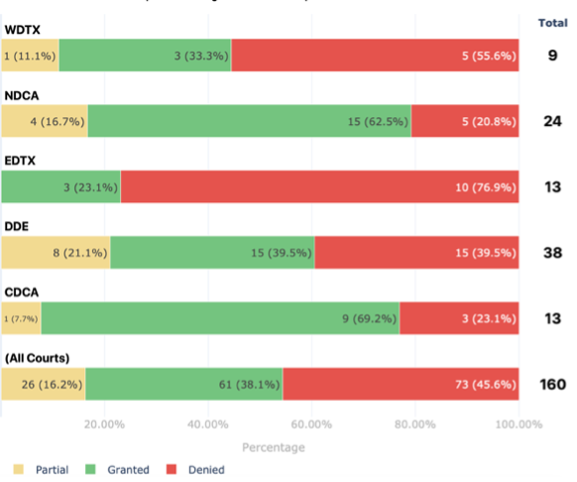
Source: Docket Navigator
At a micro level, and perhaps not surprisingly when it comes to Alice challenges, litigants considering the most popular patent venues should be aware that a patent owner is likely to face significantly more difficulty passing the Alice hurdle in California compared to Texas. In 2023, Delaware also proved a moderate jurisdiction for software patent owners.
Section 101 Legislative Reform Efforts
In response to Alice and the cases from the Federal Circuit and district courts that have followed Alice, efforts to reform Section 101 have progressed, but have yet to prove successful.
In 2017, the Intellectual Property Owners Association (IPO) put forth a proposed revision to Section 101, as did the American Intellectual Property Lawyers Association (AIPLA). In 2018, the IPO and AIPLA agreed on a “Joint AIPLA-IPO Proposal on Patent Eligibility,” under which only laws of nature and mental steps would be patent-ineligible under Section 101.
Building on these proposals, a bipartisan group of legislators (including Senators Thom Tillis and Chris Coons) released a draft bill in May 2019 which would eliminate the judicial exceptions to patent eligibility altogether, and instead only require that an invention meet one of the statutory subject matter areas (process, machine, manufacture, or composition of matter) in order to be patentable under Section 101. Following the release of this draft legislation, the Senate Judiciary Subcommittee on Intellectual Property held three public hearings in June 2019 on Section 101 reform.
Most recently, in August of 2022, Senator Tillis first presented legislation to reform subject matter eligibility in the United States, dubbed the Patent Eligibility Restoration Act (“PERA”). The new bill would allow subject matter to qualify for potential patent protection so long as the subject matter does not fall within the following, predefined exclusions derived from case law:
- A mathematical formula, apart from a useful invention or discovery.
- A process that – (i) is a non-technological economic, financial, business, social, cultural, or artistic process; (ii) is a mental process performed solely in the human mind; or (iii) occurs in nature wholly independent of, and prior to, any human activity.
- An unmodified human gene, as that gene exists in the human body.
- An unmodified natural material, as that material exists in nature.
Senator Coons has since co-sponsored the Bill. The Senate Judiciary Committee on Intellectual Property introduced the bill in June of 2023 (S.2140) and it is currently scheduled for mark-up on September 26, 2024.
Alice at the USPTO
One of the most noteworthy developments on the Alice front came on January 7, 2019, when the USPTO issued its “2019 Revised Patent Subject Matter Eligibility Guidance.” See generally 2019 Revised Patent Subject Matter Eligibility Guidance (“Guidelines”), 84 Fed. Reg. 50-57 (Jan. 7, 2019). By strictly interpreting the kinds of subject matter that fall within judicial exceptions to subject matter eligibility, the Guidelines are likely to significantly reduce the volume of Section 101 rejections emanating from the USPTO.
The Guidelines mandate a two-pronged approach to Alice issues. Under Prong One, an Examiner must determine whether a patent claim is directed to a judicial exception (law of nature, natural phenomenon or abstract idea). The Guidelines set forth the three categories that qualify as abstract ideas: “mathematical concepts, certain methods of organizing human activity, and mental processes.” Guidelines at 50. Only if a given claim falls within one of these three abstract idea categories (or is directed to a law of nature or natural phenomenon) is it directed to a judicial exception. Id. at 53. When a judicial exception is not present, the analysis ends and the patent passes muster under Section 101. Id. When a judicial exception is present, the Examiner must proceed to Prong 2 of the analysis. Id.
Under Prong 2 (Step TwoA), the Examiner must determine whether a claim, though directed to a judicial exception, is nonetheless “integrated into a practical application of the judicial exception.” Id. “A claim that integrates a judicial exception into a practical application will apply, rely on, or use the judicial exception in a manner that imposes a meaningful limit on the judicial exception, such that the claim is more than a drafting effort designed to monopolize the judicial exception.” Id. In delineating specific considerations that should guide this analysis, the USPTO leans on a number of Federal Circuit cases finding no abstract idea when the challenged claim set forth technological improvements or other limitations that remove the claim from being abstract. Id. at 55 & nn. 25-32.
Where no practical application has been found, an examiner must determine (Prong 2, Step TwoB) whether the claim nonetheless sets forth an “inventive concept.” Id. at 56. Only if an inventive concept is found will the claim survive under § 101. See id. Tracking Federal Circuit precedent on the issue, the inventive concept inquiry examines considerations such as whether the claim sets forth a limitation or combination of limitations “that are not well-understood, routine, conventional activity in the field.” Id. at 56. If an inventive concept is found under Step TwoB, the patent remains eligible under Section 101. Id. If no such inventive concept is found, the patent is not eligible. Id.
As the USPTO’s data has demonstrated, the issuance of the Guidelines resulted in markedly fewer first office-action Alice rejections. [1] Whether this trend will continue in light of recent Federal Circuit precedent remains a very open question. One interesting technology area to follow with respect to Alice will be artificial intelligence (“AI”). On July 17, 2024, the USPTO issued an extremely important update to the Guidelines with respect to patent directed to artificial intelligence technologies (“AI Update”). The AI Update provides several teaching examples and highlights that in order to pass muster under Section 101, AI patent claims must set forth sufficient technological specificity as to “how”, and be directed to technologies that go far beyond mere data processing.
Next Week: A Closer Look
When it comes to predicting whether a particular software technology can even qualify for patenting, knowing the data is obviously not going to be enough. Having read over 90 Federal Circuit decisions since 2018, there is a lot more to share. What kinds of software technologies have a shot at surviving Alice? How should a software patent claim or specification be drafted to survive? What themes can be drawn from the last six years of Federal Circuit precedent on software patents? Please check back next week, or join us at IPWatchdog LIVE, for key takeaways and best practices.
Don’t miss Michael Gulliford’s panel, “101 in the District Courts and Federal Circuit: What is Happening with Alice” at IPWatchdog LIVE on September 30, where he will discuss these issues in more depth. You can read the full version of this paper, which was first published with the Practising Law Institute, here.
Image Source: Deposit Photos
Author: highflier
Image ID: 76678271
![[Advertisement]](https://ipwatchdog.com/wp-content/uploads/2026/10/BlackBox-IP-Oct-20-2026-sidebar-700x500-1.jpg)
![[Advertisement]](https://ipwatchdog.com/wp-content/uploads/2026/10/Questel-Oct-22-2026-sidebar-700x500-1.jpg)
![[Advertisement]](https://ipwatchdog.com/wp-content/uploads/2026/09/Life-Sciences-2026-sidebar-early-bird-ends-Oct-25-700x500-1.jpg)
![[Advertisement]](https://ipwatchdog.com/wp-content/uploads/2026/09/WE-BUY-PATENTS-SIM-IP-Ad-1-revised-on-Sep-28-2026-700x500-1.jpg)
![[Advertisement]](https://ipwatchdog.com/wp-content/uploads/2024/09/Patent-Prosecution-Training-sidebar-700x500-2025-03-27.jpg)




![[Advertisement]](https://ipwatchdog.com/wp-content/uploads/2021/12/WEBINAR-336-x-280-px.png)
![[Advertisement]](https://ipwatchdog.com/wp-content/uploads/2021/12/Ad-4-The-Invent-Patent-System™.png)





Join the Discussion
One comment so far.
Chris Scoones
September 26, 2024 05:52 pmhttps://x.com/scooneschris/status/1839419926710481258?s=61&t=7w4I54Sxb1biB-YQHuM1hA