
![[IPWatchdog Logo]](https://ipwatchdog.com/wp-content/themes/IPWatchdog%20-%202023/assets/images/temp/logo-small@2x.png)

 5
5 “While GoPro argued the claims ‘simply employ known or conventional components that existed in the prior art at the time of the invention,’ the CAFC said, even if true, ‘that alone does not necessarily mean that the claim is directed to an abstract idea at step one.’”
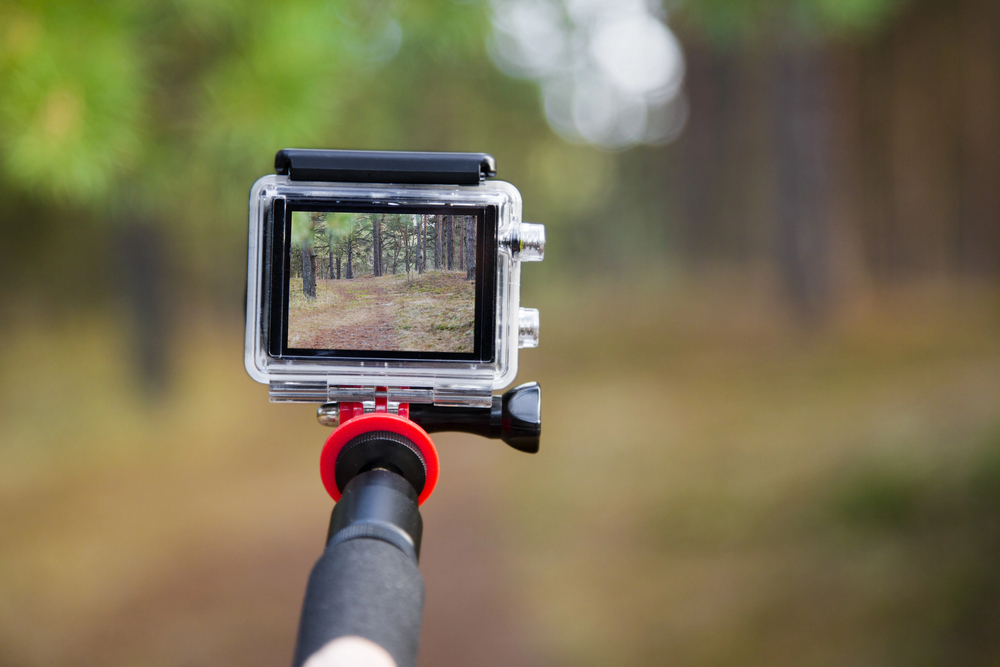 The U.S. Court of Appeals for the Federal Circuit (CAFC) today issued a precedential opinion reversing a district court’s invalidation of patent claims challenged by GoPro, Inc. as patent ineligible. The CAFC said the district court erred in concluding at Alice step one that the claims were directed to an abstract idea and distinguished the case from its precedent in Yu v. Apple and ChargePoint v. SemaConnect. The opinion was authored by Judge Reyna.
The patents in question—U.S. Patent Nos. 8,890,954 and 8,896,694—are owned by Contour IP Holding LLC and cover “portable, point of view (‘POV’)” video camera technology. Specifically, they disclose a “‘hands-free, POV action sports video camera’ that is ‘configured for remote image acquisition control and viewing.’”
Contour sued GoPro in 2015, and again in 2021, alleging several of the company’s handheld action cameras infringed the patents. After the district court granted partial summary judgment of infringement against GoPro in the first lawsuit, GoPro challenged claim 11 of the ’954 patent and claim 3 of the ’694 patent as patent ineligible under 35 U.S.C. § 101. GoPro also filed a motion for judgment on the pleadings that the claims were ineligible under Federal Rule of Civil Procedure 12(c) in the second lawsuit, relying on the CAFC’s ruling in Yu v. Apple. In that case, the Federal Circuit found a claim that recited “image sensors, lenses that are mounted to the image sensors, a digital image processor and even analog-to-digital converting circuits” to be abstract.
The district court denied the Rule 12(c) motion but said “its decision was made without prejudice to GoPro’s raising § 101 patent ineligibility ‘again at summary judgment based on a factual record,’” according to the CAFC opinion. GoPro did so and this time the district court found that representative claim 11 “was directed to the abstract idea of ‘creating and transmitting video (at two different resolutions) and adjusting the video’s settings remotely.” And at Alice step two, the district court said the claim “recites only functional, results-oriented language with ‘no indication that the physical components are behaving in any way other than their basic, generic tasks.’” The district court also cited Yu v. Apple in its reasoning.
But the CAFC disagreed with the court’s analysis and distinguished the Yu case. Specifically, said the CAFC:
“Here, when read as a whole, claim 11 is directed to a specific means that improves the relevant technology. Claim 11 recites an improved POV camera through its combination of claim limitations and requirement that the claimed POV camera processor be configured to record low-and high-quality data streams in parallel, followed by the low-quality data stream’s wireless transfer to a remote device. With the claimed POV camera, a user can remotely view and adjust the desired recording in real time, with the elimination of bandwidth limitations on wireless data transfer. See ’954 patent, 20:9–16. The claims thus require specific, technological means—parallel data stream recording with the low-quality recording wirelessly transferred to a remote device—that in turn provide a technological improvement to the real time viewing capabilities of a POV camera’s recordings on a remote device.”
This determination relies in part on the district court’s own claim construction, said the CAFC, which found the term “generate” in representative claim 11 to “require recording multiple video streams ‘in parallel.’” This indicates that the claims can’t over other ways of generating multiple streams, such as “in sequence,” said the CAFC. “Rather, the claims are drawn to a ‘specific means or method that improves the relevant technology.’”
The district court’s decision that the claims were drawn to an abstract idea “characterizes the claims at an impermissibly high level of generality,” said the Federal Circuit’s opinion. While GoPro argued the claims “simply employ known or conventional components that existed in the prior art at the time of the invention,” the CAFC said, even if true, “that alone does not necessarily mean that the claim is directed to an abstract idea at step one.”
Turning to GoPro’s reliance on Yu, the CAFC explained that the claims in Yu were clearly directed to “a longstanding, fundamental practice in photography.” But in the present case, “GoPro does not argue that a camera’s recording two video streams in parallel and wirelessly transferring the lower quality video stream to a remote device for real time viewing and adjustment was a long-known or fundamental practice supporting patent ineligibility at Alice step one.”
The opinion went on to distinguish Contour’s claims from those at issue in ChargePoint v. SemaConnect, another recent controversial Section 101 decision. There, the CAFC found that the claims “were drawn to the abstract idea of ‘communication over a network,’ applied to the context of electric vehicle charging stations.” But here, “claim 11 of the ’954 patent describes more than wireless data transfer within a particular technological environment,” said the CAFC.
“The claims are directed to a technological solution to a technological problem,” the opinion added, holding that they therefore recite patent eligible subject matter at Alice step one, and there was thus no need to proceed to step two. The district court’s decision was reversed and remanded.
Image Source: Deposit Photos
Author: ronstik
Image ID: 91133612
![[Advertisement]](https://ipwatchdog.com/wp-content/uploads/2026/04/ClearstoneIP-May-14-2026-sidebar-700x500-1.jpg)
![[Advertisement]](https://ipwatchdog.com/wp-content/uploads/2026/04/Virtual-AI-2026-May-18-19-2026-sidebar-700x500-1.jpg)
![[Advertisement]](https://ipwatchdog.com/wp-content/uploads/2026/05/Patent-Masters-2026-sidebar-early-bird-price-700x500-1.jpg)








![[Advertisement]](https://ipwatchdog.com/wp-content/uploads/2021/12/WEBINAR-336-x-280-px.png)
![[Advertisement]](https://ipwatchdog.com/wp-content/uploads/2021/12/Ad-4-The-Invent-Patent-System™.png)






Join the Discussion
5 comments so far.
Anon
September 12, 2024 09:07 pmAddy,
Calling it an “opinion” is a disservice.
Addy
September 12, 2024 10:10 amAnon – thanks for sharing your opinion.
Anon
September 12, 2024 08:04 amClaim 11 of the ‘954 (emphasis added):
11. A portable, point of view digital video camera, comprising:
a lens;
an image sensor configured to capture light propagating through the lens and representing a scene, and produce real time video image data of the scene;
a wireless connection protocol device configured to send real time image content by wireless transmission directly to and receive control signals or data signals by wireless transmission directly from a personal portable computing device executing an application; and
a camera processor configured to:
receive the video image data directly or indirectly from the image sensor,
generate from the video image data a first image data stream and a second image data stream, wherein the second image data stream is a higher quality than the first image data stream,
cause the wireless connection protocol device to send the first image data stream directly to the personal portable computing device for display on a display of the personal portable computing device, wherein the personal portable computing device generates the control signals for the video camera, and wherein the control signals comprise at least one of a frame alignment, multi-camera synchronization, remote file access, and a resolution setting, and at least one of a lighting setting, a color setting, and an audio setting,
receive the control signals from the personal portable computing device, and
adjust one or more settings of the video camera based at least in part on at least a portion of the control signals received from the personal portable computing device.
Addy,
I call BULL on your comment – this is NO LESS than most all claims to which your whine of “not merely outcomes + functional language applies.
Addy
September 11, 2024 10:48 amNothing special here; the CAFC merely did it’s job in a manner that’s consistent with prior cases. The patentee actually claimed technology and not merely outcomes + functional language, and was appropriately (and predictably) rewarded with a good outcome.
Pro Say
September 10, 2024 10:14 amBravo CAFC! For the sake of American innovation, more like this.
Please.