
![[IPWatchdog Logo]](https://ipwatchdog.com/wp-content/themes/IPWatchdog%20-%202023/assets/images/temp/logo-small@2x.png)
Posts Tagged: "intellectual property"
An Exclusive Interview with Francis Gurry, WIPO Director General
Yesterday I had the honor of spending 30 minutes interviewing Francis Gurry, the Director General of the World Intellectual Property Organization (WIPO). The Director General spoke substantively about issues facing the Patent Offices of the world, as well as some possible solutions. Gurry also discusses harmonization attempts, work-sharing agreements and the crushing worldwide backlog of patent applications that could lead to irrelevance of the system. As you read the interview you will also see that he thinks it is possible that the rest of the world will adopt a US-like grace period.
Kappos Talks Patent Reform and Gene Patents at BIO Convention
What follows are pieces of Director Kappos’ remarks at the session prior to taking questions and answers. While it is probably unfair to call these remarks prepared remarks, it was clear that he referred to his notes as he provided detailed information and statistics. He also seemed to be reading what he said when he spoke about the ACLU case against Myriad Genetics, but who can blame him given the USPTO was a nominal party to the case and it will be appealed to the Federal Circuit. It is also worth mentioning that during the Q&A there were a few interesting things that came up, chief among them was Kappos’ explanation of the long odds facing a small entity claiming to be the first to invent but who filed the patent application second. Kappos likened the odds of such a Junior Party prevailing to the odds of being bitten by a Grizzly Bear and a Polar Bear on the same day. He then went on to say that you have to go back to FY 2007 to find a prevailing small entity Junior Party in an interference.
US Trade Representative Issues Annual Report on Global IP Rights
For 2010 the US Trade Representative reviewed 77 trading partners for this year’s Special 301 Report, and placed 41 countries on either the Priority Watch List, Watch List, or the Section 306 monitoring list. The Priority Watch List for 2010 names the following countries:China, Russia, Algeria, Argentina, Canada, Chile, India, Indonesia, Pakistan, Thailand and Venezuela.
WIPO Turns 40! Happy World Intellectual Property Day!
How is it possible that a calendar that tells me that January 2 is a bank holiday in the UK, that February 6 is Waitangi Day in New Zealand, that March 13 is Eight Hours Day in Australia, and that July 12 is Battle of the Boyne Day in Northern Ireland, could possibly forget to mention that April 26 is World Intellectual Property Day! After all, World Intellectual Property Day is one of those global holidays celebrated all around the world, right? It is sort of universal, almost like Christmas and New Years Eve, although with substantially less hoopla. But not too much less hoopla this year given that today marks the 10th Anniversary, or birthday if you prefer, of World Intellectual Property Day.
CorporateCounsel.com Names Top 10 IP Litigation Wins of 2009
The victories selected represent a diverse array of wins, which a press release announcing the Top 10 list says is due to “the differing objectives of IP litigation today.” These victories range from multimillion-dollar jury verdicts, including the biggest patent award ever, which was won by Johnson & Johnson’s Centocor Ortho Biotech unit against Abbott Laboratories, to the i4i injunction win blocking the distribution of Microsoft Word editions having a popular XML feature.
Congress Urges Strong IP Stance in UN Climate Change Talks
As first reported by Bartholomew Sullivan of The Commercial Appeal, last week, on October 22, 2009, thirty-four members of Congress wrote a letter to Secretary of State Hillary Clinton urging her to steadfastly support strong intellectual property rights and not to given in to international demands that would weaken intellectual property rights, particularly patent rights. The concern expressed by these…
Understanding Intellectual Property Basics
Intellectual property is probably best thought of (at least in general terms) as creations of the mind that are given the legal rights often associated with real or personal property. The rights that are given are a function of statutory law (i.e., law created by the legislature). These statutes may be federal or state laws, or in some instance both…
Hotwire.com Reviews Are Not Really Useful
Back in March 2009, I had an occasion to need to stay at a hotel I booked through Hotwire.com. The hotel was nice enough, but there were a few things that were a bit peculiar. For one, they did not offer dry cleaning services, which is odd for any hotel and particularly one not far from a major airport that…
Fordham IP Institute Goes to Cambridge
PRESS RELEASE – Fordham Law School’s Intellectual Property Law Institute has announced that for the first time, its Annual Conference on Intellectual Property Law & Policy, the world’s leading intellectual property law forum, will be held outside of New York City. The 17th annual conference will be held at Cambridge University, U.K., on April 15 and 16, 2009. It will…
Stanford Launches IP Litigation Clearinghouse
On Monday, December 8, 2008, the Law, Science & Technology Program at Stanford Law School launched the Stanford Intellectual Property Litigation Clearinghouse (IPLC), a unique online database that offers comprehensive information about intellectual property disputes within the United States. This publicly available, online research tool will enable scholars, policymakers, lawyers, judges, and journalists to review real-time data about IP legal…
John McCain on Technology & IP
John McCain has a broad and cohesive vision for the future of American innovation. His policies will provide broad pools of capital, low taxes and incentives for research in America, a commitment to a skilled and educated workforce, and a dedication to opening markets around the globe. He’s committed to streamlining burdensome regulations and effectively protecting American intellectual property in…
Protecting Trade Secret Assets
If you ask the owners of most companies whether they have any intellectual property assets, assuming they know what you are talking about they are likely to say no. The problem with that, however, is that the answer should universally be a resounding YES! Every company has intellectual property assets. The name of your company is an asset that can…
Varsity Sponsors
![[Advertisement]](https://ipwatchdog.com/wp-content/uploads/2026/03/NLPatent-Apr-2-2026-sidebar-700x500-1.jpg)
![[Advertisement]](https://ipwatchdog.com/wp-content/uploads/2026/02/Junior-Apr-7-2026-sidebar-700x500-1.jpg)

Latest IPW Posts
Mainstream Media Attention for Judge Newman Suspension Grows as Saga Continues
April 1, 2026 @ 11:15 amHow to Draft AI Patents That Survive the Next Guidance Cycle, and the One After That
April 1, 2026 @ 07:15 amTesla Partially Succeeds at CAFC with Ruling Finding Some EV Charging Claims Obvious
March 31, 2026 @ 04:28 pmCAFC Upholds Ineligibility of Targeted Ad Claims in Win for TikTok
March 31, 2026 @ 01:14 pmWIPO in Focus: Beyond Treaties, Toward a Market-Driven IP System | IPWatchdog Unleashed
March 31, 2026 @ 11:00 am
Latest Podcasts
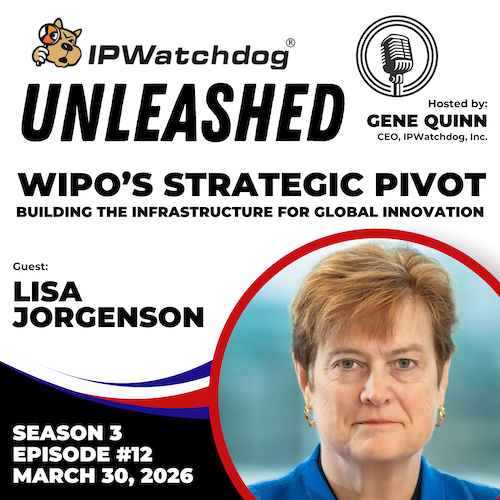

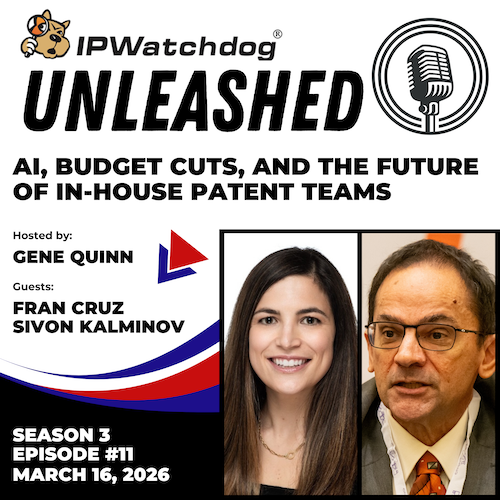

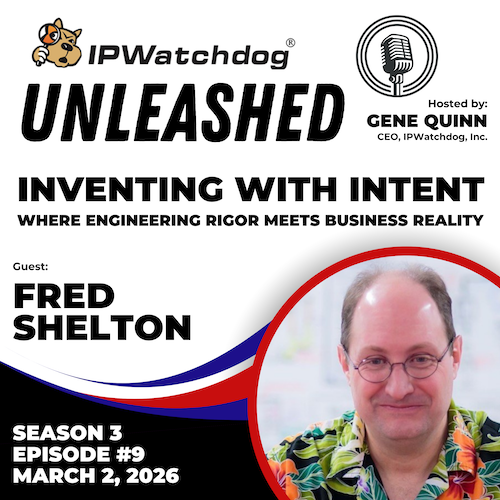
IPWatchdog Events
Webinar: Unlocking New Capabilities – The Real ROI of AI in Patent Practice
April 2 @ 12:00 pm - 1:00 pm EDTCLE Webinar: All in the Prompt – Crafting AI Prompts for Precision Outputs
April 7 @ 12:00 pm - 1:00 pm EDTPatent Masters™ 2026 – Portfolios, Licensing and Enforcement
June 8 @ 8:00 am - June 10 @ 5:00 pm EDT
Industry Events
24th Annual Rocky Mountain Intellectual Property & Technology Law Institute
May 28 @ 8:30 am - May 29 @ 4:30 pm MDTFrom IPWatchdog
![[Advertisement]](https://ipwatchdog.com/wp-content/uploads/2021/12/WEBINAR-336-x-280-px.png)
![[Advertisement]](https://ipwatchdog.com/wp-content/uploads/2021/12/Ad-4-The-Invent-Patent-System™.png)