
![[IPWatchdog Logo]](https://ipwatchdog.com/wp-content/themes/IPWatchdog%20-%202023/assets/images/temp/logo-small@2x.png)
Posts in Guest Contributors
Why High-Quality U.S. Patent Specifications Face Fatal Failures in China
In 2025, a patent dispute between Chinese companies in the camera-module space drew close attention across the industry — SUNNY v. AAC [Patent Reexamination and Invalidation Department Decision No. 566288, et al.]. The case ended with 11 patents invalidated, four of them in their entirety. There was a single reason: the claims were not supported by the specification.
Nigeria Is Building the Next Global Economy: Is Your Intellectual Property Ready for It?
U.S. companies planning to enter Nigeria typically build a careful playbook for market research, distribution, hiring, and regulatory compliance. Intellectual property is often the item furthest down that list, treated as paperwork to handle once commercial activity is already underway. That sequencing is backwards, and it is worth understanding why.
Pay for What You Traverse: Ending After-Final Practice with Content-Based Fees
For many small businesses, uncertainty in patent prosecution can mean the difference between a strong issued patent and either abandonment or suboptimal coverage. One source of uncertainty in today’s system is final office action practice. Recent data suggests that roughly 42% of patent applications receive a final office action, meaning they are not allowed initially or after a response to a non-final office action. While receiving a final office action does not close the door on a patent application, it does give examiners greater discretion in directing its path. This discretion is unnecessary and can be eliminated by tying U.S. Patent and Trademark Office (USPTO) fees more closely to the actual content and complexity of each office action response.
When the Quantum-AI Invention Stack Speeds Up Discovery, Patent Practice Has to Move Upstream
Artificial intelligence (AI) and quantum computing are compressing the invention cycle itself. That compression is no longer theoretical. Discovery Loop, a new public benefit corporation founded by leading former Google and Google DeepMind researchers, has announced a mission to automate experimental loops of the scientific method; the AItonomy Foundation similarly frames automated experimental loops as a path to accelerating science and engineering. The trend is also visible in Faraday, a recent AI model for automated scientific discovery that links model-driven hypothesis generation with iterative experimentation and R&D workflows, further illustrating how AI systems are moving from passive analysis toward active participation in the scientific method.
The ‘Captain Obvious’ Approach: What the Nielsen Decision Reveals About the U.S. Obviousness Inquiry
About 20 years ago, Hotels.com had a series of commercials starring a character called “Captain Obvious.” This character would make observations that were funny because they were apparent to all. And that is what non-patent lawyers think of when it comes to something that is obvious. That is also the approach taken in a recent U.S. Court of Appeals for the Federal Circuit (CAFC) cases, i.e. the “Captain Obvious” approach. Specifically, the recent Nielsen (The Nielsen Co. (US), LLC, v. TVision Insights, Inc., —
From Testimony to Action: Proposed Legislation to Address Issues Raised by Rights Owners During Recent House Hearing
On June 30, 2026, the House Judiciary Subcommittee on Courts, Intellectual Property, Artificial Intelligence, and the Internet held a hearing titled, “A Midlife Crisis? IP and the Internet After 40,” which examined whether current U.S. intellectual property laws and enforcement mechanisms are effective against Internet-driven infringement and counterfeiting. The hearing focused on online counterfeiting, digital piracy, and AI-enabled or generated infringement and digital replicas. The hearing also considered the difficulty in enforcing rights against overseas operators, and enforcement tools to address these issues, including Schedule A litigation and website blocking.
Every Patent Is a Spy Report: How Patent Filings Are Now the World’s Largest Open-Source Intelligence Database
For more than two centuries, the patent system has rested on a simple bargain: inventors publicly disclose their inventions in exchange for a limited monopoly. That bargain assumes disclosure primarily benefits competitors, researchers, and the public. Today, however, the audience has changed. Patent filings are now mined not only by competitors, but by governments, intelligence agencies, sovereign investors, and increasingly sophisticated artificial intelligence systems capable of analyzing millions of documents simultaneously. The result is that patent databases have become one of the world’s richest sources of open-source technological intelligence.
Structuring IP and Legal Teams in Conglomerates: Missteps and Masterstrokes
A conglomerate—a large enterprise comprising multiple discrete companies, divisions, or business units—may come into being organically or inorganically, due to business growth, expansion into new markets, internal restructuring, or a merger, acquisition, or joint venture. Regardless of a conglomerate’s origin story, its leaders face a fundamental question: How should they structure the intellectual property or legal function to optimally serve the needs and interests of the divisions and the conglomerate at large?
AI Chatbots and Trademark Confusion: No Human Means No Confusion, and No Confusion Means No Case
As AI assistants take over product discovery and purchase, the likelihood of confusion test is losing the consumer it was built around. And brands are therefore losing their primary line of defense. For decades, building a brand has meant the same, patient work. You develop a differentiated story, then bring it to life everywhere a customer might meet it: Advertising; digital; packaging; product design; customer care. Every piece is guided by consumer insight, a hard-won read on what a person feels at each stage of the journey, from the first moment of awareness through consideration to the purchase itself.
Weeding Out the Vague: What Gompert Teaches About Trade Secret Identification
Trade secrets occupy a unique position among the major forms of intellectual property. Patents, copyrights, and trademarks are, by design, defined and publicly registered, and can be consulted to determine exactly what is claimed. In contrast, trade secrets depend on their being undisclosed. This creates a structural problem the moment a trade secret owner goes to court. Because they are secret, they cannot be identified in public filings without destroying the very subject matter of the plaintiff’s claim. On the other hand, defendants must understand what the secrets are and what they’ve allegedly misappropriated. In addition, the court needs to know what the case is about to manage it.
Federal Circuit Holds There is No ‘Presumption of Irreparable Harm’ on Preliminary Injunction Motions: What Took So Long?
On August 4, 2026, the U.S. Court of Appeals for the Federal Circuit (CAFC) chose to issue a precedential opinion formally holding that there is no “presumption of irreparable harm” in preliminary injunction proceedings in patent cases. The court acknowledged that this conclusion should have been apparent from the 2006 Supreme Court decision in eBay Inc. v. MercExchange, L.L.C., 547 U.S. 388, 393-94 (2006).
USPTO Policy On Discretion to Deny Ex Parte Reexamination Is Contrary to Statute and Precedent
As the institution rate of inter partes reviews (IPRs) has plunged under U.S. Patent and Trademark Office (USPTO) Director John Squires, parties have increasingly turned to ex parte reexaminations (EPRs) to challenge patents. The number of requests for EPRs has skyrocketed. The number of EPR requests more than doubled between 2020 (198 requests) and 2025 (481 requests). See USPTO Reexam Statistics. Based on the number of requests for EPRs (831) assigned a filing date through Q3 of 2026, we are on track to have more than 1,100 requests for EPRs filed in FY2026. See USPTO Operational Statistics.
Risky Business: Patent Term Adjustment in the Post- Forest Era
What value is a patent that expires before it issues? Until recently, that question seemed wholly academic. In In re Forest, however, the U.S. Court of Appeals for the Federal Circuit (CAFC) answered it directly: A patent that issues after its expiration date has no value; it provides neither exclusionary rights nor provisional rights. In the court’s view, the applicant has no cognizable interest in the patent or the application on which it would be based.
Outdated Protective Orders are Impeding Software Code Analysis in Copyright and Trade Secret Cases
As an expert witness on intellectual property litigations, I have noticed over the past few years parties with poor arguments in software copyright and software trade secret cases, both plaintiffs and defendants, have been taking advantage of technologically outdated protective orders to gain an unfair advantage. The U.S. District Court for the Northern District of California, where probably the majority of software IP cases take place, has a Model Protective Order for Litigation Involving Patents, Highly Sensitive Confidential Information and/or Trade Secrets that has become a de facto standard for software IP cases around the country. It is antiquated and needs to be updated.
Are Your Patent Assets Monetizable or Merely Countable?
Patent count is often the first thing people notice about a portfolio. It should not be the last. A portfolio with 500 patents may have little monetization value if the claims are difficult to understand, the infringing products are unclear, the damages are weak, the strongest assets are expired or expiring soon, or there are no pending applications. Conversely, a smaller portfolio with well-supported claims, identifiable infringing products, meaningful damages, remaining patent life, and pending applications in both the U.S. and Europe may be far more valuable.
Varsity Sponsors
![[Advertisement]](https://ipwatchdog.com/wp-content/uploads/2026/09/ClaimHit-Oct-1-2026-sidebar-700x500-1.jpg)
![[Advertisement]](https://ipwatchdog.com/wp-content/uploads/2026/09/WE-BUY-PATENTS-SIM-IP-Ad-1-700x500-1.jpeg)
![[Advertisement]](https://ipwatchdog.com/wp-content/uploads/2026/09/Life-Sciences-2026-sidebar-early-bird-price-700x500-1.jpg)
From the IPWatchdog Institute
![[Advertisement]](https://ipwatchdog.com/wp-content/uploads/2024/09/Patent-Prosecution-Training-sidebar-700x500-2025-03-27.jpg)

Latest IPW Posts
Epiq Counsel Client is Seeking a Senior Trademark Paralegal (Global Portfolio | In-House)
September 25, 2026 @ 06:15 amEpiq Counsel Client is Seeking a Patent Paralegal (Global Portfolio | In-House)
September 25, 2026 @ 05:15 amSquires’ Anniversary Celebration Raises Serious Ethical, Legal Questions
September 24, 2026 @ 03:15 pmCoke Stewart Tells Women’s IP Forum It’s Time to ‘Shock’ the U.S. Patent System Into Action
September 24, 2026 @ 01:36 pmBiosimilars in Brazil: Intellectual Property, Regulatory and Market Landscape
September 24, 2026 @ 07:15 am
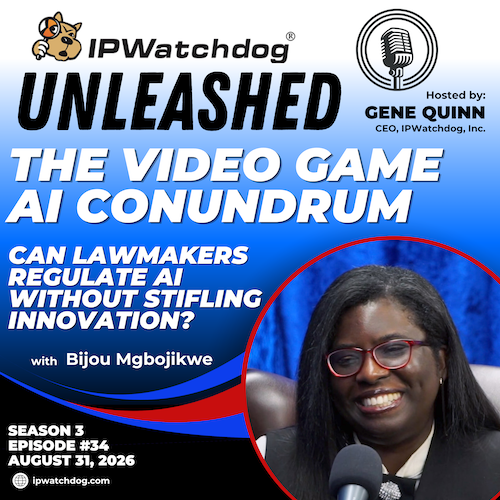
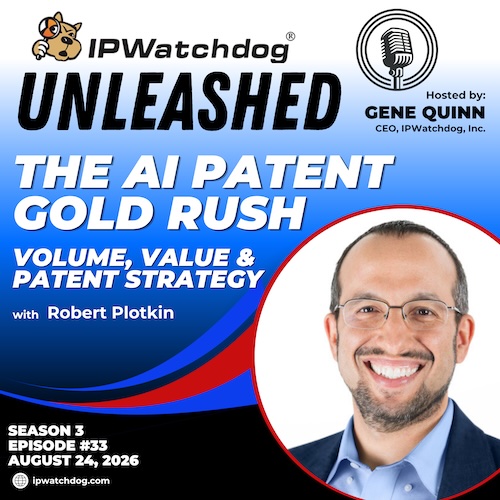
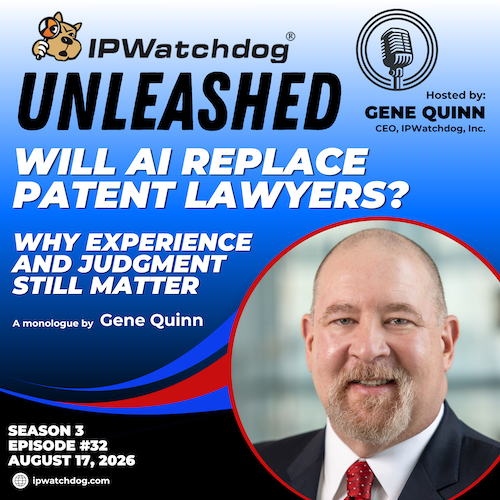
Latest Podcasts



IPWatchdog Events
Webinar: AI for Patent Licensing – Beyond Statistical Triage to Evidence-Grounded Product Analysis
October 1 @ 12:00 pm - 1:00 pm EDTCLE Webinar: Protecting the Product – Mapping Features to Patent Claims and Closing Coverage Gaps
October 13 @ 12:00 pm - 1:00 pm EDTCLE Webinar: How to Prompt AI – University IP Workflows in Action
October 15 @ 12:00 pm - 1:00 pm EDT
Industry Events
AI Skills: A Phased Roadmap for Junior and Senior Attorneys (CLE Webinar)
September 29 @ 1:00 pm - 1:30 pm EDTFrom IPWatchdog
![[Advertisement]](https://ipwatchdog.com/wp-content/uploads/2021/12/WEBINAR-336-x-280-px.png)
![[Advertisement]](https://ipwatchdog.com/wp-content/uploads/2021/12/Ad-4-The-Invent-Patent-System™.png)