
![[IPWatchdog Logo]](https://ipwatchdog.com/wp-content/themes/IPWatchdog%20-%202023/assets/images/temp/logo-small@2x.png)

 0
0 “The Federal Circuit held that the Board’s finding that Dr. Almeroth’s testimony was conclusory is not supported by substantial evidence.”
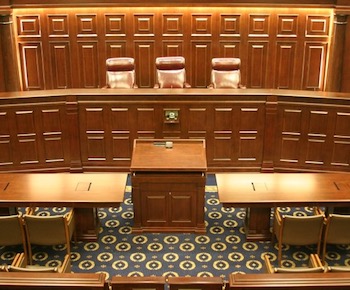 The U.S. Court of Appeals for the Federal Circuit (CAFC) on Thursday vacated a Patent Trial and Appeal Board (PTAB) decision that had found Go1 Pty, Ltd. failed to prove the challenged claims of U.S. Patent No. 8,784,113 unpatentable as obvious. In the opinion, Judge Stoll found that the PTAB improperly dismissed expert testimony as conclusory when the expert relied on professional judgment and common sense to explain a simple design choice. The case involves an inter partes review (IPR) petition filed by Go1 challenging claims 1-16 of the ‘113 patent, which is owned by OpenSesame, Inc. and directed to an open and interactive e-learning system and method.
The ‘113 patent describes a process in which content is readily publishable by a teacher and readily accessible by a student via platform-independent means, thereby producing a nearly universal e-learning marketplace. The disputed limitation in claim 1 requires a licensing and reporting server to verify a user license and, if valid, provide a location designator, such as a URL, to a proxy for accessing the content player. Go1 and OpenSesame agreed that this limitation sets forth two steps in sequence, requiring license verification to occur before providing the location designator.
In the IPR petition, Go1 asserted that the claims were obvious over U.S. Patent Application Publication No. 2007/0111180, known as Sperle, in combination with U.S. Patent Application Publication No. 2004/0015703, known as Madison. Go1 combined Sperle’s remote learning delivery methods with Madison’s access control mechanisms. Madison describes a system in which a web server generates a cryptographic ticket and sends a redirector file to an end user before any access verification occurs. Thus, Madison discloses first providing the location designator and then verifying the license, which is the reverse of the sequence recited in claim 1.
Go1 argued that a person of ordinary skill in the art would have been motivated to combine these teachings and would have viewed the specific sequence as an obvious design choice. To support this argument, Go1 presented testimony from its expert, Dr. Kevin Almeroth, who explained that a professional in the field would not require Madison to operate in an identical sequence to be motivated to combine the references. Dr. Almeroth opined that there is no practical difference between the two sequences and that a skilled artisan would view them as insubstantially different.
OpenSesame argued that the reverse order in Madison meant the prior art failed to teach the required limitation, and that Dr. Almeroth’s testimony was merely conclusory. The PTAB agreed with OpenSesame, concluding that Go1 failed to meet its burden because Madison did not disclose the proper sequence. The PTAB characterized Dr. Almeroth’s testimony was unsupported and conclusory, stating that his declarations could not fill in the gaps of the prior art references. Since Dr. Almeroth did not point to specific design considerations or provide a detailed technical explanation, the PTAB determined that Go1 did not persuasively show the claims would have been obvious over the combination of Sperle and Madison.
The Federal Circuit disagreed, holding that “the Board’s finding that Dr. Almeroth’s testimony was conclusory is not supported by substantial evidence.” The Federal Circuit emphasized that under the precedent of the Supreme Court of the United States, an obviousness analysis must take into account the “ordinary creativity” and common sense of a skilled artisan. In KSR, the Court noted that if a skilled artisan “can implement a predictable variation, § 103 likely bars its patentability.” When a design need exists, and there is a “finite” and “predictable” number of solutions, a skilled artisan has “good reason to pursue the known options within his or her technical grasp.” The Federal Circuit observed that the sequencing of these two steps presented only two predictable alternatives, making it a simple, binary design choice within the technical grasp of a skilled artisan.
Moreover, the Federal Circuit also rejected the argument that Dr. Almeroth needed to cite a separate reference to support his opinion. The Federal Circuit explained that the amount of explanation needed to establish obviousness “necessarily depends on context.” In some contexts, where the technology is “easily understandable, a motivation to modify analysis may include recourse to logic, judgment, and common sense available to the [skilled artisan] that do not necessarily require explication in any reference.” Given the simple difference in the order of steps between Madison and the claim, and the unchallenged fact that verifying access entitlement before granting access was generally known in other contexts, Dr. Almeroth did not need a specific reference. Instead, he grounded his opinion in his own professional expertise and understanding of how a skilled artisan would have approached the sequencing issue.
Ultimately, the Federal Circuit concluded that the absence of a separate reference expressly teaching the claimed sequencing does not, by itself, render the testimony conclusory. After considering and rejecting OpenSesame’s remaining arguments, the Federal Circuit vacated the PTAB’s final written decision and remanded the case for further proceedings consistent with its opinion. Go1 is seeking to invalidate the claims of the ‘113 patent, and the remand will require the PTAB to re-evaluate the obviousness challenge with the correct evidentiary standard for expert testimony.
![[Advertisement]](https://ipwatchdog.com/wp-content/uploads/2026/08/Anaqua-Aug-25-2026-sidebar-700x500-1.jpg)
![[Advertisement]](https://ipwatchdog.com/wp-content/uploads/2026/08/Solve-Intelligence-Aug-27-2026-sidebar-700x500-rev1.jpg)
![[Advertisement]](https://ipwatchdog.com/wp-content/uploads/2026/07/Womens-IP-Forum-2026-sidebar-register-early-bird-now-700x500-1.jpg)
![[Advertisement]](https://ipwatchdog.com/wp-content/uploads/2026/07/Juristat-Varsity-Ad-2026-IPW-ad-Solo_1.png)
![[Advertisement]](https://ipwatchdog.com/wp-content/uploads/2026/08/OneTransform_700x500_v1.png)
![[Advertisement]](https://ipwatchdog.com/wp-content/uploads/2024/09/Patent-Prosecution-Training-sidebar-700x500-2025-03-27.jpg)





![[Advertisement]](https://ipwatchdog.com/wp-content/uploads/2021/12/WEBINAR-336-x-280-px.png)
![[Advertisement]](https://ipwatchdog.com/wp-content/uploads/2021/12/Ad-4-The-Invent-Patent-System™.png)







Join the Discussion
No comments yet. Add my comment.
Add Comment