
![[IPWatchdog Logo]](https://ipwatchdog.com/wp-content/themes/IPWatchdog%20-%202023/assets/images/temp/logo-small@2x.png)

 2
2 “Section 357(c)’s language does not come close to providing the requisite ‘clear and convincing’ evidence that Congress intended to bar judicial review of Judge Newman’s constitutional claims.” – Judges’ brief
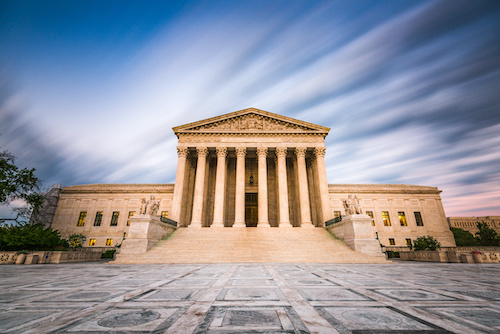 Seven retired federal judges have filed an amicus brief supporting U.S. Court of Appeals for the Federal Circuit (CAFC) Judge Pauline Newman’s Supreme Court petition seeking review of her case against CAFC Chief Judge Kimberly Moore for what she has dubbed Moore’s “unlawful” removal of Newman from her duties on the court.
The brief’s authors are Hon. Janice Rogers Brown (United States Court of Appeals for the District of Columbia Circuit, Ret.), Hon. Paul R. Michel (CAFC, Ret.); Hon. Kent A. Jordan (United States Court of Appeals for the Third Circuit, Ret.); Hon. Randall R. Rader (CAFC, Ret.), Hon. Thomas I. Vanaskie (United States Court of Appeals for the Third Circuit, Ret.); Hon. Paul G. Cassell (United States District Court for the District of Utah, Ret.); and Hon. Susan G. Braden (United States Court of Federal Claims, Ret.).
Newman filed her petition to the Supreme Court on March of this year. It poses two questions:
- Does 28 U.S.C. § 357(c)’s bar on judicial review of previously issued “orders” and “determinations” apply to ultra vires acts that exceed the scope of authority conferred by the Disability Act and the Constitution?
- Does 28 U.S.C. § 357(c)’s bar on judicial review of previously issued “orders” and “determinations” deprive a court of jurisdiction to consider claims that seek forward-looking relief to enjoin future unlawful actions?
The judges’ amicus brief focuses on question two and argues that “permitting misconduct of the sort alleged here to proceed unchecked and unexamined by the federal courts poses a grave threat to the independence of all federal judges, particularly the 50% of judges who are 68 or older.”
The D.C. Circuit in its August 2025 decision agreed with the U.S. District Court for the District of Columbia that judicial review of Newman’s case is 1) precluded by precedent in McBryde v. Committee to Review Circuit Council Conduct & Disability Orders of the Judicial Conference of the United States, 264 F.3d 52 (D.C. Cir. 2001) as to the statutory and as-applied constitutional challenges to the Judicial Conduct and Disability Act of 1980 and 2) that Newman’s facial constitutional challenge to the Act’s case-suspension provision fails because even Newman agreed that it has other constitutional applications. But the court also took pains to point out that it was not commenting on the merits of Judge Newman’s case or whether McBryde is good law.
The judges add that, in doing so, “the D.C. Circuit reaffirmed a 25-year-old precedent that prevents federal judges from seeking federal-court redress from Judicial Council actions that de facto remove them from the federal bench.” And the fact that such a bar applies whether or not the Council has violated the judge’s constitutional rights is problematic, said the brief.
“Particularly in light of the threat to judicial independence posed by the many recent attacks on the authority of federal judges, the Court should grant review to reaffirm the authority of federal courts to intervene to hear claims raising constitutional claims of the sort at issue here,” the judges explained.
28 U.S.C. § 357(c) reads:
“(c)No Judicial Review.—
Except as expressly provided in this section and section 352(c), all orders and determinations, including denials of petitions for review, shall be final and conclusive and shall not be judicially reviewable on appeal or otherwise.”
But, according to the brief, the D.C. Circuit’s “over-broad reading of § 357(c) fails to take proper account of the constitutional-avoidance canon.” The Supreme Court explained in Johnson v. Robison, 415 U.S. 361, 366 (1974) that interpreting another statute, 38 U.S.C. § 211(a), as barring federal courts from deciding the constitutionality of veterans’ benefits legislation “would, of course, raise serious questions concerning the [statute’s] constitutionality.” The Court has further recognized that there is a “strong presumption that Congress d[oes] not mean to prohibit all judicial review” of federal action, as explained in Dunlop v. Bachowski, 421 U.S. 560, 567 (1975), unless there is “clear and convincing” evidence to the contrary. The judges’ brief notes:
“Section 357(c)’s language does not come close to providing the requisite ‘clear and convincing’ evidence that Congress intended to bar judicial review of Judge Newman’s constitutional claims. Section 357(c) is silent about whether its limitations on jurisdiction apply to constitutional claims. Robison relied on the absence of an explicit reference to ‘constitutional claims’ in the jurisdictional statute at issue there, as a basis for concluding that the statute did not bar judicial review of such claims.”
Furthermore, Newman’s petition is also concerned with “prospective relief” to stop the Council from renewing her suspension for the fourth year in a row, rather than strictly with relief from past “orders and determinations” of the Council.
The D.C. Circuit’s decision to affirm dismissal of Newman’s claims was based on the precedent in McBryde, the holding of which the brief called “unsupported and unsupportable.” McBryde’s distinction between facial constitutional challenges to Judicial Council actions and as-applied constitutional challenges has no support in the statute, said the brief, and the decision’s rationale for finding that federal courts can consider facial challenges applies just as equally to as-applied challenges.
Additionally, Boumediene v. Bush, 553 U.S. 723 (2008), “strongly suggests that the statute is unconstitutional as so construed because the constitutional right at issue here—the right of federal judges to remain in office unless impeached and convicted by Congress—is explicitly spelled out in the Constitution,” said the brief.
Boumediene, which concerned statutory habeas jurisdiction for Guantanamo prisoners, held that “protection for the habeas privilege was one of the few safeguards of liberty specified in a Constitution that, at the outset, had no Bill of Rights.”
Finally, the brief reiterated that Newman’s case is representative of a broader trend of the authority of federal judges being undermined by means not authorized by the Constitution, such as filing a misconduct complaint under the Judicial Conduct and Disability Act. “Misconduct complaints are an increasingly common method by which a judge’s antagonists can circumvent the constitutionally prescribed impeachment process,” wrote the judges.
Five other amicus briefs have been filed in support of Newman thus far, including one by eight of her former law clerks, who argue that the D.C. Circuit’s own statements that Newman’s case poses “important and serious questions” warrant the Court’s review.
![[Advertisement]](https://ipwatchdog.com/wp-content/uploads/2026/07/Juristat-Aug-11-2026-sidebar-700x500-1.jpg)
![[Advertisement]](https://ipwatchdog.com/wp-content/uploads/2026/07/IP-Author-Aug-13-2026-sidebar-700x500-1.jpg)
![[Advertisement]](https://ipwatchdog.com/wp-content/uploads/2026/07/Womens-IP-Forum-2026-sidebar-register-early-bird-now-700x500-1.jpg)
![[Advertisement]](https://ipwatchdog.com/wp-content/uploads/2026/07/Juristat-Varsity-Ad-2026-IPW-ad-Solo_1.png)
![[Advertisement]](https://ipwatchdog.com/wp-content/uploads/2026/07/ClearstoneIP-Varsity-Ad-2026-Ad-2.jpg)
![[Advertisement]](https://ipwatchdog.com/wp-content/uploads/2024/09/Patent-Prosecution-Training-sidebar-700x500-2025-03-27.jpg)







![[Advertisement]](https://ipwatchdog.com/wp-content/uploads/2021/12/WEBINAR-336-x-280-px.png)
![[Advertisement]](https://ipwatchdog.com/wp-content/uploads/2021/12/Ad-4-The-Invent-Patent-System™.png)





Join the Discussion
2 comments so far.
Pro Say
April 21, 2026 08:51 pmThat not even one of the CAFC judges will stand up for Judge Newman and the rule of law (that only — ONLY — Congress has the authority to remove a federal judge from their duties) is sickening.
Sickening.
They should all be jailed for what they’ve done.
Jailed.
Anon
April 21, 2026 04:25 pmIn effect, the current status is “bow down or else.”
Those with the “No Kings” mantra have a better situation here for their umbrage.