
![[IPWatchdog Logo]](https://ipwatchdog.com/wp-content/themes/IPWatchdog%20-%202023/assets/images/temp/logo-small@2x.png)

 1
1 “From an average [appeals] pendency of over two years/ 28 months as of May 2025, pendency has reached just over 9 months as of April 1, 2026.”
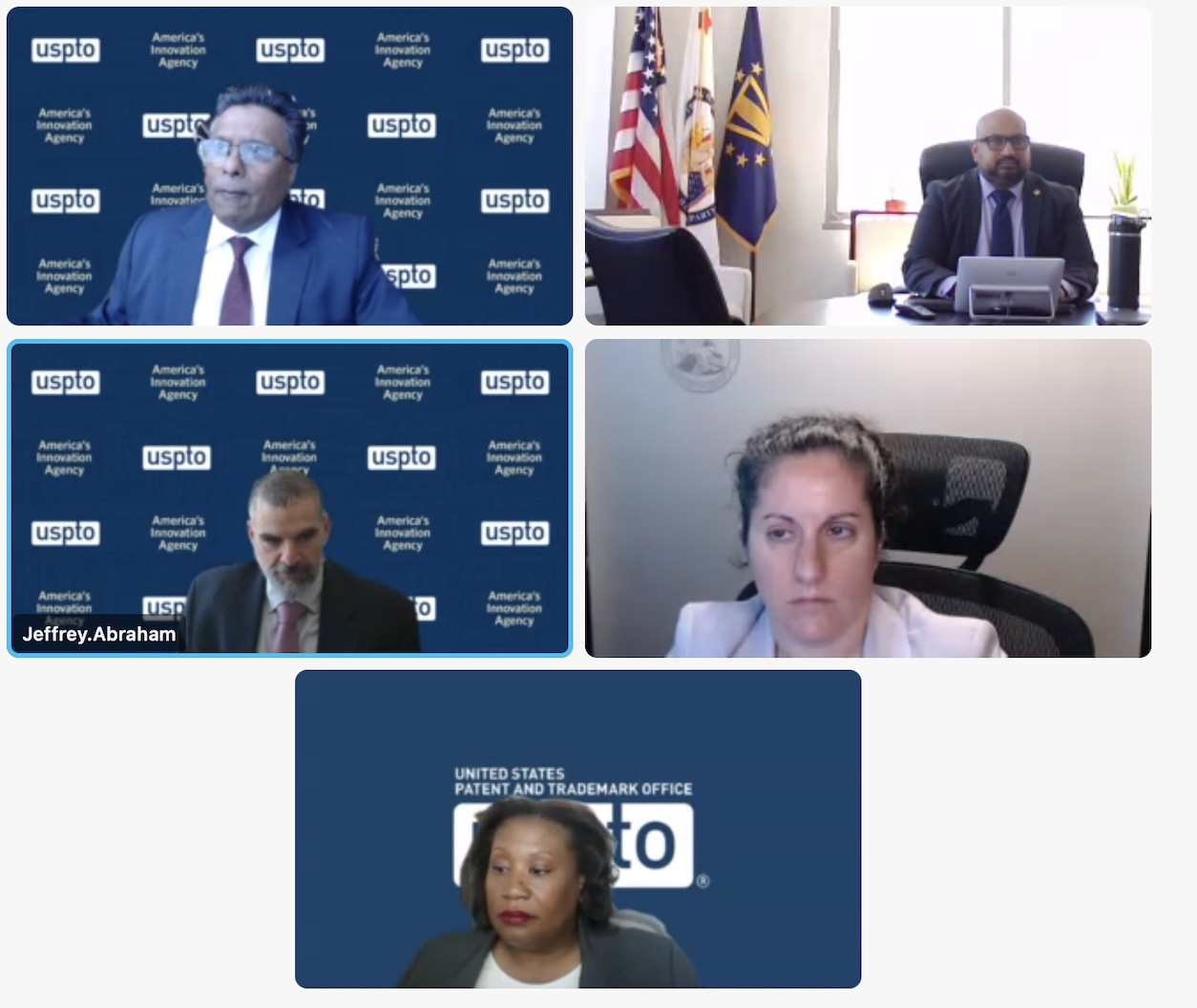
During its latest “USPTO Hour” webinar, the U.S. Patent and Trademark Office (USPTO) recapped Patent Trial and Appeal Board (PTAB) updates over the last year-plus, including statistics that show drastic changes in the overall institution rate and number of denials of institution for inter partes review (IPR) proceedings.
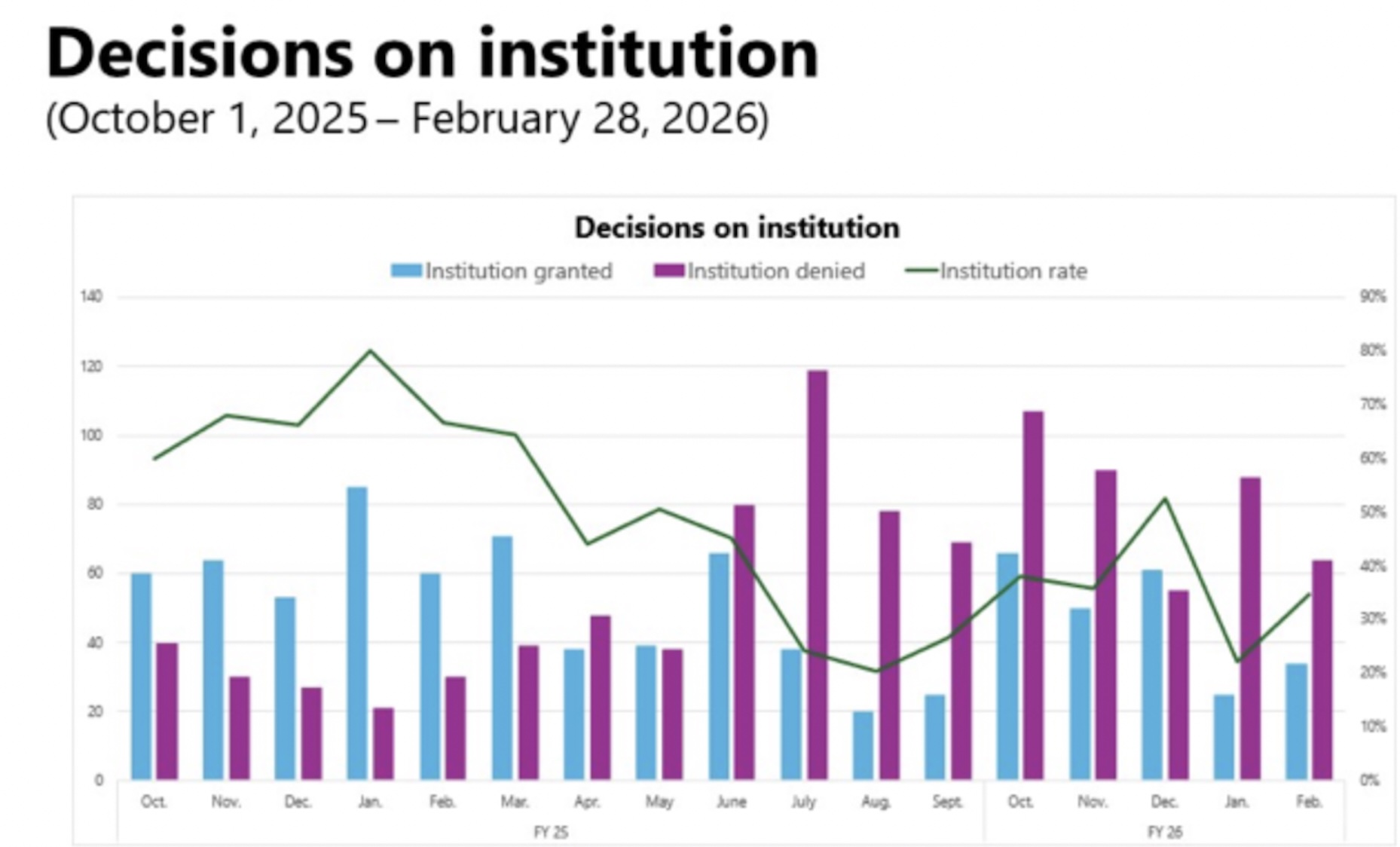
According to the USPTO’s figures (see chart below), in October 2024 the average institution rate was around 65%, whereas in February 2026 the overall institution rate was around 37%. That represents a 43% reduction in institutions.
Beginning in April 2025, the number of denials was higher than the number of grants every month except May, when it was about even, whereas prior to April 2025, the number of grants was consistently significantly higher than the number of denials.
The USPTO, under then-Acting Director Coke Morgan Stewart, first announced its interim process for PTAB workload management in March 2025. That memo said that to ensure the PTAB can continue to meet its statutory obligations relating to ex parte appeals, the Director would exercise discretion under 35 U.S.C. 314(a) and 324(a) to determine whether discretionary denial is appropriate for any IPR or post-grant review (PGR) petition.
Director John Squires then took over all IPR institution decisions in October 2025.
According to Kalyan Deshpande, PTAB Chief Administrative Patent Judge (APJ), since the March memo there have been 600 discretionary considerations decisions issued.
Acting Vice Chief Judge Stacey White shared statistics on appeal pendency, noting a “striking reduction in maximum pendency” over the last year. From an average pendency of over two years/ 28 months as of May 2025, pendency has reached just over 9 months as of April 1, 2026 (see chart below).
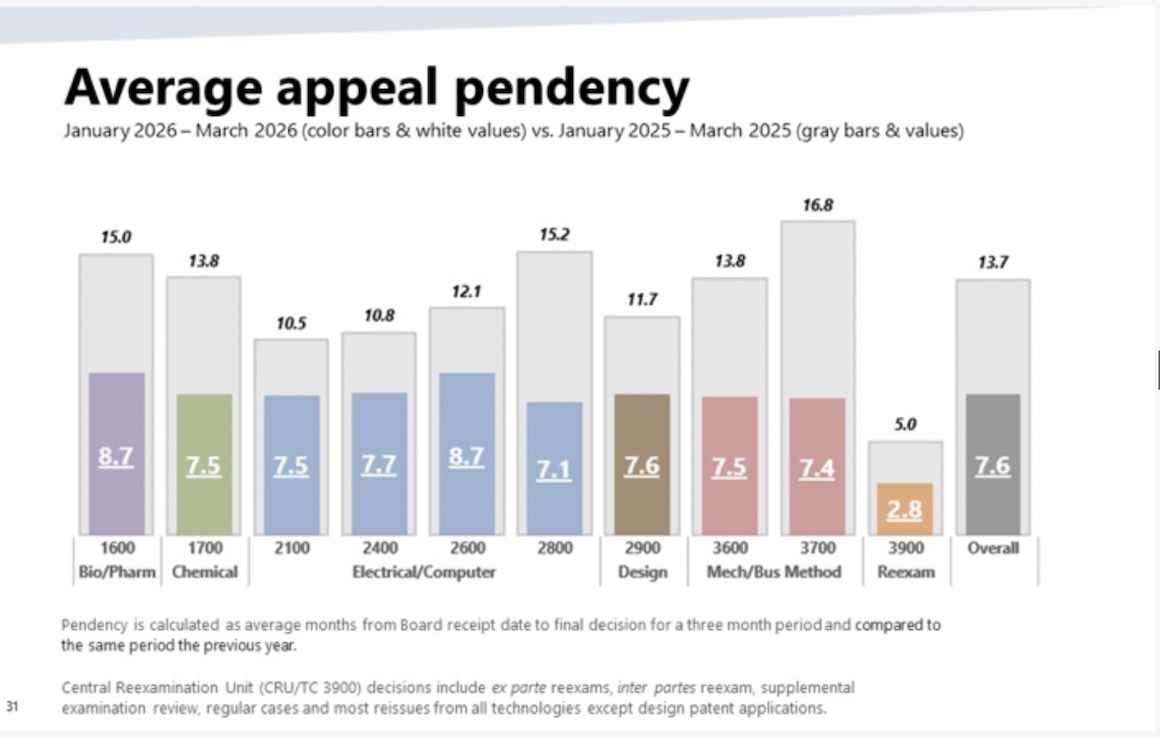
According to White, “sustained effort and disciplined case management” have driven the inventory of appeals down dramatically as well. From a highwater mark of 26,570 pending appeals in FY 2012, today the Office has only 1,866 pending appeals (as of March 31, 2026). “That’s a reduction of more than 90% from the peak,” White noted.
The panel also reviewed recent precedential and informative decisions that have changed PTAB practice, including the January 2026 informative decision in Yangtze Memory Technologies v. Micron Technology. That decision, which vacated two PTAB decisions granting IPR institution for Yangtze Memory Technologies, addressed the issue of real party in interest (RPI), which Squires said Micron had sufficiently disputed, while Yangtze failed to rebut the evidence presented and show that it had named all RPIs.
Prior to Yangtze, Squires sent a memo to all APJs at the PTAB informing them that the agency was restoring the practice of requiring petitioners to identify all RPIs prior to institution. The change was intended to address the exploitation of PTAB proceedings by foreign state-backed actors arising as an unintended consequence of less stringent RPI standards enforced by previous administrations.
In the Q&A at the end of the USPTO Hour, one question presented to the panel asked whether an RPI concern can be raised after the patent owner response has been filed. Michelle Ankenbrand, Acting Deputy Chief APJ, said it’s best to surface RPI issues “as soon as you identify them” and early in the case. “If you think there’s an RPI issue once you review a petition that’s the time when you should raise the RPI issue with the Office,” Ankenbrand said. “We’re trying to surface these issues early in a case before it gets through institution and assigned to a panel of judges,” when it becomes a more complex consideration with respect to factors such as conflicts of interest, she added.
Another questioner asked whether the Office has reviewed any discretionary briefs regarding Squires’ March 2026 memo indicating that the USPTO Director will consider additional discretionary factors for institution of IPR and PGR going forward that focus on the extent to which products involved in those proceedings are manufactured and sold in the United States.
Deshpande said that due to the timing considerations issued with the memo—which said the considerations were available to the extent the patent owner’s request for discretionary denial had not yet been filed—they have not yet seen any, but should within the next few weeks.
Ankenbrand said they have seen several requests in Director Review petitions post-institution but have generally denied them due to the memo’s effective date on those considerations. “Post-institution we’re not going to consider those discretionary considerations. The time to raise them is in Discretionary considerations briefing,” Ankenbrand said.
![[Advertisement]](https://ipwatchdog.com/wp-content/uploads/2026/09/ClaimHit-Oct-1-2026-sidebar-700x500-1.jpg)
![[Advertisement]](https://ipwatchdog.com/wp-content/uploads/2026/09/WE-BUY-PATENTS-SIM-IP-Ad-1-700x500-1.jpeg)
![[Advertisement]](https://ipwatchdog.com/wp-content/uploads/2026/09/Life-Sciences-2026-sidebar-early-bird-price-700x500-1.jpg)
![[Advertisement]](https://ipwatchdog.com/wp-content/uploads/2024/09/Patent-Prosecution-Training-sidebar-700x500-2025-03-27.jpg)







![[Advertisement]](https://ipwatchdog.com/wp-content/uploads/2021/12/WEBINAR-336-x-280-px.png)
![[Advertisement]](https://ipwatchdog.com/wp-content/uploads/2021/12/Ad-4-The-Invent-Patent-System™.png)





Join the Discussion
One comment so far.
Pro Say
April 8, 2026 10:27 pmBravo USPTO!
American innovation is on it’s way back.
Now about that CAFC problem . . .