
![[IPWatchdog Logo]](https://ipwatchdog.com/wp-content/themes/IPWatchdog%20-%202023/assets/images/temp/logo-small@2x.png)

 3
3 “My time is valuable. I can’t keep going back and forth. Be a bit more serious about what you believe is a reasonable offer.” – Caroline Pinkston, HPE at IPWatchdog LIVE
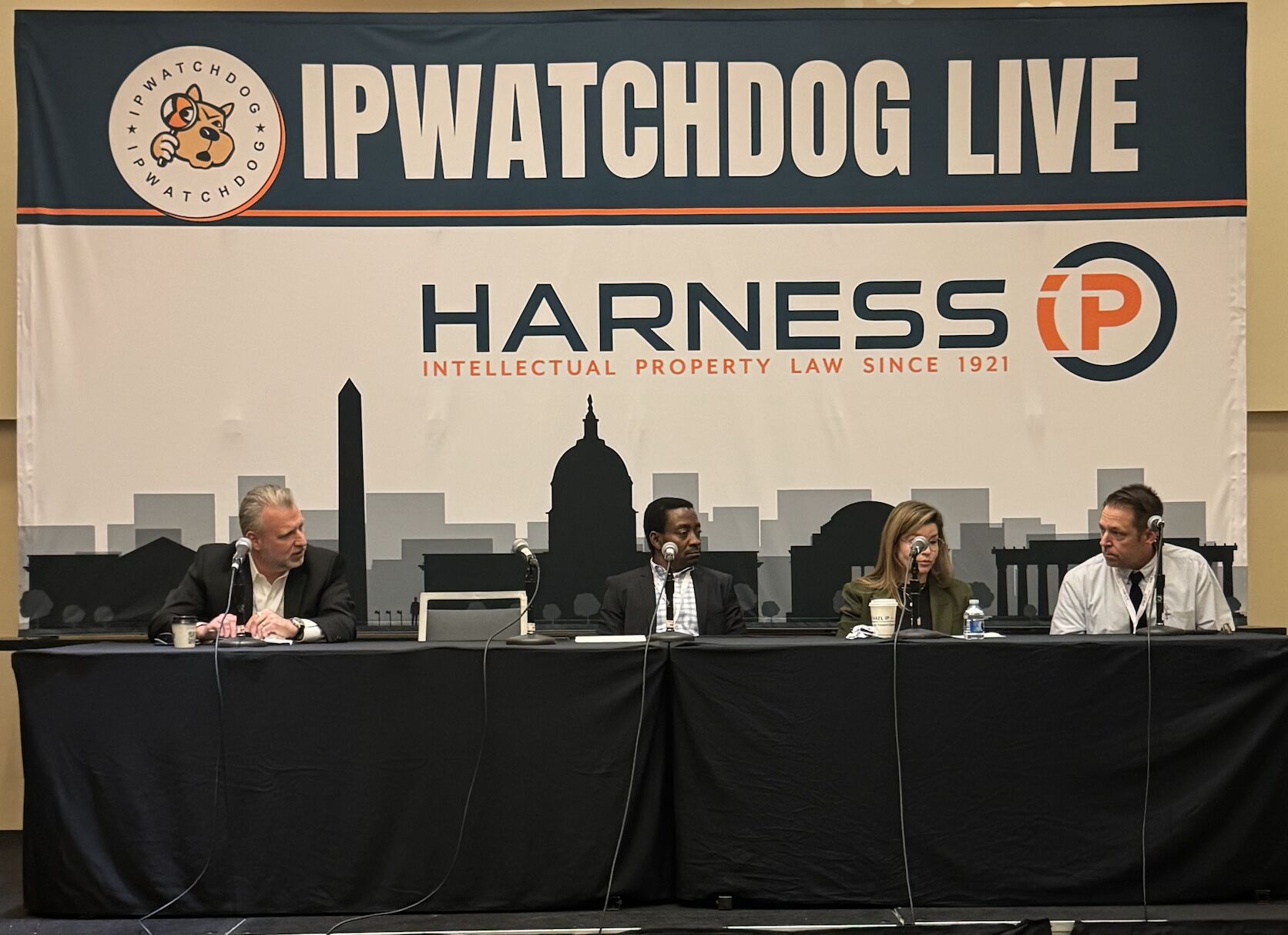 A panel on day three of IPWatchdog LIVE 2026 offered the IP community a candid look at how large operating companies actually evaluate and respond to patent assertions. The answers carry direct implications for every practitioner advising clients on the sell side of a transaction.
The session, titled The Big Tech View on Patents and the Patent Market, featured Russell Binns (Allied Security Trust (AST)), Ola Adekunle (Google), Caroline Pinkston (Hewlett Packard Enterprise (HPE)), and Dean Geibel (Samtec). Together, they represent the demand side of the patent market, and their collective message was direct: the market is active, buyers are disciplined, and the criteria for getting a deal done have been sharpened considerably in recent years.
Defense First
The threshold orientation every IP practitioner needs to internalize before advising a client on outbound licensing is this: large operating companies are not trying to make money from patent licensing. They are trying to prevent losing money to it.
“For us, it’s mostly defensive,” Adekunle said of Google’s approach. “It also protects our differentiators.” Google licensed over 25,000 patents in 2025, not to generate revenue, but to reduce risk exposure across its technology stack. The company has simultaneously scaled back proactive acquisitions. “We will not be proactive about purchasing patents,” Adekunle stated. HPE uses a similar policy, “We’ve invested a lot into R&D, and we look at patents to protect those interests,” said Pinkston. The operative threshold is whether the asset protects a specific revenue stream.
The 93% Statistic and the NPE Disposition Problem
“93% of patent litigation by technology companies involves patents transacted in the secondary market,” said Binns. That number reframes the portfolio disposition question entirely.
Geibel made the downstream risk concrete from Samtec’s perspective. The company strategically holds patents it is not actively using, “I don’t want to sell a patent family for $100,000 and lose $30 million in business,” Geibel said. When a non-practicing entity (NPE) chooses to assert an acquired patent, the most accessible targets are often the customers of the company that sold it. “We have patents we’re not using. If you sell them to an NPE, who are they going to assert them against? We can’t have NPEs suing our customers.”
The short-term transaction value of a patent sale can be structurally incompatible with a client’s long-term commercial interests. Secondary market transactions do not simply transfer assets. They change the litigation risk profile for everyone downstream.
Licensing as Competitive Architecture
Geibel offered a patent licensing model built not around revenue generation or assertion avoidance, but around supply chain architecture.
Samtec licenses its proprietary technology to direct competitors by design. A single-source dependency is commercially unacceptable to large purchasers, and Samtec’s ability to satisfy that requirement depends on its capacity to license a competitor as a second source. “Without IP, we wouldn’t be able to do that,” said Geibel. The competitor selected for licensing is chosen with precision, capable of qualifying as an alternative source but not scaled to displace Samtec’s primary position.
Samtec’s approach demonstrates how a well-structured licensing agreement with a competitor can simultaneously preserve a key customer relationship and protect market position.
What Gets a Deal Done, and What Ends It Immediately
Claim charts work. Binns was unequivocal: “Claim charts do actually help, even bad claim charts.” A claim chart that maps patent claims to the target’s product line is a low-cost, high-signal investment. Adekunle identified a related threshold: “EOUs are a great way to get my attention.” Well-constructed evidence of use (EOU) analysis demonstrates that the patent owner has mapped claims to actual products with specificity, and signals credibility to in-house counsel who are flooded with inquiries from parties who have done no such work.
Unrealistic pricing terminates engagement immediately. “My time is valuable. I can’t keep going back and forth. Be a bit more serious about what you believe is a reasonable offer,” was Pinkston’s advice. HPE’s minimum threshold for consideration is $1 million. Anything below that does not justify the internal transaction cost. Assets priced unrealistically “go on the back burner,” she added.
Business alignment. Pinkston also articulated an internal approval dynamic that can’t be overlooked. A technically sound asset at a reasonable price still fails if the business unit will not fund it. “If it’s not one the business is willing to foot the money for, the answer is no,” she said. Internal buy-in is not a downstream formality.
Assertion Triage and the Litigation Funding Variable
The panel expressed a unanimous preference for resolving patent assertions before they reach patent litigation. Litigation is “a waste of time and treasure,” according to Geibel. Pinkston applies a two-factor triage to every incoming assertion: how serious is the threat, and how much will it cost to litigate? “You start looking for alternatives, because you don’t want to have to go to the business unit to say there’s a serious threat,” she said. A negotiated licensing agreement is not just commercially preferable; it’s organizationally cleaner than presenting an internal stakeholder with a litigation budget request tied to an acknowledged serious threat. Adekunle said, “We prefer not to litigate, but when negotiation starts to break down, that’s when I give litigation a heads-up.”
Third-party litigation funding disrupts this dynamic entirely and in both directions. “If there’s a third-party funder, they just go straight to litigation,” Adekunle observed. The negotiation window that both Adekunle and Pinkston described as their preferred path narrows or closes when a funder is involved. Pinkston added the reciprocal effect: “If I know it’s funded by a third party, I may have to take it more seriously than I otherwise would.” Litigation finance makes enforcement credible. It also signals to the defendant that the negotiation phase may be bypassed entirely.
![[Advertisement]](https://ipwatchdog.com/wp-content/uploads/2026/08/Anaqua-Aug-25-2026-sidebar-700x500-1.jpg)
![[Advertisement]](https://ipwatchdog.com/wp-content/uploads/2026/08/Solve-Intelligence-Aug-27-2026-sidebar-700x500-rev1.jpg)
![[Advertisement]](https://ipwatchdog.com/wp-content/uploads/2026/07/Womens-IP-Forum-2026-sidebar-register-early-bird-now-700x500-1.jpg)
![[Advertisement]](https://ipwatchdog.com/wp-content/uploads/2026/07/Juristat-Varsity-Ad-2026-IPW-ad-Solo_1.png)
![[Advertisement]](https://ipwatchdog.com/wp-content/uploads/2026/08/OneTransform_700x500_v1.png)
![[Advertisement]](https://ipwatchdog.com/wp-content/uploads/2024/09/Patent-Prosecution-Training-sidebar-700x500-2025-03-27.jpg)



![[Advertisement]](https://ipwatchdog.com/wp-content/uploads/2021/12/WEBINAR-336-x-280-px.png)
![[Advertisement]](https://ipwatchdog.com/wp-content/uploads/2021/12/Ad-4-The-Invent-Patent-System™.png)




Join the Discussion
3 comments so far.
Sally Jones
March 31, 2026 12:37 pmFind an investor. Sign a NDA that says it is only your idea and Patent. No different from an illegal shell company, only this is legal.
Blue Lake
March 27, 2026 01:28 pmThis is a comment from an engineer with close to 5 decades of expert witness work in licensing and infringement litigation. This is how I often see independent inventors and small companies treated. Start with an independent inventor with a proven track record of inventing successful products and licensing 3rd party manufacturers, as well as successful infringement litigation. The inventor personally contacts a large corporation with a portfolio of a half dozen patents to talk about licensing a new widget. No response. Later, sales people at the large corporation see the independent inventor’s new widget at a trade show when their competitor introduces a new product. The sales people tell the large corporation engineers that the widget needs to be added to their new product. A couple of years later, the inventor again contacts the large corporation with claim charts, as well as an estimate of the annual (now infringing) sales. The inventor requests a meeting with the business people of the involved division to discuss a license. The in house counsel responds with a ‘we don’t infringe, your patents are invalid and we’ll file for an IPR’ attitude. The in house counsel refuses to arrange a meeting with the business people, or the inside counsel staff and doesn’t even bother to ask the inventor what they want.
Where will this now willful infringement matter will end up? Did the independent inventor make the second contact without having a litigation law firm and litigation financing at the ready? Did the in house counsel even bother to inform his business people of their infringement problem? Does the large corporation even have a risk management department? Or, is efficient infringement a company policy? From my viewpoint, that is why so many litigation finance backed infringement suits get filed by individual inventors.
I also have witnessed several instances where the accused infringer was willing to bring the business people to a meeting, litigation was avoided and everybody walked away happy. I don’t personally know of any independent inventor that particularly likes to go to litigation and pay huge percentages of any recovery to the funding companies and attorneys.
IP Nerd
March 27, 2026 08:59 amIndependent inventors who are pursuing the idea for the satisfaction of making an effort are often thrilled just to recoup costs once they are a few years down the patent promotion journey. You must ask yourself is your goal to make a tiny profit or see the product in the market place? Obviously the dream is not have to make that choice but if you are two to five years into the process without a profitable offer merely recouping funds could be seen as a new definition of a “win”. Getting your expiring patent rights shelved by a bigger player is often better than your rights expiring with zero revenue captured per claim granted.