
![[IPWatchdog Logo]](https://ipwatchdog.com/wp-content/themes/IPWatchdog%20-%202023/assets/images/temp/logo-small@2x.png)

 0
0 “Congress… evidently viewed that prospect [of off-label, patented uses] as an acceptable cost of expedited competition with respect to lawful unpatented uses.” – U.S. Solicitor General
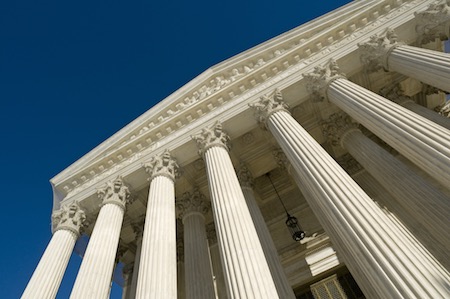 On Friday, the U.S. Supreme Court granted certiorari to a petition filed by patent owner Hikma Pharmaceuticals, taking up Hikma’s appeal of the U.S. Court of Appeals for the Federal Circuit’s ruling from June 2024 finding that Amarin Pharma plausibly alleged patent infringement against Hikma’s generic omega-3 fatty acid product. The decision indicates that the nation’s highest court may be willing to overturn the Federal Circuit’s finding that Hikma’s U.S. Food & Drug Administration (FDA) -approved skinny label induced infringement in light of Hikma’s public statements about its generic product.
Hikma Pharmaceuticals filed a petition for writ last February presenting two questions: whether a drugmaker calling its product a “generic version” while citing public sales information about the branded drug induces infringement of a patented use fully carved out by the generic’s label; and whether a complaint states an induced infringement claim if it doesn’t allege any instruction or statement by the defendant mentioning the patented use. Last June, the Supreme Court invited the U.S. Solicitor General to file a brief reflecting the views of the U.S. government in the case.
Hikma Reply Brief: No Plausible Allegations Made to Cure Pre-Twombly Pleading Standard
In early June, Hikma filed a reply brief faulting the Federal Circuit for eviscerating the requirement that an alleged infringer must induce all steps of a method patent claim to be liable for infringement under 35 U.S.C. § 271(b). Such active inducement is not found in calling its version a “generic equivalent” of Vascepa or a label’s indication that the generic can be prescribed for noninfringing uses, Hikma argued. Amarin’s passive inducement theory, under which physicians prescribe Hikma’s generic for patented uses because of their knowledge of Vascepa’s uses, departs from Supreme Court precedent in MGM v. Grokster (2005) which required active steps to induce infringement.
The Federal Circuit’s decision flouts the Supreme Court’s pleading standard by quoting the pre-Twombly “no-set-of-facts” standard while opening defendants to the threat of costly discovery, Hikma’s argued. The Federal Circuit’s treatment of inducement as a question of fact that shouldn’t be resolved on a motion to dismiss conflicts with the Ninth Circuit, where inducement is a legal determination that can be dismissed if no affirmative acts by the defendant are alleged under cases like Perfect 10 v. Visa (2007).
U.S. Solicitor General: Statements Subjects to Regulatory Scheme Cannot Support Inducement Liability
The U.S. Solicitor General’s brief reframed Hikma’s question presented as: “Whether respondents’ complaint plausibly alleged that petitioners had actively induced infringement of respondents’ patents claiming the carved-out uses.” In enacting Hatch-Waxman, “Congress presumably understood” that some off-label, patented uses of generic drugs would occur and “evidently viewed that prospect as an acceptable cost of expedited competition with respect to lawful unpatented uses,” the Solicitor General argued. Opening Hikma to massive liability due to statements it made to use the Section viii pathway for U.S. Food & Drug Administration (FDA) approval of its generic subverts Congressional intent and creates uncertainty deterring drugmakers from invoking Section viii.
While doctors and pharmacists possess knowledge on medicines that most lay people lack, Hikma’s statements cannot show culpability for induced infringement, the Solicitor General contended. First, Hikma’s FDA-approved skinny label does not reflect the drugmaker’s unencumbered choices but are rather subject to statutory requirements and FDA approval. Second, Hikma’s public statements on the generic equivalency of its product are essential to the Hatch-Waxman scheme and do not mention the patented method of treating patients with hypertriglyceridemia. Finally, while Hikma’s use of data on total Vascepa sales is not necessary under the Hatch-Waxman scheme, those statements were directed to investors and not medical professionals. Further, Amarin offered no allegations creating a further causal connection between the press release and acts of direct infringement.
This case’s motion to dismiss posture and Amarin’s narrow, uncomplicated pleading makes this case an appropriate vehicle to ensure that the Section viii pathway is operating properly and saving American consumers billions of dollars on pharmaceutical costs, the Solicitor General stated. If Amarin’s allegations survive dismissal, the high cost of discovery would force Hikma and most generic drugmakers to settle, especially given Federal Circuit precedent on lost profits for every infringing sale of a generic drug from GlaxoSmithKline v. Teva (2021).
Amarin’s Supplemental Brief: No Section Viii Exodus Despite Government’s Fears
In late December, respondent Amarin filed a supplemental brief suggesting that the Solicitor General’s reformulation of the question presented showed that there was no meaningful legal dispute at issue but rather a fact-based question over the application of established law. Many of the government’s policy concerns echoed those raised by the Solicitor General’s unsuccessful briefing on Teva’s cert petition appealing GlaxoSmithKline, and Amarin noted that there has been no mass exodus from the Section viii pathway.
Granting review would have “virtually no practical application,” Amarin contended, because it would be entitled to amend its complaint with additional facts supporting infringement liability. Amarin said that the Solicitor General’s brief agrees with the Federal Circuit’s inducement standard and that the government disregarded important aspects of Hikma’s broad marketing campaign, including Hikma’s website listing its generic in a category marked “hypertriglyceridemia” and Hikma’s failure to identify limitations to its FDA approval. Amarin argued that the Solicitor General’s challenge to the adequacy of Amarin culpable intent allegations was unpersuasive as Hikma’s petition only challenges the requirement of showing active steps to induce infringement from Grokster.
The same day that Amarin filed its supplemental brief, counsel for Hikma filed a letter with the Supreme Court noting that Amarin’s complaint in this case was dismissed with prejudice by the District of Delaware. This undercut Amarin’s own characterization of the appeal as interlocutory with the possibility of remand with leave to amend its complaint.
![[Advertisement]](https://ipwatchdog.com/wp-content/uploads/2026/01/IP-Author-Jan-22-2026-sidebar-700x500-1.jpg)
![[Advertisement]](https://ipwatchdog.com/wp-content/uploads/2025/12/ClearstoneIP-Jan-27-2026-sidebar-700x500-1.jpg)
![[Advertisement]](https://ipwatchdog.com/wp-content/uploads/2025/11/PTAB-Masters-2026-sidebar-regular-price-700x500-1.jpg)
![[Advertisement]](https://ipwatchdog.com/wp-content/uploads/2025/12/LIVE-2026-sidebar-early-bird-new-700x500-1.jpg)





![[Advertisement]](https://ipwatchdog.com/wp-content/uploads/2021/12/WEBINAR-336-x-280-px.png)
![[Advertisement]](https://ipwatchdog.com/wp-content/uploads/2021/12/Ad-4-The-Invent-Patent-System™.png)


Join the Discussion
No comments yet. Add my comment.
Add Comment