
![[IPWatchdog Logo]](https://ipwatchdog.com/wp-content/themes/IPWatchdog%20-%202023/assets/images/temp/logo-small@2x.png)
 0
0 “Copyright law…does not protect the facts set forth in a work, so a defendant is not liable for copying them.” – Ninth Circuit
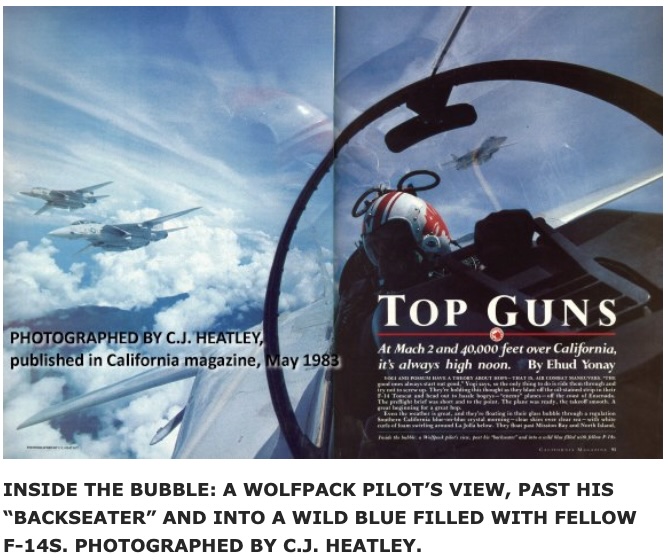
Image source: https://www.topgunbio.com/top-guns-by-ehud-yonay/
The U.S. Court of Appeals for the Ninth Circuit on Friday affirmed a district court’s grant of summary judgment in favor of Paramount Pictures Corporation in a copyright and contract dispute brought by the heirs of the author of the 1983 magazine article that inspired the original Top Gun film.
Shosh Yonay and Yuval Yonay, the widow and son of Ehud Yonay, first brought claims against Paramount in 2022, alleging that the sequel Top Gun: Maverick infringed on the copyright of Ehud Yonay’s article, “Top Guns.” The U.S. District Court for the Central District of California in 2024 granted summary judgment for Paramount, agreeing that Maverick did not share “substantial amounts of the article’s original expression and that the depicted pilots and their experiences were factual and therefore unprotected by copyright law. The court also affirmed that Paramount did not breach its 1983 agreement with Ehud Yonay.
The dispute centered on the 11-page article published in California Magazine in 1983, which vividly described the experiences of Navy fighter pilots at the United States Navy Fighter Weapons School, popularly known as “Top Gun.” Following the article’s publication, Ehud Yonay granted Paramount all rights to the work, leading to the 1986 release of Top Gun. In 2020, the Yonays terminated the copyright grant by invoking 17 U.S.C. § 203(a)(3), which allows an author’s heirs to terminate certain grants. After Paramount released the sequel in 2022 without crediting or compensating the Yonays, they filed suit for copyright infringement and breach of contract.
The Ninth Circuit began by noting that to establish copyright infringement, Shosh Yonay and Yuval Yonay had to show that Paramount copied original aspects of the work. The court explained that copyright protection does not “extend to any idea, procedure, process, system, method of operation, concept, principle, or discovery,” regardless of its form. The court further emphasized that “copyright law also does not protect the facts set forth in a work, so a defendant is not liable for copying them.”
The district court applied the “extrinsic test,” which assesses the objective similarities between the works’ plot, themes, dialogue, mood, setting, pace, characters, and sequence of events. The Ninth Circuit agreed with the district court’s conclusion that Shosh Yonay and Yuval Yonay failed to show “meaningful similarities” in any of these categories. The court observed that while “Top Guns” contains original expression, such as its “vivid phrasing and innovative structure,” none of that expression appeared in Top Gun: Maverick.
The Ninth Circuit found that the similarities identified by Shosh Yonay and Yuval Yonay were described at such a high level of abstraction that they did not involve protected expression. For example, the court noted that while both works feature the Top Gun program and various graduates, “Top Gun is a real fighter pilot school and the graduates and instructors mentioned in the Article are real people.” The court stated that these factual elements are not protected by copyright law. Furthermore, the court found that similarities based on pilots landing on an aircraft carrier or carousing at a bar constituted “unprotected facts, familiar stock scenes, or scènes à faire.”
The court also addressed the Yonays’ argument regarding the “selection and arrangement” of elements. Under this theory, a work may be infringing if it shares the “particular way in which the artistic elements form a coherent pattern, synthesis, or design.” However, the Ninth Circuit concluded that Shosh Yonay and Yuval Yonay did not establish an original and protectable selection and arrangement, as the elements they identified were either unprotectable facts or general plot ideas.
Regarding the exclusion of expert testimony, the Ninth Circuit found no abuse of discretion in the district court’s decision to exclude the Yonays’ literary expert, Henry Bean. The district court had found that Bean failed to filter out the unprotected elements of the article, rendering his opinions “unhelpful and inadmissible.” Conversely, the court allowed Paramount’s expert, Andrew Craig, a former Top Gun instructor, to testify about the factual accuracy of the article to help the factfinder filter out unprotected elements.
On the breach of contract claim, the Ninth Circuit construed the 1983 agreement to require credit only if the movie was “produced by [Paramount] hereunder” and “substantially based upon or adapted from” the article. The court held that because Top Gun: Maverick did not infringe the copyright, it was not produced using the rights conferred by the agreement. Since both conditions were joined by the word “and,” the failure of the first condition meant Paramount was not required to credit Ehud Yonay.
![[Advertisement]](https://ipwatchdog.com/wp-content/uploads/2026/10/IP-Copilot-Oct-13-2026-sidebar-700x500-1.jpg)
![[Advertisement]](https://ipwatchdog.com/wp-content/uploads/2026/10/Junior-Oct-15-2026-sidebar-700x500-1.jpg)
![[Advertisement]](https://ipwatchdog.com/wp-content/uploads/2026/10/BlackBox-IP-Oct-20-2026-sidebar-700x500-1.jpg)
![[Advertisement]](https://ipwatchdog.com/wp-content/uploads/2026/09/WE-BUY-PATENTS-SIM-IP-Ad-1-revised-on-Sep-28-2026-700x500-1.jpg)
![[Advertisement]](https://ipwatchdog.com/wp-content/uploads/2026/09/Life-Sciences-2026-sidebar-early-bird-date-corrected-700x500-1.jpg)
![[Advertisement]](https://ipwatchdog.com/wp-content/uploads/2024/09/Patent-Prosecution-Training-sidebar-700x500-2025-03-27.jpg)





![[Advertisement]](https://ipwatchdog.com/wp-content/uploads/2021/12/WEBINAR-336-x-280-px.png)
![[Advertisement]](https://ipwatchdog.com/wp-content/uploads/2021/12/Ad-4-The-Invent-Patent-System™.png)





Join the Discussion
No comments yet.