
![[IPWatchdog Logo]](https://ipwatchdog.com/wp-content/themes/IPWatchdog%20-%202023/assets/images/temp/logo-small@2x.png)

 0
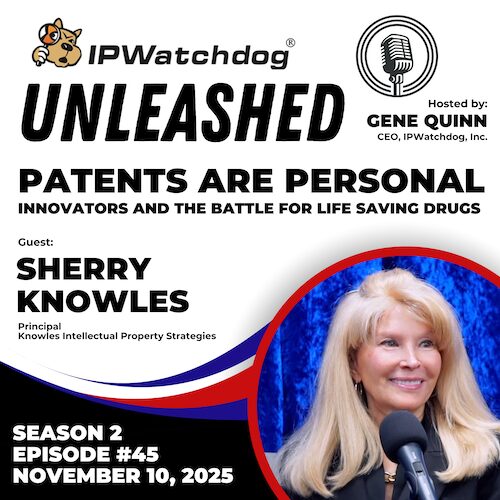
0 In our latest IPWatchdog Unleashed podcast, we had a riveting and sometimes emotional conversation that unfolded around one of the most pressing issues in life sciences today: the journey of life-saving drugs from laboratory to patient. We discuss the pivotal role a strong patent system plays in this important journey with guest Sherry Knowles. Sherry is the founder of Knowles Intellectual Property Strategies and former Senior Vice President and Chief Patent Counsel for GlaxoSmithKline. In addition to being one of the leading voices in the life sciences and patent industries, Sherry is also a cancer survivor. Among other things, we discuss numerous patent system challenges facing innovator drug companies, the downward pressure generic drugs place on the industry and leading to important drugs becoming unavailable, the role of Pharmacy Benefit Managers (PBMs) with respect to significantly raising the cost of drugs for Americans, and policy influences and legislation on Capitol Hill. Sherry also shares her personal story and insights into why patents are more than just legal constructs—they are deeply personal lifelines.
A Life-Saving Journey: The Power of Patents
Sherry opened up about her battle with breast cancer—she was diagnosed with cancer 20 years ago and after successful treatment has been in remission ever since. She shared her gripping story, moving beyond the statistics and into defining her personal struggle and triumph, having undergone extensive chemotherapy and being prescribed numerous drugs along the way. “These drugs saved my life,” she said, crediting innovative treatments like Adriamycin, Cyclophosphamide, Taxol, and Herceptin. These aren’t just names on a pill bottle, she explained, they are testaments to the perseverance and triumph of scientific discovery and it was because of the protection of patents that the innovator companies could invest in these miraculous drugs and bring them to market to benefit patients.
As Sherry so vividly puts it, “Patents are personal.” To her and many others, they represent the tireless efforts of small teams dedicated to changing lives. Whether it’s a groundbreaking antibiotic or a new cancer treatment, behind every innovation lies a story of determination and hope. She highlighted the need to understand who the inventors are and appreciate the personal link they have to improving lives through their work.
Lifecycle of a Generic Drug
We also discuss the role generic drugs play, and perhaps more significantly the gaps generic manufacturers leave. All too often policy makers have adopted generic friendly patent policies because they want to champion cheaper prices, but generic drugs are not the panacea that so many believe them to be.
Yes, when generic drugs exist, they are significantly cheaper, but there is no requirement for the generic to be identical to the tested and approved innovator brand name drug, so they aren’t. This is why they often will not work for some patients. And unfortunately, just because a brand name falls off patent does not mean it will be available as a generic now or into the future.
The Food and Drug Administration (FDA) has a list of generic drugs that are in critically low supply. There generic graveyard exists because of the race to the bottom to cut prices lower and lower, pushing prices lower than any rationale business can justify the decision to sell. With generic manufacturers being the truest of capitalists they copy only the most successful drugs—those drugs where they can make money. But by the time prices for generics crater the innovators have long moved on because they can’t make anything competing against generics. And then when prices get too low the generics similarly leave the market, which makes the drugs unavailable at any price. Indeed, there are 89 generic drugs that the FDA identifies as being in critically low supply; 24 are antibiotics and 21 are oncology drugs.
Challenges Within the Patent System
 Our discussion also touched on critical issues surrounding the patent system’s current state, particularly in pharmaceuticals. Sherry drew attention to the judicial spread and the dangers of allowing legal interpretations to deviate from foundational statutes and constitutional intent. She emphasized how legislative hurdles like patent eligibility standards have become significant obstacles, potentially stifling innovation.
The conversation shifted towards legislative actions like the Patent Eligibility Restoration Act (PERA), aiming to address unconstitutional judicial rulings that hinder pharmaceutical innovation. Sherry expressed concern over the indirect ratification of unestablished legal doctrines, which could further complicate the patent landscape for life sciences.
She particularly pointed to the so-called judicially created non-statutory doctrine of obviousness type double patenting. Obviousness type double patenting has been a frequent target for Sherry over the years, with her publishing a number of articles on IPWatchdog variously explaining why it is unconstitutional and why it wreaks havoc for innovators. It comes up here and now as a part of our conversation about patent eligibility because the latest additions to PERA include a section that says nothing in the bill is intended to have any impact on obviousness type double patenting. Our sources tell us this was added because a Senator raised a question about whether PERA would impact obviousness type double patenting, so the thought was to simply say that the bill has nothing to do with and no effect on obviousness type double patenting. As Sherry and I discuss, however, and every litigator knows, if PERA passes with that statement it will be argued that Congress knows of and implicitly ratifies the existence of this judicially created non-statutory doctrine.
The Broader Implication
The conversation with Sherry laid bare the profound consequences of patent policies, not just for inventors but for society at large. The discussion underscored how essential it is for the U.S. to maintain a robust patent system, not only to safeguard economic interests but to continue leading in global healthcare innovations.
The discussion drove home an urgent call to action: tell these personal stories on Capitol Hill. Sherry’s call to recognize and share the human impact behind patents is more critical than ever. She emphasizes that narratives like hers—woven from personal triumphs and professional insights—have the power to shift debates in favor of stronger patent protections.
Final Thoughts
These narratives aren’t just about policy; they’re about life. Listening to Sherry recount her experiences with both gratitude and urgency serves as a powerful reminder of what’s at stake. The battle for a fair and effective patent system is one fought for every individual who has ever relied on a lifesaving drug, and for every researcher whose work holds the promise of new medical breakthroughs.
The voice of the life sciences community, enriched by personal accounts like Sherry’s, must be amplified. Her story—and that of countless others—illustrates why we must strive tirelessly to protect and enhance our patent system; because behind every patent lies a life, a journey, and the ever-persistent hope for a healthier future.
More IPWatchdog Unleashed
You can listen to the entire podcast episode by downloading it wherever you normally access podcasts or by visiting IPWatchdog Unleashed on Buzzsprout. You can also watch IPWatchdog Unleashed conversations on the IPWatchdog YouTube channel. For more IPWatchdog Unleashed, see below for our growing archive of previous episodes.
![[Advertisement]](https://ipwatchdog.com/wp-content/uploads/2026/04/ClearstoneIP-May-14-2026-sidebar-700x500-1.jpg)
![[Advertisement]](https://ipwatchdog.com/wp-content/uploads/2026/04/Virtual-AI-2026-May-18-19-2026-sidebar-700x500-1.jpg)
![[Advertisement]](https://ipwatchdog.com/wp-content/uploads/2026/05/Patent-Masters-2026-sidebar-early-bird-price-700x500-1.jpg)



![[Advertisement]](https://ipwatchdog.com/wp-content/uploads/2021/12/WEBINAR-336-x-280-px.png)
![[Advertisement]](https://ipwatchdog.com/wp-content/uploads/2021/12/Ad-4-The-Invent-Patent-System™.png)





Join the Discussion
No comments yet.