
![[IPWatchdog Logo]](https://ipwatchdog.com/wp-content/themes/IPWatchdog%20-%202023/assets/images/temp/logo-small@2x.png)

 1
1 “If you’re sitting on a large patent estate, you’ve got a choice: treat it as a sleeping asset or activate it as a financial lever.”
 Over the past year, I’ve been in dozens of boardrooms where the same question keeps resurfacing: What are we missing in monetizing our intellectual property (IP) assets? The answer may surprise you—it’s no longer just licensing. It’s private equity.
We’re witnessing an unprecedented wave of private equity (PE) attention directed toward patent portfolios. What was once a niche curiosity has turned into strategic financial engineering. IAM recently reported that every nine-figure patent package marketed in the past 24 months received PE bids. The implication is loud and clear: patents are no longer merely legal assets—they’re investable, yield-generating financial products.
Why PE Funds Want Patents—Now
So, what’s attracting PE funds to IP like moths to a flame?
Let’s look at the financial DNA of patents. Royalty streams and litigation outcomes don’t follow the same market cycles as traditional investments. That uncorrelated return is gold in today’s economic environment. Add in their inflation-protected value, sectoral convergence across AI, semiconductors, and telecom, and the $2.6 trillion capital overhang reported by Preqin in Q1 2025, and the fit is perfect.
From a corporate perspective, this creates a quiet exit ramp for non-core intellectual property. Offload what no longer aligns with your innovation trajectory without flashing it on a public auction block.
In my advisory work, I’ve seen this strategy allow global companies to recycle capital and double down on future bets without diluting control or signaling distress.
Emerging Deal Structures: Beyond Simple Sales
Here’s where things get interesting. The structures emerging today are anything but one-size-fits-all.
- Outright Sales can generate headline-grabbing numbers (like BlackBerry’s $900 million portfolio divestiture).
- Spin-Outs with Retained Upside give you optionality—a minority equity stake in a monetization vehicle, plus use rights.
- IP-backed credit or Convertible Debt offers non-dilutive liquidity, which is ideal when you’re trying to preserve equity for innovation investments.
- Litigation-Finance Vehicles de-risk assertion while letting you share in the upside.
- Platform Strategies—such as VSS Capital’s acquisition of Lumenci—highlight how funds are building the full monetisation stack, not just buying assets.
Each of these options opens a different kind of door, and knowing which door leads to long-term value is what separates savvy IP owners from those chasing short-term relief.
Opportunity Matrix: What’s in it for Patent-Rich Enterprises?
Whether you’re a CTO, IP counsel, or strategy head, this movement isn’t about liquidating IP—it’s about activating it for growth and innovation.
Done right, PE-backed deals can:
- Inject liquidity to fund innovation or strengthen the balance sheet.
- Transfer enforcement and maintenance risks without losing visibility.
- Signal hidden value to investors and stakeholders.
But the devil is in the details. Mispricing today can mean giving away your future upside. Broad assignments can also come back to bite if freedom-to-operate or customer relationships are compromised.
I’ve seen corporations leave value on the table simply because they didn’t set license-back clauses or missed reversion triggers. That’s where experience and foresight matter.
Before You Engage: Due Diligence Isn’t Optional
PE buyers expect IPO-level diligence rigor. That means:
- Segmenting your portfolio to isolate monetizable vs. defensive assets.
- Using forward-citation analysis to highlight infringement exposure in high-growth sectors (think: Gen-AI, sustainability tech, 5G).
- Scrubbing legal hygiene to avoid last-minute erosion.
- Staying ahead of regulatory shifts, like UPC interpretations and US IPR case law trends.
- Negotiating control terms to prevent exit routes into adversarial hands.
Diligent preparation can surface both red flags and hidden opportunities—and help ensure the deal structure supports your strategic intent.
Implementation Roadmap: From Exploration to Execution
Even with momentum, timelines still matter. A structured roadmap helps maintain discipline:
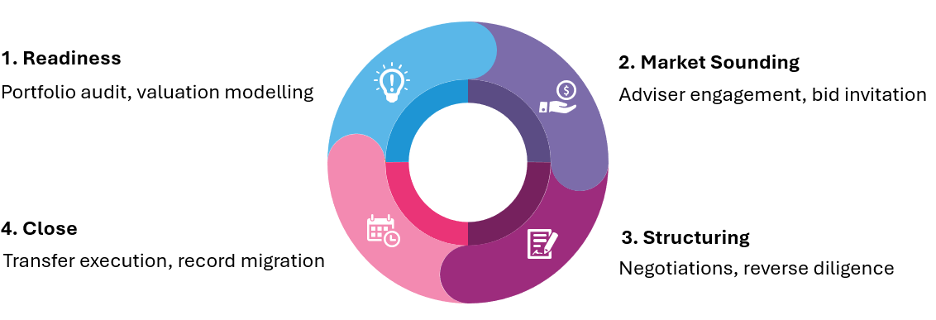
If you’re just getting started, consider piloting with a non-core subset of patents. It allows you to test governance, value models, and partner alignment without overcommitting.
Final Takeaways: Patents as Strategic Financial Assets
Private equity is no longer testing the waters—it’s diving in. And if you’re sitting on a large patent estate, you’ve got a choice: treat it as a sleeping asset or activate it as a financial lever. So, to sum up:
- View PE funds as collaborators—their capital stack can be tailored to your objectives.
- Keep one hand on the wheel—structured royalties and retained rights give you continued upside.
- Don’t cut corners on prep—PE funds do public-market-grade diligence.
- Start small, scale fast—pilot deals help institutionalize new governance and financial models.
![[Advertisement]](https://ipwatchdog.com/wp-content/uploads/2026/09/Patently-Sep-22-2026-sidebar-700x500-1.jpg)
![[Advertisement]](https://ipwatchdog.com/wp-content/uploads/2026/09/Junior-Sep-29-2026-sidebar-700x500-1.jpg)
![[Advertisement]](https://ipwatchdog.com/wp-content/uploads/2026/06/Womens-IP-Forum-2026-sidebar-regular-price-700x500-rev1.jpg)
![[Advertisement]](https://ipwatchdog.com/wp-content/uploads/2026/08/OneTransform_700x500_v1-REVISED.jpg)
![[Advertisement]](https://ipwatchdog.com/wp-content/uploads/2024/09/Patent-Prosecution-Training-sidebar-700x500-2025-03-27.jpg)








![[Advertisement]](https://ipwatchdog.com/wp-content/uploads/2021/12/WEBINAR-336-x-280-px.png)
![[Advertisement]](https://ipwatchdog.com/wp-content/uploads/2021/12/Ad-4-The-Invent-Patent-System™.png)







Join the Discussion
One comment so far.
IP Nerd
July 14, 2025 10:14 am“We’re witnessing an unprecedented wave of private equity (PE) attention directed toward patent portfolios. What was once a niche curiosity has turned into strategic financial engineering.” Written by Justin Delfino
It’s a miracle! IP Nerd mysterious son of billionaire who name lineage owns a private equity firm barring his sir name conducted a decade plus long investigation on patent and IP portfolios monetizing strategies. All of sudden now demand is up. It has nothing to do with my 50,000 hours of research with over 10,000 phone and home to home reach outs surveys results on consumer habits on IP spending. It has nothing to do with solving market efficiency of reducing time to verify market demand resulting from the Line Age application code algorithm our team wrote. Couldn’t have anything to do with Blockchain technology offering superior time stamping commerce scale. It’s a miracle and Private Equity would never respond to increase consumer spending patterns through capital investment injections further validating thesis on IP Nerd utility tokens and Decentralized IP Utility tokens that is reducing Trademarks surveys costs to Pennies on the dollar as tokens are tracked and traced in real time with AI generated data.