
![[IPWatchdog Logo]](https://ipwatchdog.com/wp-content/themes/IPWatchdog%20-%202023/assets/images/temp/logo-small@2x.png)

 1
1 “The CAFC said here, the prosecution history… supported an atypical meaning for ‘consisting essentially of’ because the applicant secured allowance of the amended claims by arguing the exclusion of other active ingredients.”
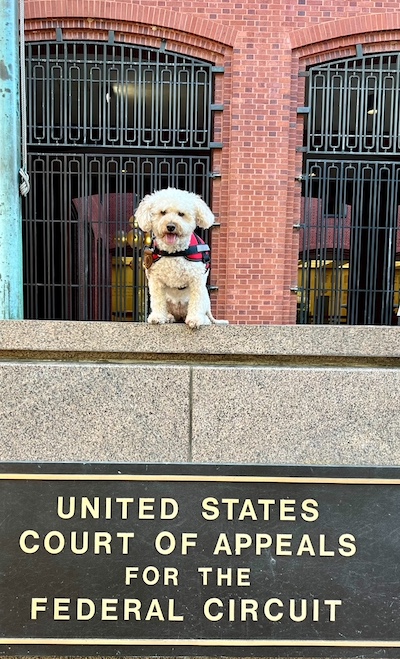
Abita is a five year old Cavapoo who belongs to Benjamin Cappel of AddyHart.
On Monday, the U.S. Court of Appeals for the Federal Circuit (CAFC) issued a precedential ruling in Eye Therapies, LLC v. Slayback Pharma, LLC, vacating an obviousness ruling by the Patent Trial and Appeal Board (PTAB) that invalidated Eye Therapies’ patent claims to methods of treating eye redness. Reviewing the relevant patent prosecution history at the U.S. Patent and Trademark Office (USPTO), the Federal Circuit found that the Board’s validity ruling was ultimately infected by an erroneous construction of the transitional phrase “consisting essentially of” in light of intrinsic evidence supporting a narrow interpretation for that disputed claim term.
Claim Amendments to Avoid Prior Art Rejection Preclude Use of Additional Ingredients
This appeal stems from inter partes review (IPR) proceedings petitioned by Slayback Pharma to challenge Eye Therapies’ U.S. Patent No. 8293742, Preferential Vasoconstriction Compositions and Methods of Use. Claim 1 of the ‘742 patent teaches “a method for reducing eye redness consisting essentially of administering brimonidine to a patient having an ocular condition,” while claim 3 discloses a similar method “consisting essentially of topically administering to a patient having an ocular condition a composition consisting essentially of brimonidine into ocular tissue.”
During prosecution of the ‘742 patent, Eye Therapies introduced the “consisting essentially of” phrase to replace the prior term “comprising,” which overcame an examiner rejection based on prior art claiming the administration of brimonidine with brinzolamide, a separate active ingredient. In allowing the amended claims, the patent examiner noted that the presently claimed methods do not require active ingredients in addition to brimonidine. Although Eye Therapies argued during IPR that the prosecution context supported a reading of “consisting essentially of” limiting the sole active ingredient to brimonidine, the PTAB concluded that the semi-open-ended claim language must have a different meaning than the closed transition phrase “consisting of,” which met Eye Therapies’ proffered construction.
In discussing Eye Therapies’ claim construction appeal, the Federal Circuit acknowledged that, while the transitional phrase “consisting essentially of” has long been understood to permit inclusion of unlisted components that don’t materially affect the invention’s basic and novel properties, a patentee can alter this typical meaning by disclaiming alternative meanings during prosecution. Here, the prosecution history for the ‘742 patent supported an atypical meaning for “consisting essentially of” because the applicant secured allowance of the amended claims by arguing the exclusion of other active ingredients, a conclusion confirmed by the examiner’s reasoning.
Statements From Prosecution History Strongly Evince Restrictive Claim Interpretation
The PTAB supported its claim construction findings by citing to the Federal Circuit’s 2009 ruling in Ecolab v. FMC Corp., in which the CAFC reviewed intrinsic evidence to determine that the patentee did not clearly disclaim additional antimicrobial agents in using the transition phrase “consists essentially of.” In that case, the specification’s disclosure of compositions including additional antimicrobial compositions was irreconcilable with the more restrictive alternative meaning for the disputed claim term advanced by the patentee.
Here, however, the Federal Circuit found its alternative conclusion to be consistent with Ecolab’s reasoning. Whereas the patent specification at issue in Ecolab included disclosures inconsistent with a narrower interpretation of the “consists essentially of” transition phrase, the intrinsic evidence of patent prosecution here “strongly evinces a restrictive meaning of ‘consists essentially of.’” While some embodiments disclosed in the ‘742 patent’s specification describe compositions containing active ingredients other than brimonidine, such embodiments were “hardly surprising” given narrowing amendments during prosecution accompanied by a clear narrowing explanation. In a footnote, the Federal Circuit stated that the Board’s reasoning that additional agents would not impact the invention’s novel characteristics was well beyond the text of the specification and did not foreclose the more restrictive meaning supported by the prosecution history.
Slayback Pharma argued that Eye Therapies only contended that its claims do not require additional active agents, not that the claims preclude their use, but the Federal Circuit rejected this under reasoning analogous to its holding in Aylus Networks v. Apple (2017). In that case, the Federal Circuit applied prosecution history estoppel to dismiss the patentee’s contention that a conceptually distinct logic was precluded from being invoked by the claimed logic. In another footnote, the CAFC noted that unmistakable disavowal through prosecution estoppel was distinguishable from statements informing claim construction, though Aylus Networks still precluded readings made unreasonable by the prosecution context.
Concluding that the Board’s erroneous construction infected its obviousness ruling, the Federal Circuit addressed the PTAB’s additional finding that a separate prior art reference suggesting additional agents do not affect brimonidine’s redness-reducing action and could thus satisfy the “consists essentially of” limitation. While cautioning that the proper claim construction could lead to the same obviousness conclusion, the Federal Circuit said that the PTAB’s fallback position still relies on a construction inconsistent with prosecution history. Having reversed the PTAB’s claim construction and vacated its final written decision, the Federal Circuit remanded the case for further proceedings consistent with the construction it provided.
![[Advertisement]](https://ipwatchdog.com/wp-content/uploads/2026/03/NLPatent-Apr-2-2026-sidebar-700x500-1.jpg)
![[Advertisement]](https://ipwatchdog.com/wp-content/uploads/2026/02/Junior-Apr-7-2026-sidebar-700x500-1.jpg)





![[Advertisement]](https://ipwatchdog.com/wp-content/uploads/2021/12/WEBINAR-336-x-280-px.png)
![[Advertisement]](https://ipwatchdog.com/wp-content/uploads/2021/12/Ad-4-The-Invent-Patent-System™.png)





Join the Discussion
One comment so far.
George
July 2, 2025 05:33 pmPerfect example of why ‘humans’ have to now be replaced by CONSISTENT and COMPETENT AI agents for doing initial examination and initial patent reviews! They should also be developed to replace most patent attorneys to allow inventors to much more easily draft ‘strong’, ‘broad’ and ‘valid’ patents that can’t be overturned, except in exceptional cases.
The number of patents issued would then go down drastically as well. Maybe 90% fewer will be allowed to issue. Those will primarily be for actually ‘significant’ inventions, having true utility and commercial worth – not like now, where 95% don’t have any real value at all, especially legal value, and therefore are just a complete waste of billions in legal fees and then also encourage pointless lawsuits. That money could then go into ‘serious’ R&D rather than amateur stabs in the dark.
AI will give us a ‘super-efficient’, 100% objective, legally valid, 100% equitable, 21st century, patent system that is once again ‘equitable’ (rather than wealth or power based). It would also be ‘affordable’ for even the poorest person in America to benefit from, giving them actual IP protections, not ‘fake ones’ as we have now, since patents are just a huge scam now that only enriches lawyers, monopolies, and those working for the USPTO.
With AI, we could replace 95% of those ‘worthless patents’ (and huge wastes of time and effort), thereby saving billions in the process! We could get ‘valid’ and ‘bulletproof’ patents, in as little as A WEEK – not YEARS – and for as little as $100 too! What would that do for the U.S. economy in terms of freeing up much more money for ‘real’ R&D? And, what would that do if we did it BEFORE China does . . . because they will?