
![[IPWatchdog Logo]](https://ipwatchdog.com/wp-content/themes/IPWatchdog%20-%202023/assets/images/temp/logo-small@2x.png)

 1
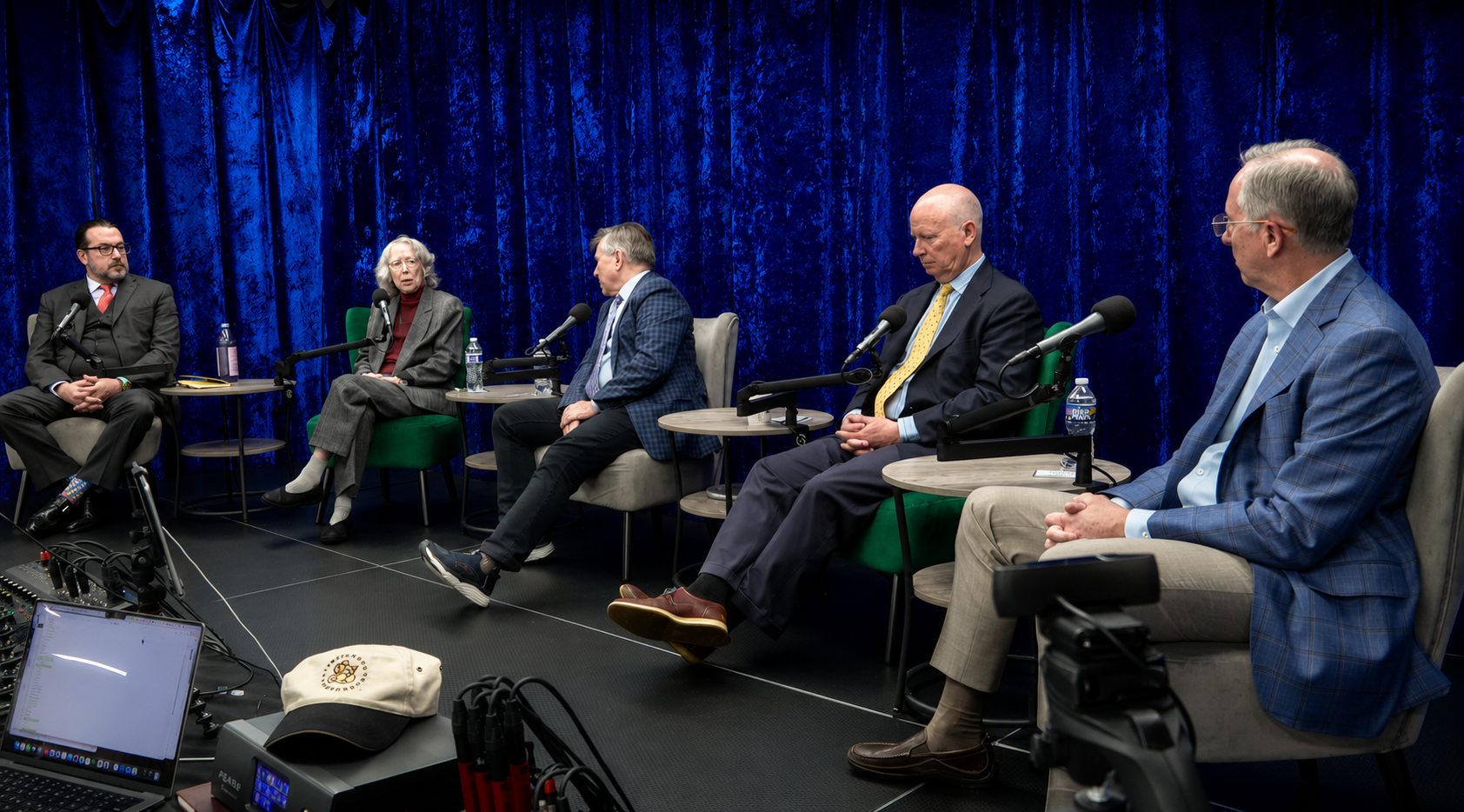
1 This week on IPWatchdog Unleashed we have a conversation that was recorded at the end of our AI 2025 program in front of a live studio audience. Joining me were Stephanie Curcio, Clint Mehall, and John Rogitz, who make up the new IPWatchdog Advisory Committee. They have all been long-time attendees at our events, they often speak on panels, they often written articles for us, and now they will help advise me with respect to programs and continue to provide content for IPWatchdog.com.
To jumpstart our conversation, I asked Stephanie, Clint and John if there was anything that they heard during our AI program that was surprising. This led into an interesting conversation about the possible existential threat presented by AI, quantum computing, data protection and trade secrets.
“Yeah, it was a really strange change in tone from Jason Allen Snyder, the AI expert, the technical non-legal person, who led off the first panel,” Rogitz said. “I’ve spoken with Jason at length before about AI, and its implications for society, and things like that, and he was always the one to sort of pump the brakes… but then he got up here this time, and he starts throwing around terms like ‘existential threats,’ in reference to AI, and I well, that’s a huge change in tone for Jason, the fact that now he, the person who knows on a technical level what’s happening, is starting to say things like that, gave me a lot of pause.”
“I think that the consciousness of AI in 13 to 15 years, the prediction that was discussed in the first panel, is one of the most interesting aspects,” Mehall said. “Because when CHAT GPT came out at first, it was, oh, this is amazing, this is going to change everything, and then like a couple months later, it’s like, oh, this isn’t going to do anything…”
“What I took away from the [quantum] panel, at least, is just the level of complexity,” Curcio said. “I know that very few people really understand quantum to begin with, and then when you have experts that are so deep in that space, and so intimately familiar with the technology [say] of course not, there’s no 101 issue. Why? Well, it’s obvious that there’s no 101 issue. And there’s a disconnect between explaining why and just inherently knowing why. And I feel like that’s sort of a common thread amongst any discussion around quantum. It’s like, well, it just is what it is. It just is that way… And trying to unpack this, the quantum world that seems to be the future, but very difficult to grasp. And the related patenting issues that may arise from it are a little bit uncertain right now, at least from my perspective.”
After spending time discussing patent prosecution strategy for AI, we turn to data protection and trade secrets, which I personally think we didn’t spend enough time on this year and plan to spend more time on next year. To jumpstart this part of our conversation I set the table by saying that not all data is created equally. There is the data that is collected and imported into AI tools and processes, and what is particularly valuable is the insights from that data, which is a different form of data itself. So, I asked: What should do companies be doing? What are the best practices for identifying and protecting valuable data in the AI age?
“If you’re going to go too much one way or the other, it would be towards protecting everything as a trade secret, as opposed to not protecting enough,” Rogitz said. “Because once the data is out there, it’s out there. And if you’re not the misappropriator, then you can’t even be held liable for distributing the data yourself or using it yourself… You have to do something to protect it. So, identify what it is and do something to protect it. Now, from a legal perspective, from our perspective, this goes back to first principles about understanding your client’s business, understanding what their objectives are, and then carrying out a legal strategy from that point forward. And I think you’re right. The inferences that you get from this sea of data are really where the value is, and they need to be kept secret.”
 “With all of these off-the-shelf AI tools, I think companies that are using them at different stages, I think a lot of it, honestly, is refining their prompt engineering over the years,” Mehall said. “If you’re 15 years ahead of somebody or five years ahead of somebody o refining prompt engineering, then that’s something that’s extremely valuable for your company, and you should have procedures and agreements in place to keep it confidential.”
We then pivot to copyrights and whether the use of copyrighted material for purposes of training AI platforms is a fair use. I confidently predicted that it will not be fair use because the alternative ruling would make content creation a bursting bubble.
“Well, Gene, I admire your optimism,” Rogitz said. “I do not have that level of faith in our institutions. I mean, look, I just said it earlier today about how Justice Thomas and Alice said we don’t want this swallowing all of patent law, talking about patent eligibility, and that’s what’s happened. And if you look at pretty much any Supreme Court decision that relates to IP, the court is unanimous. They’re unanimously wrong, but they’re unanimous.”
It is hard to argue with Rogitz here, and I admitted that I have every confidence that the courts can and will get this wrong from my content creator perspective, but if they get it wrong, I expect Congress will come to the rescue. Too many politically powerful and connected content producers, from Disney, to the New York Times, to Getty Images, to the movie studios and record labels would immediately be compromised, and such a coalition would be formidable.
You can listen to my conversation with Stephanie, Clint and John by downloading the podcast wherever you normally access podcasts, by visiting IPWatchdog Unleashed on Buzzsprout or by watching the conversation on the IPWatchdog YouTube channel.
More IPWatchdog Unleashed
For more IPWatchdog Unleashed, see below for our growing archive of previous episodes.
![[Advertisement]](https://ipwatchdog.com/wp-content/uploads/2026/06/Junior-Jun-18-2026-sidebar-700x500-1.jpg)
![[Advertisement]](https://ipwatchdog.com/wp-content/uploads/2026/05/Protege-in-PatentSight-spotlight-350x250-Ad-B.png)



![[Advertisement]](https://ipwatchdog.com/wp-content/uploads/2021/12/WEBINAR-336-x-280-px.png)
![[Advertisement]](https://ipwatchdog.com/wp-content/uploads/2021/12/Ad-4-The-Invent-Patent-System™.png)




Join the Discussion
One comment so far.
Grant Castillou
May 6, 2025 01:04 pmIt’s becoming clear that with all the brain and consciousness theories out there, the proof will be in the pudding. By this I mean, can any particular theory be used to create a human adult level conscious machine. My bet is on the late Gerald Edelman’s Extended Theory of Neuronal Group Selection. The lead group in robotics based on this theory is the Neurorobotics Lab at UC at Irvine. Dr. Edelman distinguished between primary consciousness, which came first in evolution, and that humans share with other conscious animals, and higher order consciousness, which came to only humans with the acquisition of language. A machine with only primary consciousness will probably have to come first.
What I find special about the TNGS is the Darwin series of automata created at the Neurosciences Institute by Dr. Edelman and his colleagues in the 1990’s and 2000’s. These machines perform in the real world, not in a restricted simulated world, and display convincing physical behavior indicative of higher psychological functions necessary for consciousness, such as perceptual categorization, memory, and learning. They are based on realistic models of the parts of the biological brain that the theory claims subserve these functions. The extended TNGS allows for the emergence of consciousness based only on further evolutionary development of the brain areas responsible for these functions, in a parsimonious way. No other research I’ve encountered is anywhere near as convincing.
I post because on almost every video and article about the brain and consciousness that I encounter, the attitude seems to be that we still know next to nothing about how the brain and consciousness work; that there’s lots of data but no unifying theory. I believe the extended TNGS is that theory. My motivation is to keep that theory in front of the public. And obviously, I consider it the route to a truly conscious machine, primary and higher-order.
My advice to people who want to create a conscious machine is to seriously ground themselves in the extended TNGS and the Darwin automata first, and proceed from there, by applying to Jeff Krichmar’s lab at UC Irvine, possibly. Dr. Edelman’s roadmap to a conscious machine is at https://arxiv.org/abs/2105.10461, and here is a video of Jeff Krichmar talking about some of the Darwin automata, https://www.youtube.com/watch?v=J7Uh9phc1Ow