

 3
3 “Every breakthrough invention is a miracle in its own way, but it’s not often that you witness the human impact firsthand.”
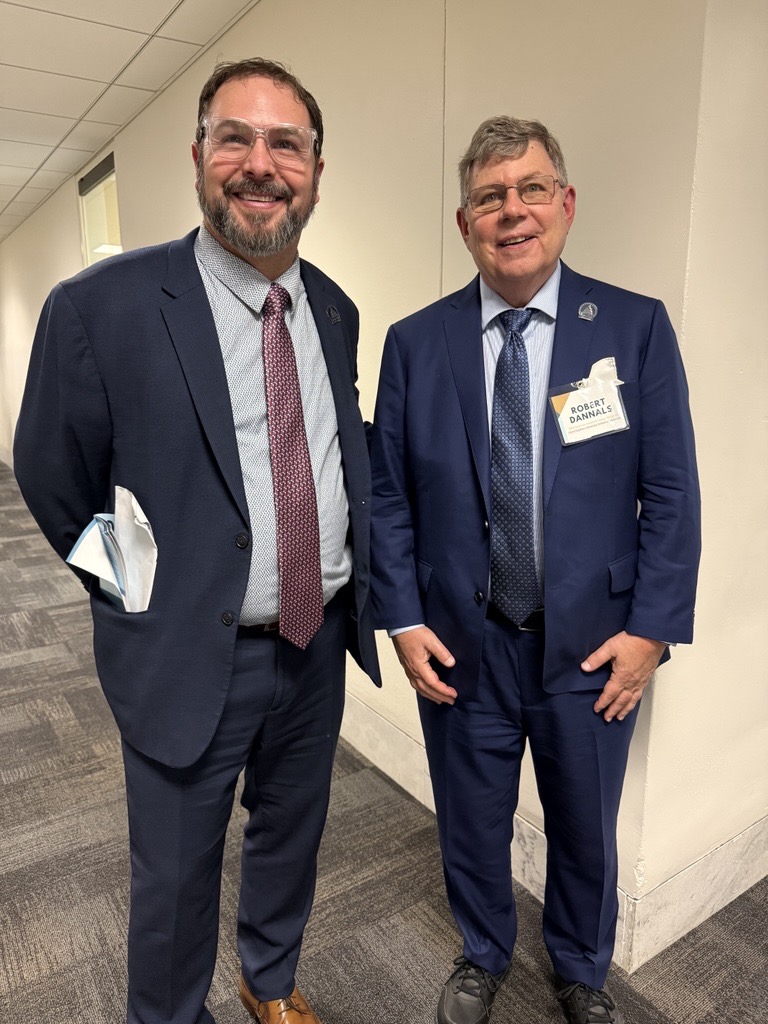
John Sears (left) and Dr. Robert Dannals
Many of us have spent our careers defending and promoting our patent system and related policies like the Bayh-Dole Act, which injected the authorities and incentives of patent ownership into the federal R&D system so that resulting discoveries would no longer waste away on the shelves, benefiting no one.
While we usually focus on statistics, legal analysis and case studies, sometimes the impact of what we’re doing hits you square in the face. Last week, I was fortunate enough to have that happen and it’s an experience I’ll never forget.
The Faces of Innovation
The Bayh-Dole Coalition, which I’m privileged to lead, recognizes several remarkable people each year whose dedication, vision, perseverance and determination helped turn a government supported invention into a useful product. We present them with the Faces of American Innovation award and their stories are well worth reading as you can see in our report.
This year, we honored researchers who made it possible to take photos from your iPhone (a technology Cal Tech couldn’t license because no one was interested until the inventors spun off a company), a revolutionary new material called “Thubber” with great promise in thermal management for electronics and AI data centers, a breakthrough test for detecting Alzheimer’s disease and a new imaging dye enabling surgeons to visualize tumors so only cancerous cells are removed during surgery. And there was one more winner, which we’ll discuss next.
The day after receiving their awards, the Coalition takes the awardees along with our members representing academic tech transfer, venture funding, industry and others on a round of Capitol Hill meetings to explain the importance of our patent-based innovation system to American competitiveness, economic growth and public well-being.
The Real Impact
I was part of a team with Dr. Robert Dannals, who along with his colleague Dr. Martin Pomper, developed an improved test for the early detection of prostate cancer. Another member of our team was John Sears, a venture capitalist, patent attorney and recognized expert in the commercialization process who advises startups, investors, universities and others in IP protection and navigating their way through the process.
We were meeting with a Congressional staffer and Dr. Dannals was describing how the new prostate test works and why it is so effective. I was sitting between Dr. Dannals and John on a couch. Suddenly, John sat straight up and said: “I just realized that this man’s test saved my father’s life!”
The impact was electrifying.
Later, John told me the story. Four years ago, he received a call from his father who had just been diagnosed with an aggressive, late-stage prostate cancer and was told he was unlikely to live more than six months. The news was devastating to the entire family.
John sold his home to move closer to his parents so he could help as much as he could. John and his mother took turns driving three hours to Vanderbilt University and back for his father’s treatments. They decided they were not going to just accept the diagnosis, so they turned to the doctors at Emory University for a second opinion.
One doctor recommended the PSMA-PET scan developed by Dr. Dannals and Dr. Pomper, which provided a far clearer baseline picture of how far the cancer had spread. They agreed, and after reviewing the results opted for an aggressive hormone treatment to shrink the tumors. The same PSMA-PET technology made it possible to precisely target the radiation, minimizing damage to surrounding healthy tissue.
The combination of brilliant doctors at Vanderbilt utilizing the PSMA-PET technology worked. Now, more than four years later, John Sears’ father is doing well (his PSA levels are nearly undetectable) and the cancer has not returned.
On a couch in a Congressional office, John Sears suddenly realized that he had finally met one of the men whose test literally saved his father’s life.
The Road to a Life-Saving Invention
Like most federally funded inventions, it was a long hard road required to create that new test. For one thing, when Dr. Pomper started out, he wasn’t thinking about prostate cancer at all, he was studying brain disorders when he happened on two unrelated papers and realized that an enzyme he was investigating was also related to prostate cancer. He thought that if he could find a way to illuminate that enzyme it would be an early indication of prostate cancer. But the question was how to do that?
It took years, but finally he found a compound that lit up the cancer cells, but what was required was turning that into a reliable tool that doctors could use. That’s where Dr. Dannals came in. He had long been fascinated by nuclear medicine and how to make it practical. Combining their talents, they disclosed an invention to Johns Hopkins University, which found a licensee in Progenics Pharmaceuticals.
Later, Dr. Pomper was speaking at a meeting of the Prostate Cancer Foundation. When he presented his findings, many in the audience asked why they couldn’t use the technology right now as it was so badly needed. The CEO of Progenics was seated in the back of the auditorium. Pointing him out, Pomper said: “Don’t ask me, ask him!” The CEO agreed on the spot to get the test onto the market as fast as possible.
Without the incentives of the Bayh-Dole Act —which allows universities and researchers to own and commercialize federally funded inventions— none of this would have been possible. Even with the law, innovation is a long, hard road.
Every breakthrough invention is a miracle in its own way, but it’s not often that you witness the human impact firsthand. The story of John Sears’ father, Doctors Pomper and Dannals, and the CEO of Progenics who pushed the test to market—is why we do what we do.
The Patent System Enables Miracles
John and his father gave me permission to share their story so that others facing dire circumstances don’t give up hope. His father has shared holidays, family gatherings, and the privilege of watching grandchildren play sports—time together that, without the PSMA-PET technology and the Bayh-Dole Act that allowed it to be commercialized, they would not have had.
With a strong patent system and the Bayh-Dole Act, these miracles will continue to occur and millions around the world will benefit. And if you’re lucky, you might unexpectedly meet someone who saved your life or that of someone you love. If so, be sure to say thank you.
![[Advertisement]](https://ipwatchdog.com/wp-content/uploads/2026/10/Questel-Oct-22-2026-sidebar-700x500-1.jpg)
![[Advertisement]](https://ipwatchdog.com/wp-content/uploads/2026/10/ClaimHit-Oct-28-2026-sidebar-700x500-1.jpg)
![[Advertisement]](https://ipwatchdog.com/wp-content/uploads/2026/09/Life-Sciences-2026-sidebar-early-bird-ends-Oct-25-700x500-1.jpg)
![[Advertisement]](https://ipwatchdog.com/wp-content/uploads/2026/09/WE-BUY-PATENTS-SIM-IP-Ad-1-revised-on-Sep-28-2026-700x500-1.jpg)
![[Advertisement]](https://ipwatchdog.com/wp-content/uploads/2024/09/Patent-Prosecution-Training-sidebar-700x500-2025-03-27.jpg)



![[Advertisement]](https://ipwatchdog.com/wp-content/uploads/2021/12/WEBINAR-336-x-280-px.png)
![[Advertisement]](https://ipwatchdog.com/wp-content/uploads/2021/12/Ad-4-The-Invent-Patent-System™.png)



Join the Discussion
3 comments so far.
“Pete”
June 12, 2026 06:03 am“Be sure to say thank you” – Please know we-will..!
Thank -You- (Joe) for all re Baye-Dole. You’re an inspiration re advocacy…!
This excellent approach we need more of…
“…after receiving their awards, the Coalition takes the awardees along with our members representing academic tech transfer, venture funding, industry and others on a round of Capitol Hill meetings to explain the importance of our patent-based innovation system to American competitiveness, economic growth and public well-being.”
Pro Say
June 11, 2026 08:32 pmWonderful story and real-life example of why America needs a return to a full, strong patent system.
Which, thanks to the off-the-innovation-rails, anti-eligibility SCOTUS and CAFC (and the failure of Congress to restore patent eligibility and availability to and for ALL innovations (something PARA doesn’t do but RALIA does)), we haven’t had since Mayo / Alice.
Time for Congress — and indeed all of America — to rally around RALIA.
Model 101
June 11, 2026 08:02 pmThis is a wonderful story with a great outcome.
Too bad many will suffer and not receive advanced treatment because of 35 101.
No one will ever spend the billions it takes to invent and commercialize a life saving treatment if they know it’s uncertain they can protect it.
Shame on the Supremes and the crooks at the Federal Circuit.
This is the state of affairs now.