
![[IPWatchdog Logo]](https://ipwatchdog.com/wp-content/themes/IPWatchdog%20-%202023/assets/images/temp/logo-small@2x.png)

 1
1 “The public response to the USCO’s Notice of Inquiry reveals a deeply divided landscape. While general public sentiment skews strongly negative toward AI’s role in the creative ecosystem, expert feedback is more nuanced.”
 AI is increasingly becoming integral to the inventive and creative process across a wide range of industries. As Generative AI (“GenAI”) tools transform our workflows, questions at the intersection of AI and copyright are requiring a reexamination of our IP system.
One set of questions is whether creative works created using AI technologies in whole or in-part are eligible for copyright protection, and if so, under what conditions. Another set of questions relates to the potential copyright infringement of GenAI due to: (1) the use of potentially copyrighted material for the training of AI models and (2) the potential infringement by the output of GenAI models on copyrighted works.
The U.S. Copyright Office (USCO) has undertaken a Copyright and AI initiative to address these questions. The USCO is addressing the copyright and AI issues in a three-part report – Part 1 on Digital Replicas (published in July 2024), Part 2 on Copyrightability (published in January 2025) and a Part 3 on the implications of training AI models on copyrighted works, licensing considerations, and any potential liability, is forthcoming. While each of these issues is important, the questions pertaining to the forthcoming Part 3 report on copyright infringement have received a lot of attention. As diffusion and evolution of GenAI tools is progressing at a rapid pace, the industry has witnessed a number of lawsuits by groups of writers, painters, musicians and record companies, and other creators, challenging the GenAI models for potential copyright infringement both for using potentially copyrighted content as an input for training models, and for the models’ output potentially infringing copyrighted works. In this backdrop, the guidance from the USCO has been sorely sought after.
The USCO did not release these reports in vacuum. It led several stakeholder meetings and in August 2023 issued a Notice of Inquiry (NOI) to study issues related to copyright and AI and received overwhelming interest from stakeholders, including 10,371 comments ranging from practitioners, to academics and subject matter experts, to members of the general public, all expressing their reaction to the questions raised about AI in the context of the copyright. Due to the overwhelming number of public comments, no summary for the key takeaways has been published. An analysis of these comments would give an important window into some of the key questions at the intersection of AI and copyright – both into the ones that have already been covered in published reports and others that have not yet been covered and that are expected to be addressed in the forthcoming Part 3 report.
The Landscape of AI and Copyright Policy
Executive Orders
In October 2023, President Biden issued an Executive Order on AI aimed to ensure the safe, secure, and trustworthy development of AI, emphasizing protecting privacy, advancing equity and civil rights, and promoting responsible innovation and competition. Following this, the USPTO and the USCO started developing their framework for AI and Intellectual Property (“IP”) issues. President Trump revoked President Biden’s 2023 Executive Order on AI shortly after taking office in January 2025. The new executive order prioritizes accelerating AI development and reducing regulatory barriers to strengthen U.S. leadership in AI. In light of the new executive order, it is worth noting that neither the USPTO nor the USCO guidance on patents or copyrights with respect to AI has required a change in direction.
Digital Replicas
In July 2024, the USCO released Part 1 of its report on Digital Replicas, which focused on the legal challenges posed by AI-generated digital replicas — realistic but unauthorized imitations of people’s voices or appearances — often used in deepfakes, presenting serious risks of fraud, misinformation, and exploitation. The USCO notes the shortcomings in existing federal and state law to adequately address the risks from rapidly evolving digital replicas and concludes that new federal legislation is urgently needed to protect individuals from unauthorized use of their likenesses, emphasizing the need for consent and legal safeguards.
In the backdrop of existing congressional activity, the report makes recommendations for legislation to clearly define digital replicas, specify who is protected, establish a protection period lasting at least a person’s lifetime, and include provisions for secondary liability. The recommendations include balancing First Amendment rights, allowing for licensing, and offering strong remedies including monetary penalties and injunctive relief for individuals to seek redress.
Copyrightability of AI-Generated Works
Earlier this year, the USCO released Part 2 of its report, on Copyrightability. The report makes clear that works generated entirely by AI are not eligible for copyright protection under US law. The report emphasizes that copyright protection requires human authorship and creativity, and that providing prompts to an AI system does not constitute “sufficient human contribution”. However, much like the USPTO’s previous guidance on patents, this creates uncertainty about what constitutes as “sufficient human contribution” for the USCO to decide that the work is copyrightable. In USCO’s own words, if a human author contributes “original, creative, and expressive elements to an AI-generated work—such as modifying the output or incorporating it into a larger human-created work”, then that work may qualify for copyright protection, and that such a decision is made on a case-by-case basis. No need for new legislation is identified for this aspect.
The report also discusses international approaches to AI and copyright, noting that countries like Japan and China have adopted different standards for determining authorship of AI-generated works. Indeed, the USCO decision to deny the copyright application of Suryast, an AI-assisted artwork generated by a photographer in India, wasn’t matched by decisions by the Canadian and the Indian Copyright offices to grant a copyright to the photographer. Despite these differences, the USCO maintains that human creativity remains central to copyright eligibility.
Public Comments Received by the Copyright Office: A Sentiment Analysis
When the USCO launched its Copyright and AI initiative, it led several stakeholder meetings. Based on those meeting, in August 2023, it issued a Notice of Inquiry (NOI) that asked specific questions to stakeholders. A sentiment analysis of the 10,371 comments submitted in response to USCO’s inquiry reveals who the interested parties are, and what the key take-aways are in the court of public opinion.
Importantly, these takeaways help us identify the existing gaps in the USCO’s current guidance and some framework for how to shape the forthcoming guidance on the most litigated area of GenAI model training, its outputs, and copyright infringement.
Questions Asked by the USCO
In the Notice of Inquiry, the Copyright Office identified four broad copyright issues tied to the development and use of AI:
- Use of copyrighted works to train AI models: how the AI datasets are collected, managed, and used to train AI models; whether permission by and/or compensation for copyright owners should be required when their works are included.
- Copyrightability of AI-generated material: the proper scope of copyright protection for creative material created using GenAI.
- Treatment of GenAI outputs for potential copyright infringement: how copying of artists and performers creative content and personal attributes may be relevant to the state rights of publicity, unfair competition law, as well as to various international treaty obligations.
- Potential liability for infringing works generated using GenAI systems: how copyright liability principles could apply to materials created by GenAI systems.
Respondents to the Copyright Office’s Notice of Inquiry
The 10,371 comments submitted to the USCO ranged from practitioners, to academics and subject matter experts, to members of the general public, all expressing their reaction to the questions raised about AI in the context of the copyright. A majority (9,788) of the comments did not include any document with detailed comments attached, or offer any technical suggestions, and expressed general thoughts and opinions around AI in the context of the copyright law, often in just a few sentences. These are best termed “General Public Comments.” Some examples of General Public Comments are: “AI is a threat to humanity,” “The fact that copywritten material is being used to train AI is so immoral. This needs to be regulated,” “I do not believe that work or products created by AI should eligible for copyright protection. Copyright should be exclusively used to protect human made creations.”
The remaining 583 comments were submitted with attachments, with thoughtful and detailed documents that contain extractable text. We call these “Expert Comments,” providing more in-depth discussions of specific issues and were often submitted by experts in the field.
We use LLM techniques to summarize the vast volume of comments to reveal important patterns in the responses. Specifically, the model was given a certain question with the predetermined set of classifications (e.g., “entity type” for the type of entity submitting a comment, or “positive/negative” for the sentiment of a comment etc.), with specific examples of the comments that fall under each category. For example, to determine the “sentiment” of a comment, the model was asked: “Is the sentiment around AI of the following comment positive, neutral, or negative?” The LLM model was also provided with several examples of comments with negative, positive, and neutral sentiments as determined by a human reviewer. Based on the text of the comment, the model then determined a likely classification. We then perform a human review of the generated classification to ensure an accurate classification.
Sentiment Analysis of Submitted Comments
We find that most of the comments from the public expressed an overwhelmingly negative sentiment towards AI’s role in the context of copyright, both as potentially infringing on creative content used as inputs for training data and potentially producing outputs infringing upon existing creative works: 91.1% of General Public Comments expressed a negative sentiment towards AI. But peeling the layer back to a more meaningful set of comments, the Expert Comments, appear to be far more balanced with 51.8% of Expert Comments expressing negative sentiment, 35% neutral, and 13.2% positive.
A deeper dive into the expert comments provides important insights into the specific issues the USCO is dealing with. The type of entities that submitted the expert comments are listed in Figure 1. Not surprisingly, the comments reflect a lot of interest from the content creators.
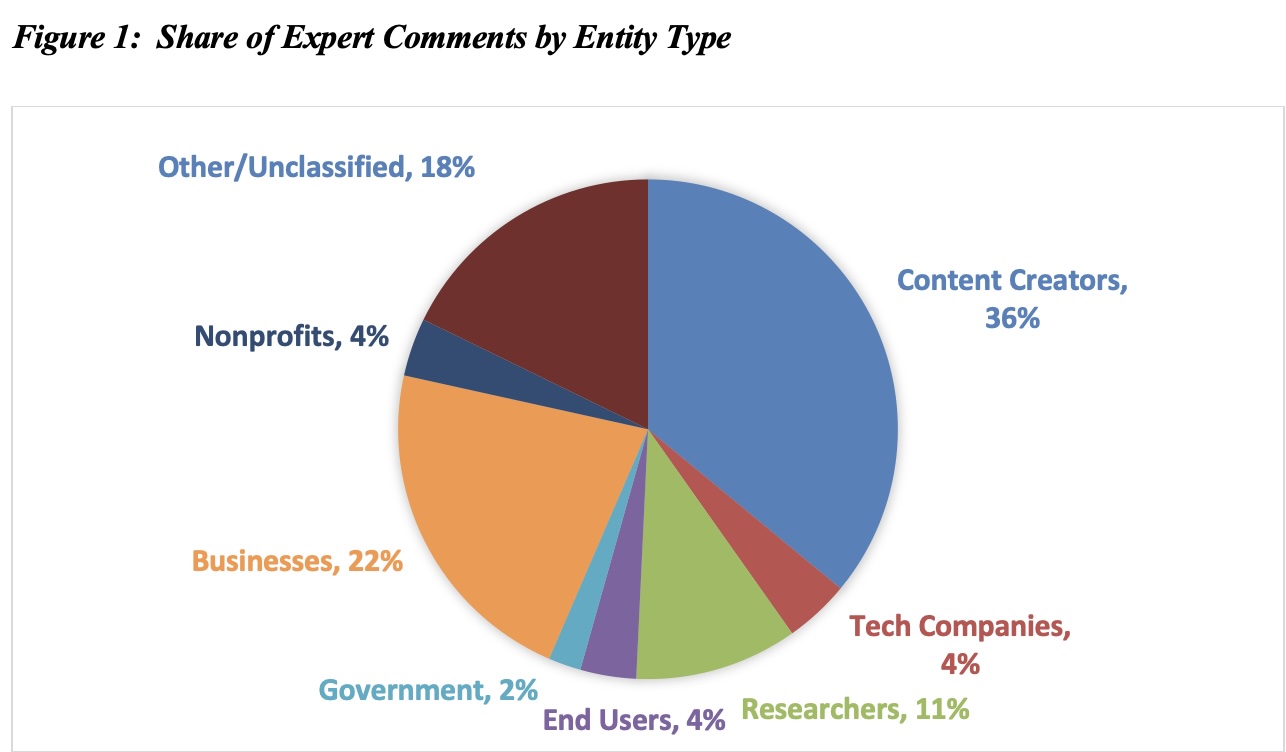
Also unsurprisingly, the sentiment towards AI varies by entity type. A majority of the content creators (75%) and end users (73.4%) expressed negative sentiment towards AI in the copyright context, while only 21.4% of tech companies expressed a negative sentiment. Comments from researchers were more balanced: 70.6% neutral and 23.5% negative.
The 583 comments from experts cover the themes addressed in the USCO questions: the standards for copyrightability of AI-assisted works, potential copyright infringement by inputs for GenAI training models (and whether the use of “fair use doctrine” is an appropriate test), potential copyright infringement by outputs from GenAI models (and whether “substantial similarity” is an appropriate test), and who the liable party should be if the GenAI generated output is found to infringe an existing copyrighted work.
- Copyrightability of AI-assisted works: We find that a number of experts who submitted comments, 369 out of 583, opined on the question whether GenAI assisted work should be copyrightable. About a third (36.6%) of those experts argued against copyright registration of AI-assisted material at all, while about 21% argued in favor, the rest were neutral. This mixed sentiment marks the open question of copyrightability of AI-assisted material for the USCO to examine more carefully and with a balanced approach.
- Use of copyrighted works to train AI models: Specifically, the comments addressed whether training datasets should be allowed to include copyrighted material under the Fair Use doctrine. There were 242 expert comments relevant to this question and less than half of those (39%) argued that the Fair Use doctrine should not apply for use of potentially copyrighted training data. From the overall negative sentiment, we would have expected this to be the majority opinion, but it is not. This result indicates that there is broad-spread support for applying the fair use doctrine to use copyrighted data as training input for GenAI models.
- Treatment of GenAI outputs for potential copyright infringement: Only a few (107) expert comments addressed this question, including whether a “substantially similar test” should be used to determine whether output of a GenAI model infringes a copyrighted work. The majority of these comments (61.7%) concluded that the substantial similarity test is not enough, indicating a broader concern about potential copyright infringement from GenAI outputs and whether the current tests are sufficient. This is an area where more guidance would be needed by the USCO to proactively support the existing copyright of content creators as well as foresee and facilitate the conclusion of legal battles.
- Potential liability for infringing works generated using GenAI systems: The question about who should be liable – the GenAI model developer, the system incorporating the GenAI model, or the end-user of the model – when a copyrighted work is found to be infringed by the output of a GenAI model was addressed by 210 expert comments. Here, the comments reflect joint liability – while a majority (83.8%) of the comments conclude that a developer of the GenAI model should be liable, there is also support for establishing liability for system developers (71.4%) and end-user (69.5%).
A Deeply Divided Landscape
As the USCO navigates the complex and evolving landscape at the intersection of AI and copyright law, it becomes increasingly clear that there is no one-size-fits-all solution. While the first two parts of the USCO’s reports on copyright and AI have provided some clarity on issues like digital replicas (Part-1) and the copyrightability of AI-generated content (Part-2), they have also exposed important gray areas—the answer to the question what AI assisted content is and isn’t copyrightable will likely evolve with time and across jurisdictions. On the heavily litigated and the high stakes topic of the use of copyrighted material to train GenAI models and the legal implications of AI-generated outputs, the guidance is forthcoming in the USCO Part-3 report. Until the report is published, we have to rely on what the public comments received by the USCO reveal.
The public response to the USCO’s Notice of Inquiry reveals a deeply divided landscape. While general public sentiment skews strongly negative toward AI’s role in the creative ecosystem, expert feedback is more nuanced, indicating a mix of cautious optimism, critical concerns, and thoughtful recommendations. The forthcoming Part-3 report holds the potential to set a crucial precedent—one that balances innovation and technological progress with the rights and protections of human creators. The USCO has an important balance to strike: one that protects the incentives for creators to generate and monetize their creative content, while ensuring that the GenAI innovation ecosystem is not bogged down. In the meantime, the public comments provide an important compass to guide us about the brewing sentiment from stakeholders.
Image Source: Deposit Photos
Author: supatman
Image ID: 734390440

![[Advertisement]](https://ipwatchdog.com/wp-content/uploads/2026/05/Protege-in-PatentSight-product-350x250-Ad-A.png)
![[Advertisement]](https://ipwatchdog.com/wp-content/uploads/2026/04/Virtual-AI-2026-May-18-19-2026-sidebar-CLE-last-chance-700x500-1.jpg)
![[Advertisement]](https://ipwatchdog.com/wp-content/uploads/2026/05/Patent-Masters-2026-sidebar-early-bird-price-ends-on-May-17-700x500-1.jpg)
![[Advertisement]](https://ipwatchdog.com/wp-content/uploads/2026/05/Anaqua-May-21-2026-sidebar-700x500-1.jpg)



![[Advertisement]](https://ipwatchdog.com/wp-content/uploads/2021/12/WEBINAR-336-x-280-px.png)
![[Advertisement]](https://ipwatchdog.com/wp-content/uploads/2021/12/Ad-4-The-Invent-Patent-System™.png)


Join the Discussion
One comment so far.
Anon
May 2, 2025 09:15 amAs to:
“A sentiment analysis of the 10,371 comments submitted in response to USCO’s inquiry reveals who the interested parties are, and what the key take-aways are in the court of public opinion.”
The labeling of “These are best termed ‘General Public Comments.’ ” immediately has me dismissing this article.
Anyone following along with any analysis would readily see that the vocal reaction is simply discordant with the actual public use of Gen AI tools.
Instead, any analysis worth its salt would see a rather emotional if not organized effort by those whose livelihood has been placed in the crosshairs by the advance of innovation.
Cornerstone Research – you really need to do a better job.