
![[IPWatchdog Logo]](https://ipwatchdog.com/wp-content/themes/IPWatchdog%20-%202023/assets/images/temp/logo-small@2x.png)

 2
2 “While ‘reliance on AAPA in combination with prior art patents or printed publications is not dispositive of whether AAPA is included in the basis of a ground…what is dispositive are express statements—as in Apple’s petitions….'” – Federal Circuit
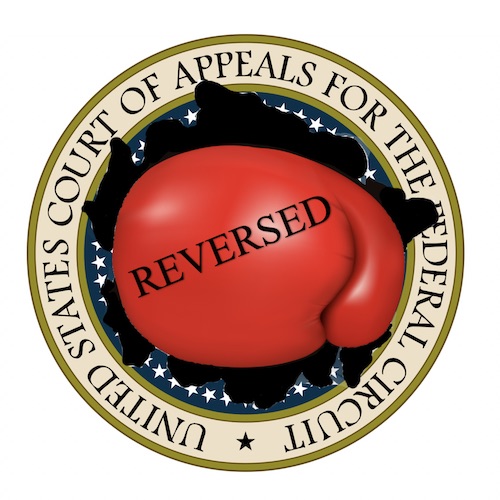 The U.S. Court of Appeals for the Federal Circuit (CAFC) on Wednesday issued a precedential decision reversing a Patent Trial and Appeal Board (PTAB) ruling that found on remand from the CAFC claims of Qualcomm’s patent for integrated circuit devices were unpatentable.
The decision relates to two inter partes review (IPR) petitions brought by Apple, Inc. against Qualcomm’s U.S. Patent No. 8,063,674 in 2018. In two separate decisions, the PTAB found the claims unpatentable under Section 103, basing its finding on a ground raised by Apple that relied in part on applicant admitted prior art (AAPA) and a prior art patent. Apple also challenged the claims as unpatentable under Section 103 based on two prior patents and one publication, but the Board said that Apple had not proven unpatentability on this ground.
Qualcomm I
In Qualcomm’s first appeal to the CAFC, the court vacated and remanded the decisions, explaining that the Board’s determination that “prior art consisting of patents or printed publications” includes AAPA was incorrect. However, the CAFC remanded the case for the PTAB to decide “whether Apple’s petition nonetheless raises its § 103 challenge on the basis of prior art consisting of patents or printed publications.”
35 U.S.C. § 311(b) says that “A petitioner in an inter partes review may request to cancel as unpatentable 1 or more claims of a patent only on a ground that could be raised under section 102 or 103 and only on the basis of prior art consisting of patents or printed publications.”
The PTAB originally held: “Because AAPA is admitted to be prior art and is found in the ’674 patent, it can be used to challenge the claims in an inter partes review.” The Board also said that “prior art consisting of patents or printed publications” includes AAPA because it is prior art contained in a patent. The Federal Circuit disagreed. The court explained:
“We agree with Qualcomm and the PTO that the ‘patents or printed publications’ that form the ‘basis’ of a ground for inter partes review must themselves be prior art to the challenged patent. That conclusion excludes any descriptions of the prior art contained in the challenged patent. This interpretation is consistent with prior judicial interpretations of the statute and represents a more natural reading of § 311(b).”
Despite that holding, the CAFC likewise noted that AAPA is still not “categorically excluded” from an IPR. Citing Koninklijke Philips N.V. v. Google LLC, 948 F.3d 1330, 1339 (Fed. Cir. 2020) (citing PharmaStem Therapeutics, Inc. v. ViaCell, Inc., 491 F.3d 1342, 1362 (Fed. Cir. 2007), the court noted that it has previously held “‘it is appropriate to rely on admissions in a patent’s specification when assessing whether that patent’s claims would have been obvious’ in an inter partes review proceeding.” This is because, like expert testimony and party admissions, AAPA can help to “establish the background knowledge possessed by a person of ordinary skill in the art.”
Because the Board did not address the question of whether AAPA improperly formed the “basis” of Apple’s challenge, the court remanded the case to the PTAB for that purpose. (Qualcomm I)
Before the Board decided on remand, the U.S. Patent and Trademark Office (USPTO) updated its existing guidance on the “Treatment of Statements of the Applicant in the Challenged Patent in Inter Partes Reviews Under § 311(b)” (Guidance). The original Guidance agreed with Qualcomm that AAPA does not fall within “prior art consisting of patents or printed publications” under § 311(b), but read CAFC caselaw to permit the use of AAPA in IPR as evidence of the general knowledge of a skilled artisan.
The updated Guidance was issued in June 2022 and responded to the CAFC’s decision in Qualcomm I by interpreting Section 311(b) “to require an ‘in combination’ rule: In an IPR petition that ‘relies on admissions in combination with reliance on one or more prior art patents or printed publications, those admissions do not form ‘the basis’ of the ground.”
On remand, the PTAB again found the claims unpatentable on Ground 2 and said the AAPA at issue did not form “the basis” of the ground and thus complied with Section 311(b).
Qualcomm II
On appeal for the second time, the CAFC first addressed Apple’s argument, citing Cuozzo Speed Techs., LLC v. Lee, 579 U.S. 261 (2016), that Qualcomm’s appeal is not reviewable because it amounts to a challenge to the Board’s determination to institute the IPRs. “Apple contends that challenging ‘the basis’ of Ground 2 as ‘not permissible’ under § 311(b) amounts to a challenge of the decision to institute the IPRs,” wrote the CAFC. But the court said Qualcomm was not challenging the “threshold” decision to institute the IPRs, but instead, “the Board’s determination of unpatentability on Ground 2, with respect to the use of AAPA in reaching that determination.” The opinion added: “In other words, Qualcomm’s challenge pertains to the Board’s interpretation and application of statutory provision, § 311(b), on what qualifies as a permissible basis for a ground in an IPR petition.”
The CAFC then turned to Qualcomm’s arguments that the Board erred in interpreting § 311(b) and in determining that Ground 2 complied with § 311(b).
On the first point, the CAFC held that the Board’s interpretation “contravened the plain meaning of the statute.” The opinion explained that Qualcomm I, “clarified that, according to the plain language of § 311(b), related case law, and a ‘natural reading’ of the statute, AAPA is not a prior art patent or printed publication. Thus, because the basis can only include prior art consisting of patents or printed publications, and because AAPA is not a prior art patent or printed publication (per Qualcomm I), it follows that the plain meaning of § 311(b) does not permit the basis to include AAPA.”
However, the PTAB interpreted Section 311(b) to mean that AAPA does “not form ‘the basis’ of the ground” where “an IPR petition relies on admissions in combination with reliance on one or more prior art patents or printed publications.” The CAFC rejected this view, noting that it “would establish an ‘in combination’ rule that would provide that AAPA cannot form the basis of a ground and, as a result, must be considered by the Board, whenever a petition combines AAPA with prior art patents or printed publications.”
Holding that AAPA can never form the basis of a ground under Section 311(b) if it is combined with prior art patents or printed publications “would not account for situations where a petition relies on AAPA in combination with prior art patents and printed publications but also includes the same AAPA as the basis or part of the basis,” wrote the CAFC. The Board incorrectly conflated “reliance” on AAPA with “basis,” the opinion added.
The CAFC next addressed Qualcomm’s argument that the Board also erred in applying Section 311(b) to determine that Ground 2 complied with the statute. The PTAB found that the AAPA did not form the basis of Ground 2 and that Ground 2 therefore complied with the statute, and then found the challenged claims unpatentable as obvious under Ground 2. Qualcomm said Ground 2 should have been found to violate Section 311(b), which would mean there could be no ground for unpatentability. The CAFC agreed.
In addition to applying its incorrect interpretation to arrive at its conclusion, the Board exacerbated its error by rejecting Qualcomm’s argument that Apple’s petitions “expressly stated or ‘conceded that AAPA forms the basis of the Ground 2 challenge,’” wrote the court. According to the CAFC opinion, “[e]ach petition opened with a table that prominently labeled the ‘Basis’ of Ground 2 as ‘AAPA in view of Majcherczak’ (and Matthews, as relevant).” Such statements amounted to Apple’s confirmation that the AAPA was a part of the basis of Ground 2, which is a violation of Section 311(b). While “reliance on AAPA in combination with prior art patents or printed publications is not dispositive of whether AAPA is included in the basis of a ground…what is dispositive are express statements—as in Apple’s petitions…” and the court ultimately “agreed with Qualcomm that Apple should be held to the phrasing of its petition because an IPR petitioner is the ‘master of its own petition.’”
The PTAB’s determination of unpatentability was therefore reversed.
Image Source: Deposit Photos
Image ID: 10042948
Author: almoond
![[Advertisement]](https://ipwatchdog.com/wp-content/uploads/2026/07/DeepIP-Jul-28-2026-sidebar-700x500-1.jpg)
![[Advertisement]](https://ipwatchdog.com/wp-content/uploads/2026/07/Ankar-AI-Jul-30-2026-sidebar-700x500-1.jpg)
![[Advertisement]](https://ipwatchdog.com/wp-content/uploads/2026/07/ClearstoneIP-Varsity-Ad-2026-Ad-2.jpg)
![[Advertisement]](https://ipwatchdog.com/wp-content/uploads/2026/07/Juristat-Varsity-Ad-2026-IPW-ad-Solo_1.png)
![[Advertisement]](https://ipwatchdog.com/wp-content/uploads/2026/07/Womens-IP-Forum-2026-sidebar-register-early-bird-now-700x500-1.jpg)





![[Advertisement]](https://ipwatchdog.com/wp-content/uploads/2021/12/WEBINAR-336-x-280-px.png)
![[Advertisement]](https://ipwatchdog.com/wp-content/uploads/2021/12/Ad-4-The-Invent-Patent-System™.png)





Join the Discussion
2 comments so far.
Doreen Trujillo
April 24, 2025 09:17 amThis passage is unsettling from Qualcomm I. The PTAB asserted that AAPA meets the “patent or printed publication” requirement because it is in the applicant’s OWN patent.
“The PTAB originally held: “Because AAPA is admitted to be prior art and is found in the ’674 patent, it can be used to challenge the claims in an inter partes review.” The Board also said that “prior art consisting of patents or printed publications” includes AAPA because it is prior art contained in a patent. The Federal Circuit disagreed. The court explained:…”
No. Just no.
Pro Say
April 23, 2025 03:29 pmWhen there are two elephants in the room . . .
How many independent and SMB American inventors could afford such a long, tortured, and expensive path to justice?
Congress: Whatever happened to the quicker, easier, cheaper path you promised when you passed the AIA (America Invalidates Act)?
Dump this PTAB experiment-gone-very-very-bad before it’s too late.