
![[IPWatchdog Logo]](https://ipwatchdog.com/wp-content/themes/IPWatchdog%20-%202023/assets/images/temp/logo-small@2x.png)

 1
1 “Going forward, Pepperdine’s initial hurdle will be to defeat Rogers by proving that the series explicitly misleads viewers to infer Pepperdine’s endorsement.”
If you happened to see the new Netflix show “Running Point,” starring Kate Hudson, that was made possible by a last-minute decision of a California federal court on the eve of the show’s February 27 release.
Pepperdine University, in an emergency motion filed one week before the show’s release, asked the court to block the release due to trademark violations occurring within the series. The court denied the motion, and the series is now the number one TV show on Netflix as of this writing.
Although the emergency motion was denied, proceedings will continue, and it is yet to be seen whether Pepperdine may ultimately succeed on some or all of its claims against Netflix and Warner Bros.
Pepperdine Calls for a ‘Time-Out’
In a lawsuit filed February 20 in the U.S. District Court for the Central District of California, Pepperdine University asked the court to indefinitely postpone the planned February 27 release of “Running Point.”
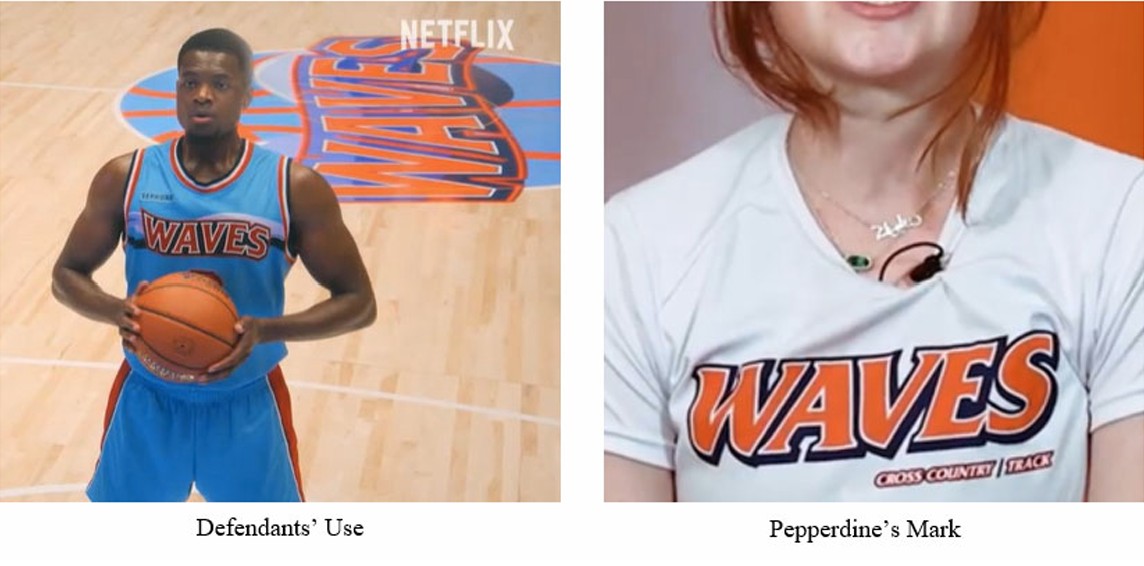
Loosely based on the life of Los Angeles Lakers owner Jeanie Buss, “Running Point” is about a woman who is suddenly tasked with leading a Los Angeles-area basketball team. The problem? The fictional basketball team in “Running Point” is called the Los Angeles Waves. The “Waves” is also the name that Pepperdine University has used for its sports teams, including basketball, since the school opened in Los Angeles in 1937. Pepperdine owns three WAVES-based trademarks that are registered in connection with entertainment services and sporting events.
The university, now located in Malibu, claims that “Running Point” appears to be associated with or endorsed by Pepperdine, as the series features a same-named sports team in the same geographic region using similar colors and visual elements. Pepperdine also claims that the show’s subject matter—which includes references to sex, drugs, and alcohol—runs counter to the university’s Christian values.
In its temporary restraining order (TRO) request, Pepperdine told the court that the university would suffer immediate and irreparable harm if the court did not prevent the show’s impending release.
In the emergency motion, Pepperdine sought relief on the basis of trademark infringement. The defendants filed opposition papers a few days later, denying any likelihood of confusion and arguing that the show’s content is protected under the First Amendment-based Rogers test (see Rogers v. Grimaldi). The court heard oral arguments on February 25 and then, in a game-day decision (sports pun intended), issued a ruling the next day.
Game-Day Decision
With hours to go before the show’s Netflix release, the court on February 26 denied Pepperdine’s request for a TRO, citing an absence of likelihood of success on the merits based on the Rogers test.
Rogers is an affirmative defense that applies to trademarks used within creative works such as films and TV shows. The legal standard to succeed on an ordinary trademark infringement claim is likelihood of consumer confusion. In Rogers cases, however, the defense bars liability unless the court finds that accused trademark explicitly misleads consumers as to the source or content of the creative work.
Ruling on the TRO motion, the court found that the “Los Angeles Waves” does not implicitly or explicitly mislead consumers as to the source of the series, for the series’ credits make clear that the show was created by Netflix, Warner Bros., and Mindy Kaling.
To invoke Rogers, there is also a requirement that the accused trademark must have some sort of artistic relevance to the creative work. The court found that requirement satisfied here, crediting the defendants’ explanation that “waves” is symbolic of the “Southern California vibe” that includes “beaches, sun, surfing, and waves.” The court also noted that calling the fictional team the “Waves” pays homage to the Los Angeles Lakers, whose name likewise refers to a body of water. (The same court back in 2016 rejected trademark challenges to the title of Fox’s TV show “Empire,” set in New York, based on similar reasoning; the Ninth Circuit Court of Appeals upheld the ruling).
Finding Rogers dispositive, the court denied Pepperdine’s motion without addressing the likelihood of confusion factors for infringement. Although the court declined to grant relief at this juncture, the court stated that Pepperdine may follow up with a motion for a preliminary injunction if it chooses to.
Play-by-Play Analysis
Emergency motions, including TRO’s and preliminary injunctions, are extraordinary remedies that generally are difficult to obtain, particularly in factually or doctrinally complex cases.
Here, the odds were stacked against Pepperdine. The biggest reason is that TV shows are a creative work subject to Rogers analysis. In order to obtain a TRO, Pepperdine would not only have needed to establish a probability of success on the Ninth Circuit’s eight likelihood of confusion factors (which are themselves factually intensive), but it also would have needed to defeat the application of the Rogers test.
The defense-friendly Rogers test is particularly difficult to resolve in a plaintiff’s favor on an early motion: artistic relevance is found in almost all cases, and explicit misleadingness is a high and somewhat elusive standard for plaintiffs to meet. As a result, Pepperdine’s loss at this juncture is unsurprising.
In addition, Pepperdine may have been disadvantaged by the court’s slight misarticulation of the explicit misleadingness standard. As stated in the seminal Rogers v. Grimaldi decision, the test fails if the accused trademark explicitly misleads as to the source or content of the work. Counsel for Netflix and Warner Bros. correctly articulated the standard in their opposition papers. The court’s order, however, refers only to source deception and does not acknowledge the possibility of content-related deception through explicit misrepresentation of Pepperdine’s endorsement—precisely the harm that Pepperdine alleges.
That said, correct application of the Rogers test to address content deception would not have guaranteed Pepperdine victory on the TRO. Even had the court believed that the series created a risk of false endorsement, ordinary confusion would not have sufficed; under Rogers, the false endorsement would have needed to be explicit in order for the court to reach likelihood of confusion analysis. And then, a victory on the TRO would have required the court to also resolve the likelihood of confusion question in Pepperdine’s favor. The court may very well have declined to do so, especially on an expedited basis, due to the number of factors involved and the competing arguments on both sides.
Ultimately, although the Rogers misarticulation may not have been outcome-determinative for the TRO, it could give Pepperdine an avenue to succeed on its infringement claims as the litigation progresses.
Future Plays
Now that “Running Point” is on Netflix, the entire 10-episode first season is fair game for future proceedings. Going forward, Pepperdine’s initial hurdle will be to defeat Rogers by proving that the series explicitly misleads viewers to infer Pepperdine’s endorsement. Pepperdine will likely claim false endorsement based on the “Los Angeles Waves” name combined with other commonalities between the university and the series. As an example, in the series, the team’s conference room is shown to have a framed “37” jersey; meanwhile, Pepperdine’s real-life mascot Willie the Wave wears a number 37 jersey, in reference to the school’s 1937 founding year.
Explicit deception is a high standard to meet, but if Pepperdine could prove it, then the likelihood of confusion factors could almost axiomatically lead to a finding of trademark infringement.

Trademark dilution, which was raised in the complaint but not the TRO, is another theory that Pepperdine could test in future proceedings. The complaint alleges dilution by tarnishment, which occurs when the accused trademark use causes reputational harm to the trademark owner by association, even in the absence of consumer confusion.
A recent illustration is the lower court’s long-awaited decision in the Jack Daniel’s v. VIP Properties case, which the U.S. Supreme Court ruled on in 2023. In January 2025, the lower court ruled that VIP’s “Bad Spaniels” whiskey-shaped dog toys diluted Jack Daniel’s trademarks. The court found dilution by tarnishment on the basis that the parody toys’ tongue-in-cheek references to dog poo created negative associations with Jack Daniel’s.
Similarly, here, Pepperdine alleges that “Running Point” paints the university in an unflattering light by associating the “Waves” with sex, drugs, alcohol, and profanity. Although it is generally a feel-good series, “Running Point” does include some mature themes. As stated by Kate Hudson’s character Isla in the opening sequence: “Our business is the greatest franchise in the history of the game, the Los Angeles Waves. This is the story of the f—-d up family that runs it.” Following this narration, it is revealed that Isla replaces her brother as the team’s president after the brother overdoses on drugs and crashes his car. Despite the show’s generally upbeat tone, the mature themes and language could support a classic case of tarnishment.
But to prevail on dilution, Pepperdine must also prove that its WAVES trademarks are nationally famous, which the defendants dispute. Although the “Waves” are not as well-known as the Bruins or the Trojans, the mark has been in use since 1937, and the university reports that nearly 60% of its student body hails from outside of California. If Pepperdine could prove that its marks are nationally known, dilution could potentially be a Rogers-free path to victory.
Season Predictions
The posture of the case has permanently changed now that “Running Point” is available to the public. As stated in the TRO motion, Pepperdine is concerned that the show’s raunchy aspects will tarnish the university’s reputation in a way that cannot be undone.
If Pepperdine were to eventually succeed on some or all of its claims, the next question would be what type of relief the court might be willing to grant after the fact of the series’ release.
Due to First Amendment principles, courts are generally reluctant to ban expressive content, especially content that is of high public interest like “Running Point.” Courts will also consider how such a ban would financially impact the defendants. In this case, Netflix and Warner Bros. have already spent tens of millions of dollars on production and marketing for the series. “Running Point” has become a Netflix fan favorite and is now ranked as the platform’s top-watched TV show. As such, any obligation to take down the series is a prospect that the defendants will strongly resist.
Perhaps an intermediate solution, through court order or settlement, would be to require the addition of disclaimers stating that the university is not affiliated with the series and that any resemblances are purely coincidental. This solution could disabuse viewers of any potential association with Pepperdine without requiring removal or revision of the series itself.
That said, I’m not the referee. Let the game continue.
![[Advertisement]](https://ipwatchdog.com/wp-content/uploads/2026/06/Womens-IP-Forum-2026-sidebar-super-early-bird-ends-July-15-700x500-1.jpg)
![[Advertisement]](https://ipwatchdog.com/wp-content/uploads/2026/07/Juristat-Varsity-Ad-2026-IPW-ad-Solo_1.png)





![[Advertisement]](https://ipwatchdog.com/wp-content/uploads/2021/12/WEBINAR-336-x-280-px.png)
![[Advertisement]](https://ipwatchdog.com/wp-content/uploads/2021/12/Ad-4-The-Invent-Patent-System™.png)






Join the Discussion
One comment so far.
SS
March 17, 2025 05:30 pmI went to Pepperdine, and I wondered if the show was based on Pepperdine, or using its facilities. It’s even the same colors – orange and blue. To me, it’s obviously a representation of Pepperdine’s trademark. The show is great, I can’t stop watching it – hopefully Pepperdine can use this to their advantage since they’re an outstanding University and organization.