
![[IPWatchdog Logo]](https://ipwatchdog.com/wp-content/themes/IPWatchdog%20-%202023/assets/images/temp/logo-small@2x.png)

 10
10 “I’m appalled that you guys are here testifying like this, this is shameless…. What you’re saying is if you’re only stealing 10% of the product, let us keep importing it, let us just keep stealing it.” – Rep. Massie at House IP Subcommittee hearing
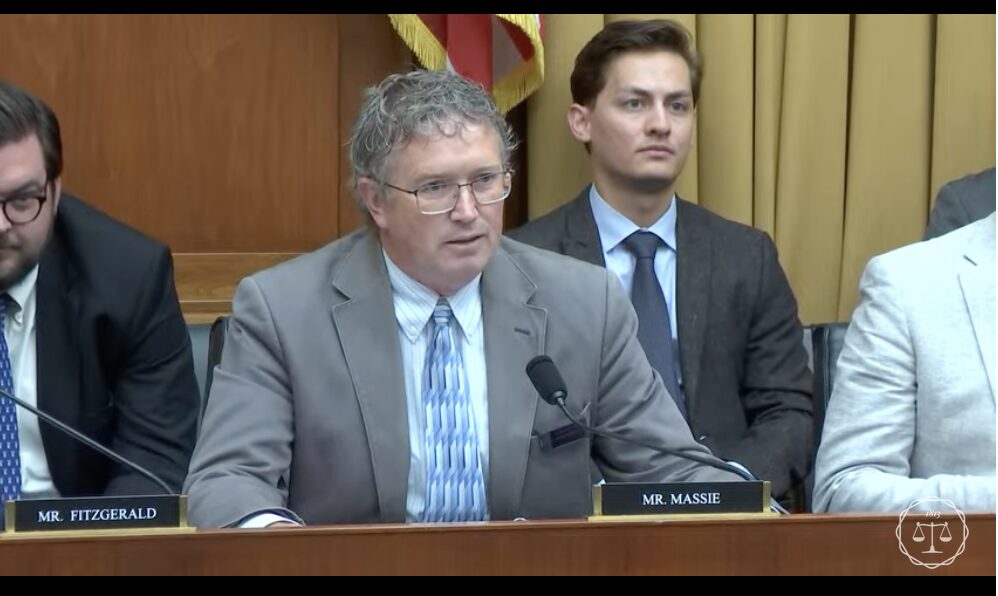 The House Judiciary Committee’s Subcommittee on Courts, Intellectual Property and the Internet today held a hearing, titled “IP Litigation and the U.S. International Trade Commission” (ITC), featuring four witnesses, most of whom were advocating for reforms to the current ITC process that many would characterize as anti-patent.
Subcommittee Chair Darrell Issa (R-CA) explained that “recently there has been a growing chorus of voices suggesting the ITC is being misused for purposes other than its intent.” Issa said these voices claim the forum is being leveraged in ways that distort the IP system.
While the Ways and Means Committee is the committee of jurisdiction over the ITC, Issa explained that the IP Subcommittee has a vested interest in the way IP litigation at the ITC fits into the overall U.S. IP system.
 In particular, since the U.S. Supreme Court’s decision in eBay v. MercExchange, the sharp drop in availability of injunctive relief in Article III courts has led to increased use of the ITC, where the remedy of an exclusion order barring import of infringing goods int other United States serves as a quick way to stop infringement. However, both Issa and Subcommittee Ranking Member Hank Johnson (D-GA) pointed out that the ITC Is only available to a very limited segment of patent owners and that exclusion orders are narrower than injunctions. Johnson said patent owners “should not be forced to resort to the limited ITC remedies to solve patent litigation issues” and that he looks forward to joining Congresswoman Madeleine Dean (D-PA) later this year when she introduces a bill to restore the availability of preliminary injunctions to patent litigants.
Witnesses and Questions
 Today’s hearing featured two witnesses from industry and two law professors. Tara Hairston, Senior Director, Technology Policy at the Alliance for Automotive Innovation, said the auto industry today faces frequent and costly lawsuits, “many filed by NPEs” [non-practicing entities]. According to Hairston, this is “happening more and more frequently and it is a problem.” The auto industry thus supports ITC reform, and Hairston said they would welcome the following potential changes, which she said would make the ITC less attractive to NPEs:
- Strengthen the domestic industry requirement to focus on production-based licensing, not revenue-based licensing.
- Reinforce consideration of the public interest throughout a Section 337 investigation.
- Identify potentially dispositive issues that should be decided by administrative law judges (ALJs) within 100 days of instituting an investigation.
- Limit the issuance of exclusion orders when an allegedly infringing component is less than or equal to 10% of the overall product.
- Mandate disclosure of real parties in interest by complainants and respondents.
‘Appalled’
Representative Thomas Massie (R-KY) took particular offense at the suggestion that infringement should be allowed if the infringing component comprises less than a certain percentage of the overall product. “I’m appalled that you guys are here testifying like this, this is shameless,” Massie said. He continued:
“You’re here trying to divvy up the goods of the American inventor. What you’re saying is if you’re only stealing 10% of the product, let us keep importing it, let us just keep stealing it.”
Massie also objected to Hairston and other witnesses’ proposal that the “public interest factors” inherent in ITC proceedings should be reinforced, calling “this public interest notion…just a communist term.” Massie explained:
“What you’re saying is it may be in the public interest to let somebody keep infringing. The constitution guarantees the right to exclude somebody from infringing…. I’m just appalled that you have no shame in saying you should be able to steal a product form an inventor in the United States, have it manufactured overseas in China [and] import that as a knockoff if you’re only stealing 10% of the idea.”
More Proposals
 Sam Korte, Senior Principal Counsel, IP, at Garmin Ltd., claimed that “the ITC has shifted from its roots.” He said the ITC has gone from a specialized forum for addressing international trade disputes “to a super powered and super expensive district court accessible to anyone with a patent.” Korte said the costs of ITC proceedings sometimes exceed $10 million and that Garmin has been targeted by NPEs and forced to engage in investigations over basic components that could shutter its American factories if excluded from import. He said that Congress could clarify the domestic industry requirement language “by requiring a patent owner to show it has assisted in bringing a product to market, such as by licensing or other efforts.” In contrast, said Korte, “today a patent owner can fabricate domestic industry by sitting on its patent for decades, suing a manufacturer that independently developed its products, cheaply licensing its patents to the manufacturer it just sued, then racing to the ITC to file a 337 complaint against the rest of the established industry. This practice should end.”
He added that Congress should also require the ITC to engage in a more detailed analysis of the public interest to avoid automatic issuance of exclusion orders and that it should make it harder for foreign companies to use the ITC. “This distortion undermines the entire congressional intent behind 337,” Korte said.
 Jorge L. Contreras, James T. Jensen Endowed Professor for Transactional Law at the University of Utah, weighed in to suggest that the recent Supreme Court ruling in Loper Bright gives Congress a perfect opportunity to reconsider the patent jurisdiction of the ITC. Contreras said “the world is a different place” compared with the world at the time the ITC statute was written. For instance, said Contreras, overseas firms routinely establish subsidiaries in the United States. He cited statistics showing that, in 2022 and 2023, only 6% of ITC patent cases lacked a domestic respondent subject to personal jurisdiction in the United States and that 94% of ITC cases are brought against domestic companies.
“There’s little justification for the maintenance and annual taxpayer expense of nearly $40 million of a duplicate patent litigation system in the U.S.,” Contreras said. Furthermore, in the last two years, 83% of all ITC patent cases had parallel proceedings in district court, adding to the costs. He suggested that Congress could restrict ITC actions to parties over which the federal courts lack jurisdiction; narrow the definition of domestic market to exclude patent assertion and licensing by parties that don’t actually make or sell products in the U.S.; require the ITC to follow judicial precedent when issuing remedies for infringement; and enable the courts to work directly with Customs and Border Protection on patent infringing goods, as they already do with copyright and trademarks.
 Michael Doane, Visiting Assistant Professor of Law at the University of Akron School of Law, was the sole witness who suggested Congress take caution when considering proposals to restrict access to relief at the ITC. Doane said the ITC is especially important for startups, who can’t afford to battle a slew of infringing products in the courts, often before they’re even up and running. “Section 337 provides startups with the most direct and efficient remedy for this problem…and is one of the most effective mechanisms for defending US IP rights from imported infringing products, particularly from China.”
Doane added that the ITC has amended its practices along the way to make it easier for universities and small inventors to bring cases, and said that is an important task of the Commission. Massie pointed to the recent ITC battle between Apple and Masimo as an example of the ITC’s power for smaller companies.
In response to a question posed by Rep. Johnson about how weakening the ITC’s IP powers might impact China’s import of infringing goods, Doane added it would help Chinese infringers. “A section 337 exclusion order is often the only way a small company can get relief,” he said.
Doane also said the data hasn’t borne out the assertion that NPEs are flooding the ITC.
The SEP Factor
The questioning also touched on the use of the ITC for SEPs and FRAND patents, with all of the witnesses except Doane urging that ITC exclusion orders should not be available for FRAND patents. “Injunctive relief is not appropriate [in those cases] because of the commitment the patent owners have made to license to all willing implementers,” Hairston said.
But Doane said the mere availability of an exclusion order is necessary for SEPs, to avoid the possibility of perpetual patent holdout by implementers.
C4IP Weighs In
The Council for Innovation Promotion (C4IP) submitted a letter to the Judiciary and IP Subcommittee Chairs and Ranking Members today explaining that proposals to limit the availability of exclusion orders or to redefine the public interest factor “miss the point”. The letter added:
“Exclusion orders are critical where the U.S. courts do not, and cannot, have complete jurisdiction over all aspects of the infringing conduct — by definition, the manufacturing must occur abroad for an import ban to be sought in the first place, meaning that a U.S.-rights holder might have to go to foreign courts to get an injunction directly against the manufacturing there or to collect damages. The ITC exists to ensure that U.S.-rights holders can solve any outstanding domestic disputes in U.S. district court if needed, including seeking monetary damages, once foreign-made infringing products are out of the U.S. market.”
C4IP said the ITC is more important than ever, considering the rampant theft of U.S. IP, and that the Subcommittee should also work to consider ways to fix problems raised by the eBay decision, which has resulted in a dynamic C4IP said “makes it perversely rational for entities to infringe, empowering domestic and foreign actors alike to benefit off of others’ investment in innovation without permission or compensation.”
![[Advertisement]](https://ipwatchdog.com/wp-content/uploads/2026/05/Ankar-AI-May-26-2026-sidebar-700x500-1.jpg)
![[Advertisement]](https://ipwatchdog.com/wp-content/uploads/2026/05/Protege-in-PatentSight-spotlight-350x250-Ad-B.png)
![[Advertisement]](https://ipwatchdog.com/wp-content/uploads/2026/05/Juristat-May-28-2026-sidebar-700x500-1.jpg)
![[Advertisement]](https://ipwatchdog.com/wp-content/uploads/2026/05/Patent-Masters-2026-sidebar-700x500-1.jpg)





![[Advertisement]](https://ipwatchdog.com/wp-content/uploads/2021/12/WEBINAR-336-x-280-px.png)
![[Advertisement]](https://ipwatchdog.com/wp-content/uploads/2021/12/Ad-4-The-Invent-Patent-System™.png)






Join the Discussion
10 comments so far.
S
August 12, 2024 01:11 pmAnon,
No worries, how was your travel? I hesitate to explain my very straightforward reply as I do not enjoy having a discussion with someone arguing in bad faith. But I will persist.
I commented that the statement “The constitution guarantees the right to exclude someone from infringing…” is wrong. Indeed, it objectively is. “The CONGRESS SHALL HAVE THE POWER…To promote the Progress of Science and useful Arts, by securing for limited Times to Authors and Inventors the exclusive Right to their respective Writings and Discoveries;” Note how this clause is in Article I, enumerating the powers of Congress, not the rights of citizens.
You replied that I should ” take the time to understand patent law PRIOR to posting.” I took this statement to mean that you disagree with my previous post, because that is what you obviously mean by your reply.
I was, frankly, shocked. I know how you profess your alleged experience in the field and respect for the Constitution in these forums. But that statement made it abundantly clear that you have little understanding of the basic structure of the Constitution, which calls into question your alleged experience. I then advised that you seek online resources to help you fill in this gap in your knowledge.
Please let me know if you do not understand this response either.
Thanks!
Anon
August 11, 2024 01:52 pmS,
Apologies for the late rebuttal, as I have been traveling – but your reply is utter nonsense.
Are you even an attorney?
There is nothing in my post to support your suppositions in your reply.
S
August 4, 2024 10:47 amAnon,
The patent clause grants Congress the power to grant exclusive rights for inventions for a limited time. It does not “guarantee[] the right to exclude someone from infringing…” Did you not know that?
I dont mean to embarrass you but do you really work defending innovation? Sorry, I don’t mean to offend, it’s just that this is pretty foundational information for anyone who really cares about intellectual property and the Constitution. There are a bunch of great online resources that you can check out if you want to learn more about this topic! But I don’t think this is the right place to shoot from the hip like you seem to do.
Take care!
Anon
August 4, 2024 10:33 amNed and S – please take the time to understand patent law PRIOR to posting.
Lab Jedor
July 26, 2024 01:40 pmProtection of infringers under the guise of “public interest” is not the same as “general welfare,” but rather “infringers welfare.”
Ned
July 26, 2024 10:17 amCraig Gregersen
The “public interest” is a “communist idea”?
Has Massie ever read the Constitution?
“We the People of the United States, in Order to form a more perfect Union, establish Justice, insure domestic Tranquility, provide for the common defence, promote the general Welfare, and secure the Blessings of Liberty to ourselves and our Posterity, do ordain and establish this Constitution for the United States of America.”
What is “general welfare” if not “public interest”?
Another knothead conservative.
Lab Jedor
July 24, 2024 07:48 pmExcellent, no outstanding work Congressman Massie.
You should also have turned to your left, to direct your scorn and disgust (“appalling”) to Darrell Issa (R-CA) the anti-patent IP chairman of this Committee.
Doreen Trujillo
July 24, 2024 10:24 am“In contrast, said Korte, “today a patent owner can fabricate domestic industry by sitting on its patent for decades, suing a manufacturer that independently developed its products, cheaply licensing its patents to the manufacturer it just sued, then racing to the ITC to file a 337 complaint against the rest of the established industry. This practice should end.””
First, term is 20 years from the earliest non-provisional filing date, unless there is PTA, so there seems to be some exaggeration on Korte’s part regarding “decades.” Second, that the development was independent does not matter. Intent is not required to be shown for infringement.
Regardless, the point about “established industry” seems to disregard that the patent right is the right to exclude. Korte seems to be saying that, if infringers decide to develop infringing products outside the US to avoid being stopped from doing so in the US, then they should be able to import those products into the US if the patent owners have not themselves produced the product. And just like the domestic manufacturer obtained a license, they could have as well.
S
July 24, 2024 10:06 amOh you KNOW someone doesn’t know what they’re talking about when they say “The constitution guarantees the right to exclude someone from infringing…”
Pro Say
July 23, 2024 06:42 pmCommunist China — one of the two greatest constrictors of and threats to world freedom (the other of course being Communist Russia) — continues to laugh its you-know-what off (behind closed doors) at the continuing innovation self-flagellation of those individuals, courts, government agencies, and congressional members who have — and continue to — squeeze the life out of American innovation with their purposeful, intentional attacks on life-giving, innovation-advancing, society-improving patents.
The actions of a small handful of bad actors (regardless of the arena) cannot — indeed must not — be relied on to justify actions which hurt the great majority of those who follow the rules, laws, and norms of society.
To do otherwise would slam the door shut on everything that’s good and worthwhile.
Daily life as we know it would be cease to exist.
We all might as well move back into the caves from whence we came.