![[IPWatchdog Logo]](https://ipwatchdog.com/wp-content/themes/IPWatchdog%20-%202023/assets/images/temp/logo-small@2x.png)
Posts Tagged: "Andrei Iancu"
I am sure that the justices of the Supreme Court did not anticipate the confusion they created when they issued their controversial decision in Alice Corporation v. CLS Bank in 2014. That case effectively upended well-established precedence when the Court unanimously held that a computer-implemented scheme for mitigating settlement risk was not patent eligible subject matter because the claims were drawn to an abstract idea, and that merely requiring generic computer implementation fails to transform the claims to eligible subject matter. The Court itself said their holding was to be narrowly construed, but in providing a vague, two-step test to determine whether something is patent eligible, they unleashed a world of hurt on some of our domestic industries seeking patents in cutting-edge technologies. The application of the Alice test to some of our health-related industries is having disastrous effects. On February 6, 2019, in a split decision, the United States Court of Appeals for the Federal Circuit (CAFC) found in Athena Diagnostics v. Mayo Collaborative Services that diagnostic methods are not patent subject matter eligible unless they embody a separate technical improvement beyond the correlation of certain antibodies in bodily fluids to particular diseases. In a footnote, the majority lamented that they felt compelled by Supreme Court precedence to render their decision, but recognized that protection of diagnostic methods would be for good for society. The Athena case does not portend well for the CAFC adoption of the recent USPTO guidance on Section 101. The courts will eventually be able to either put their imprimatur on those guidelines or discard them. The sooner that is done, the better.
When the Supreme Court believes that the Federal Circuit has made an error, they will reverse and remand with broad guidance, but often are not able to determine what the proper test should be. The Supreme Court wants, and expects, the Federal Circuit to determine the proper test because, after all, it is the Federal Circuit that is charged with being America’s chief patent court. But the Federal Circuit has become myopic. It is getting tiring to read in case after case— where real innovation is involved—the Federal Circuit saying that they are constrained, even forced by either Alice or Mayo, to find the very real innovation to be declared patent ineligible. This madness has to stop! It is time for the judges of the Federal Circuit to stand up and fulfill their Constitutional Oaths. They must interpret Supreme Court precedent—all of it—consistent with the statute and the Constitution.
Since having been sworn in as the new director of the U.S. Patent and Trademark Office (USPTO) in February 2018, Andrei Iancu has led the charge to improve predictability of patent-eligible subject matter. In his speech at the Intellectual Property Owners’ (IPO) Association’s annual meeting in Chicago in late September 2018, the director told IPO’s membership that the USPTO is “contemplating revised guidance to help categorize the exceptions [to patent eligibility]—and indeed to name them—and instruct examiners on how to apply them.” Moreover, Director Iancu had created a new post that coordinates between the Patent Trial and Appeal Board (PTAB) of the USPTO and the examining corps, and he installed former PTAB Chief Judge David Ruschke to that post in August 2018. True to his word, on January 7, 2019, Director Iancu issued “2019 Revised Patent Subject Matter Eligibility Guidance,” which explains how U.S. Patent Examiners should analyze patent-eligibility questions under the judicial exception to 35 U.S.C. § 101. See 84 Fed. Reg. 50-57 (Revised Guidance). In less than two weeks since the Revised Guidance, the PTAB issued two decisions reversing examiners’ 35 USC § 101 rejections based on the Revised Guidance—ex parte Rockwell, Appeal No. 2018-004973, Jan. 16, 2019; and ex parte Fanaru, Appeal No. 2017-002898, Jan. 22, 2019.
Here we go again! Another patent whose claims have been invalidated at the Federal Circuit—predictably, another medical diagnostic patent. Athena Diagnostics v. Mayo Collaborative (Fed. Cir. Feb. 6, 2019). This is getting old, tired and fundamentally ridiculous. The statute, which is all of one-sentence long, specifically lists discoveries as patent eligible. So why are discoveries being declared patent ineligible? To the extent these decisions are mandated by the Supreme Court, they directly contradict the easy to understand and very direct language of the statute. The Federal Circuit is wrong, period. Perhaps they are so close to these cases and trying so hard to do what they think is right that they have lost perspective, but these rulings are fundamentally saying that discoveries are not patent eligible. We are told repeatedly that they are mandated by Supreme Court precedent. Obviously, that cannot be correct. The statute says: “Whoever invents or discovers… may obtain a patent…” Clearly, Congress wants discoveries to be patented, and in our system of governance, Congress has supremacy over the Supreme Court with respect to setting the law unless the law is unconstitutional. 35 U.S.C. 101 has never been declared unconstitutional, so discoveries must be patent eligible, period. It is time to face the facts—the Supreme Court has considered only bad cases, with bad facts, where there was really no innovation presented in the claims, or even in the patent application as a whole. These decisions have absolutely no meaning or proper application with respect to any inventions, let alone inventions of monumental complexity such as true artificial intelligence, autonomous vehicles, or new medical diagnostics that allow risk-free testing of common ailments, where previously existing tests required potentially catastrophic risk.
The Global Innovation Policy Center (GIPC) of the U.S. Chamber of Commerce issued its annual International IP Index ranking the intellectual property environments in 50 of the most important economies. The 2018 edition saw the United States rank #1 overall for intellectual property, as the top jurisdiction in the world broadly speaking for intellectual property protection. The 2019 edition, released February 7, 2019, again saw the U.S. maintain its dominance as the top jurisdiction in the world for intellectual property protection as a whole. In 2018, however, the U.S. sank to twelfth place in the Chamber rankings relative to patent protections. In 2019, the U.S. rose to a tie for second place. This is certainly welcome news, but it is worth mentioning that the historic lead the U.S. had as the top patent jurisdiction in the world since the early 1980s has largely been forfeited over the last decade. There is great optimism among patent owners and innovators that things are changing and will continue to improve at the USPTO under Director Iancu’s guidance. The question that remains for patent industry observers is whether the Federal Circuit will ultimately agree with what Director Iancu is doing in order to implement predictability.
On February 7, the Global Innovation Policy Center (GIPC) of the U.S. Chamber of Commerce held its 2019 U.S. Chamber International IP Index Reception to announce the findings of this year’s International IP Index, which saw the United States patent system shoot from twelfth place last year to second place this year. Following are remarks delivered by United States Patent and Trademark Office Director Andrei Iancu at the event, after being introduced by GIPC President and CEO, David Hirschmann.
This week on Capitol Hill, committee hearings in the U.S. Senate will focus on innovations related to financial systems, the race to 5G network connectivity and advances in energy-related technologies. In the U.S. House of Representatives, net neutrality makes its return as a hotly-debated topic, while the House Science Committee sets its rules for the 116th Congress, including the delegation of federally-funded research oversight to subcommittees. Elsewhere in Washington, D.C., the U.S. Chamber of Commerce releases the 2019 version of its International IP Index and the American Enterprise Institute hosts an event to look at the impact of technological advances on higher education.
This marks the final installment in my four-part interview with IBM’s Vice President and Assistant General Counsel Mark Ringes and Chief Patent Counsel Manny Schecter. I found our conversation fascinating and want to thank them both again for their time and insight. Below, we conclude with an in-depth discussion on how the U.S. patent system is affecting startups and the state of enforceability following Director Iancu’s Section 101 Guidance.
During the interview with Technology Center Director Tariq Hafiz we discussed whether it is realistic to expect patent examiners to perform a complete Section 101 analysis, including comparing a claimed invention to concepts that have been found patentable and not patentable under Section 101 in Federal Circuit and Supreme Court decisions. Unfortunately, this has often involved examiners pigeonholing claims at issue into completely unrelated court decisions that found claims to be directed to an abstract idea. In the new guidance, the USPTO plainly states that the approach of examiners comparing claims to a growing number of court decisions involving Section 101 has “become impractical.”
Congress created Inter Partes Review (IPR) to weed out clearly invalid patents that would not have been issued had the United States Patent and Trademark Office (USPTO) known about certain prior art. However, USPTO Director Iancu should consider limiting his delegated authority in 35 U.S.C. § 325(d) to prior art that was not presented to the USPTO during examination. As such, all references in the prosecution record would be presumed to have been fully considered by the examiner and could not form any part of a post grant petition. This change would exercise the discretion provided by Congress to its fullest, preserve USPTO resources by not reconsidering the Office’s prior decisions, and restore some predictability to the U.S. patent system.
The PTAB not only assented to Mirror Imaging’s suggestion that a five-page brief be entered in advance of the hearing but added that parties may submit one brief for each of the four CBM review proceedings which were petitioned by Fidelity… This could be a pivotal moment in the history of the PTAB specifically, and the USPTO more generally. If Director Iancu can achieve the goal of having the Patent Office speak with one voice, with patent examiners and the PTAB all following the same law and guidance, he will have achieved a united Patent Office that has been elusive, but desperately needed.
Before proceeding it is worth noting two things. First, that my list focuses on specific and identifiable events. Second, there are a number of stories worth mentioning, but which just missed the cut for one reason or another. The two that will probably be most glaring omissions are the Federal Circuit’s decision in Vanda Pharmaceuticals v. Westward Pharmaceuticals, 887 F.3d 1117 (Fed. Cir. 2018), and the final rules implementing the Phillips claim construction standard. With respect to Vanda, while it is a pro-patent decision, the claims found eligible are virtually indistinguishable from those held ineligible in Mayo, so it seems virtually certain a different panel of the Federal Circuit would have ruled differently. Thus, all Vanda did was seem to create uncertainty, which may be good for settlements, but likely not a repeatable decision. As for the Phillips standard, while it makes perfect sense for the PTAB to be using the same claim construction standard as used in federal district courts, many have questioned whether it will make any real difference in outcomes. Still, it is a big event and would have been 11th on my list. Had a chance to Phillips been accompanied by patent claims being presumed valid and requiring clear and convincing evidence to be declared invalid at the PTAB, that would certainly be worthy of top 10 inclusion. Alas, that would require an amendment to the statute and beyond the powers of Director Iancu. Thus, the banishment of BRI, while important, finds itself on the outside looking just in at this year’s top 10.
The U.S. Patent and Trademark Office recently released its 2018-2022 Strategic Plan, setting various goals to ensure high quality services for the agency’s customers and stakeholders aligned with the Department of Commerce’s strategic objective to strengthen intellectual property protection… “We are confident in attaining the goals set out in this plan and look forward to the continued engagement and feedback from our stakeholders and employees,” Director Andrei Iancu is quoted as saying in a press release issued by the USPTO upon the release of the new strategic plan. “Together we celebrate innovation and entrepreneurship—we are very proud of the men and women who stand behind a well-balanced American intellectual property system.”
Director Iancu’s remarks gave a first look at what his reforms will look like, and by all indications these changes will be extremely innovator friendly… What has made the quartet of patent eligibility cases so devastating is how they have been stretched and pulled, twisted and manipulated to invalidate (and prevent) patent claims on innovations of entirely different magnitudes than those contemplated by the Supreme Court. Director Iancu understands that what the Supreme Court has actually said is quite limited. Director Iancu proposes that the USPTO strictly follow the Supreme Court, and nothing more.
Director Iancu did not make much, if any, news speaking at PPAC today. He did, however, indicate that at least for now his major initiatives to reform the Patent Trial and Appeal Board (PTAB) have been rolled out, albeit with the last phase still in proposed rule form. Director Iancu indicated that he believes it is necessary now to carefully assess the implementation of these PTAB reforms and consider stakeholder reaction to the changes.
Varsity Sponsors
![[Advertisement]](https://ipwatchdog.com/wp-content/uploads/2024/04/UnitedLex-May-2-2024-sidebar-700x500-1.jpg)
![[Advertisement]](https://ipwatchdog.com/wp-content/uploads/2024/05/Quartz-IP-May-9-2024-sidebar-700x500-1.jpg)
![[Advertisement]](https://ipwatchdog.com/wp-content/uploads/2024/04/Patent-Litigation-Masters-2024-sidebar-700x500-1.jpg)

Latest IPW Posts
USPTO Proposes National Strategy to Incentivize Inclusive Innovation
May 1, 2024 @ 02:15 pmThe SEP Couch: Shogo Matsunaga on SEPs and the Law in Japan
May 1, 2024 @ 07:15 amWitnesses Tell Senate IP Subcommittee They Must Get NO FAKES Act Right
April 30, 2024 @ 05:15 pmCAFC Affirms TTAB’s Refusal to Register Hair Products Mark Due to Opposer’s Prior Use
April 30, 2024 @ 01:15 pm
IPWatchdog Events
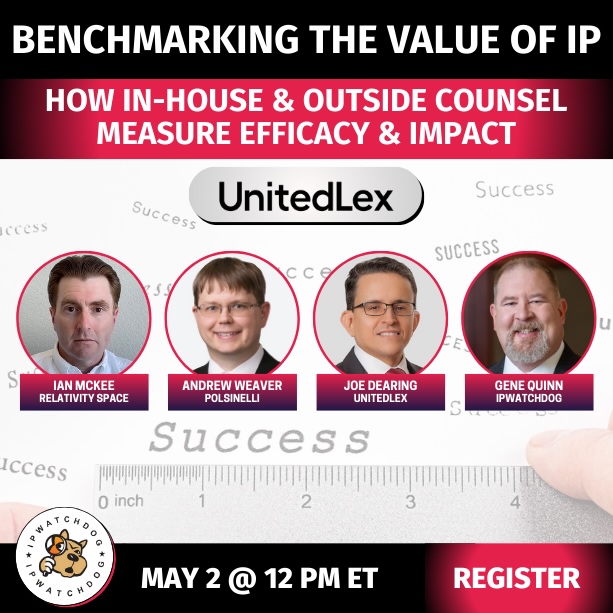
Webinar: Benchmarking the Value of IP – How In-house and Outside Counsel Measure Efficacy and Impact
May 2 @ 12:00 pm - 1:00 pm EDTWebinar: Don’t Be Blindsided – How a Competitive IP Intelligence Program Can Protect Your Company
May 16 @ 10:00 am - 11:00 am EDTFrom IPWatchdog
![[Advertisement]](https://ipwatchdog.com/wp-content/uploads/2021/12/WEBINAR-336-x-280-px.png)
![[Advertisement]](https://ipwatchdog.com/wp-content/uploads/2021/12/2021-Patent-Practice-on-Demand-recorded-Feb-2021-336-x-280.jpg)
![[Advertisement]](https://ipwatchdog.com/wp-content/uploads/2021/12/Ad-4-The-Invent-Patent-System™.png)