
![[IPWatchdog Logo]](https://ipwatchdog.com/wp-content/themes/IPWatchdog%20-%202023/assets/images/temp/logo-small@2x.png)


Recent Episodes
December 10, 2025
Understanding IP Matters: Taming the Wild West of AI
 Play Episode
As AI adoption accelerates, it is crucial that companies act proactively to develop risk, compliance, and ethical frameworks to ensure sustainable innovation and responsible IP use. On the current episode of Understanding IP Matters, Allison Gaul, a registered patent attorney who evaluates digital products with an eye toward intellectual property strategy, value creation, and legal risk, discusses the aggressive landscape of data acquisition by various AI entities.
Play Episode
November 19, 2025
Understanding IP Matters: AI Won’t Replace Human Creativity
Play Episode
Artificial intelligence (AI), viewed from an optimist’s perspective, is an accelerant for humans; a tool to handle tedious tasks that allow users to spend more time and energy on what really matters. On the current episode of Understanding IP Matters (UIPM), Eric Bear, a classically-trained actor, singer and dancer, and now a kinesthetic artist specializing in primate motion capture, discusses the interplay of creativity and technology. Bear is a successful entrepreneur, industry expert and inventor responsible for more than 100 patents.
Play Episode
November 5, 2025
Understanding IP Matters: Piracy Costs Up to $71 Billion Annually
Play Episode
On the current episode of Understanding IP Matters (UIPM), Ruth Vitale, Hollywood producer, founder and co-president of Paramount Classics, and president of Fine Line Features, discusses her efforts to effect U.S. legislation that would allow for site blocking, thereby strengthening the entertainment industry and protecting U.S. consumers. As the entertainment industry is a top cultural exporter in the United States, this added protection and greater retained revenue would ensure this status continues and grows.
Play Episode
October 22, 2025
Understanding IP Matters: ‘AI Adoption Moves at the Speed of Trust’
Play Episode
The value of intellectual property (IP) rights has decreased in the United States over the past 20 years because large tech companies consider patents and copyrights an enemy, not an ally, and because of the difficulty SMEs and independent creators have generating sufficient economic return. But when different stakeholder groups come together, they can develop an equitable and inclusive IP system that moves society forward while supporting their respective business agendas. These are the beliefs of Daryl Lim, a leader in understanding the global IP community.
Play Episode
October 8, 2025
Understanding IP Matters: Patents Don’t Block Innovation, Ignorance Does
Play Episode
The U.S. patent system is facing challenges from many stakeholders, including from groups that believe a weak patent system will result in lower drug prices and more widely available treatments. Such a system would have the opposite effect: fewer treatments being developed due to less research dollars spent. Research and development, and subsequently new drug products, will not occur without a meaningful patent system to provide a level of certainty that investments can be recovered.
Play Episode
July 16, 2025
Understanding IP Matters: Celebrated MIT Engineer and Entrepreneur Develops Medical Devices to Treat Cancer and Other Diseases
Play Episode
Universities have seen their role change since the Bayh-Dole Act was passed in 1980. They have been incentivized for both innovation and economic development, with patents being an important part of that landscape. With impending reductions in government funding for universities, finding new ways to support research has become an incredibly important activity. But replacing the funding is no simple matter and universities will have to find ways to do it.
Play Episode
June 4, 2025
Understanding IP Matters: This Fashionista Doesn’t Wear Fashion – She Covers It
Play Episode
Fashion is a more highly commercial field than other creative pursuits, such as film or music, which have a much longer shelf life. Fashion is produced to be purchased now. The fashion market relies both on IP protection and creativity in establishing brands and new products, and sometimes it can be difficult to draw a line where “borrowing” morphs from an accepted practice to an improper or illegal use.
Play Episode
April 10, 2025
Understanding IP Matters: When IP Rights Lose Their Property-Like Function Innovation Suffers
Play Episode
Some of the largest companies have invested substantial resources to change the rules of the game that govern bargaining over IP assets . This drives downward value of for all IP assets and content in tech markets and endangers innovation, creative expression and society. On the current episode of Understanding IP Matters (UIPM), Jonathan Barnett, a legal scholar focusing on the weaknesses and strengths of the U.S. intellectual property (IP) system, discusses potential ways to repair it. The shift created by companies that underpin these weaknesses is “hard to overstate,” he explains, and has largely been underappreciated.
Play Episode
March 25, 2025
Understanding IP Matters: AI Needs the Right Balance of Innovation and Regulation to Thrive
Play Episode
Some say overregulation of AI will impede development. One innovation policy expert believes both AI and IP rights need a clearer context for AI to operate productively. On the current episode of Understanding IP Matters (UIPM), Dr. Brandie M. Nonnecke, a policy expert with a background in journalism, discusses what responsible AI should be and says that regulation of AI is necessary and, if done properly, will not stifle innovation. Nonnecke knows the reluctance about regulation is a “knee jerk reaction by companies [and] investors to evade oversight,” she says, adding: “But let’s remember that regulation can actually spur a more competitive environment, a more competitive market for them to operate within.”
Play Episode
February 27, 2025
Understanding IP Matters: Emmy Award-Winning Immunologist is Remaking the Idea of Science and Technology
Play Episode
Awareness of IP rights is of vital importance to everyone from inventors to the public, especially school children. On the current episode of Understanding IP Matters (UIPM), Dr. Frederic Bertley discusses the state of IP and science education and understanding in the U.S. and abroad, and offers suggestions for how scientists and organizations can overcome knowledge deficits.
Play Episode
February 5, 2025
Understanding IP Matters: Too Much AI Regulation Will Threaten Competition and Jobs, Says Former USPTO Director
Play Episode
On the current episode of Understanding IP Matters (UIPM), Andrei Iancu, who served as Director of the USPTO, 2018-2021, discusses how the government should regulate AI, how President Trump may think about IP rights in his second term, and how the current congressional bills could impact the patent landscape.
Play Episode
January 15, 2025
Understanding IP Matters: Unreliable U.S. Tech Patents Impede Breakthrough Inventions
Play Episode
Stakeholders in U.S. patents no longer have certainty about their rights and it is affecting licensing and transaction activity and impeding innovation. On the current episode of Understanding IP Matters (UIPM), Louis Carbonneau discusses the weakening of the U.S. patent system and why he is hopeful for a future where patent enforcement is more viable but less necessary.
Play Episode
December 11, 2024
Understanding IP Matters: Ex-War Photographer Helps Remove the Source Mystery from Images and Content
Play Episode
Transparency of source or “provenance” of digital content like images is becoming essential for credibility and, to some extent, the future of artificial intelligence (AI). On the current episode of Understanding IP Matters (UIPM), Santiago Lyon discusses the importance of provenance in copyrighted content as it exists in an AI-driven world. As the role of AI has grown in the handling, manipulation and distribution of digital media, Lyon talks about how consumers will know when digital media they view is generated wholly by human creators, wholly by AI, or if there is a blend of creation.
Play Episode
November 20, 2024
Understanding IP Matters: Policy Won’t Save U.S. Innovation; Respect for Property Rights Can
Play Episode
On this episode of Understanding IP Matters (UIPM), Professor Adam Mossoff discusses how private property rights in inventions promote a growing innovation economy and a flourishing society. As the strength of patent rights in the United States has been effectively weakened over the past decade, or so, Mossoff discusses the current state of U.S. patent law and the positive impact bills before the current Congress could have.
Play Episode
November 4, 2024
Understanding IP Matters: Singer-Songwriter Says AI Could Turn Content Providers Into an Endangered Species
Play Episode
Singer-songwriter and cultural maven Elizabeth Nelson discusses the importance of creativity and musician survival to our society on the latest episode of Understanding IP Matters (UIPM). As the role of AI in the creative process changes rapidly, Nelson discusses her advocacy to educate on the importance of a robust, artistic community. Nelson is the lead singer for the band The Paranoid Style, a journalist who publishes articles in the Washington Post, The New Yorker and The New York Times Magazine, as well as a copywriter for Fender Guitars. With a Master’s Degree in sociology she also works in education policy and literacy interventions for middle school children.
Play Episode
About This Podcast
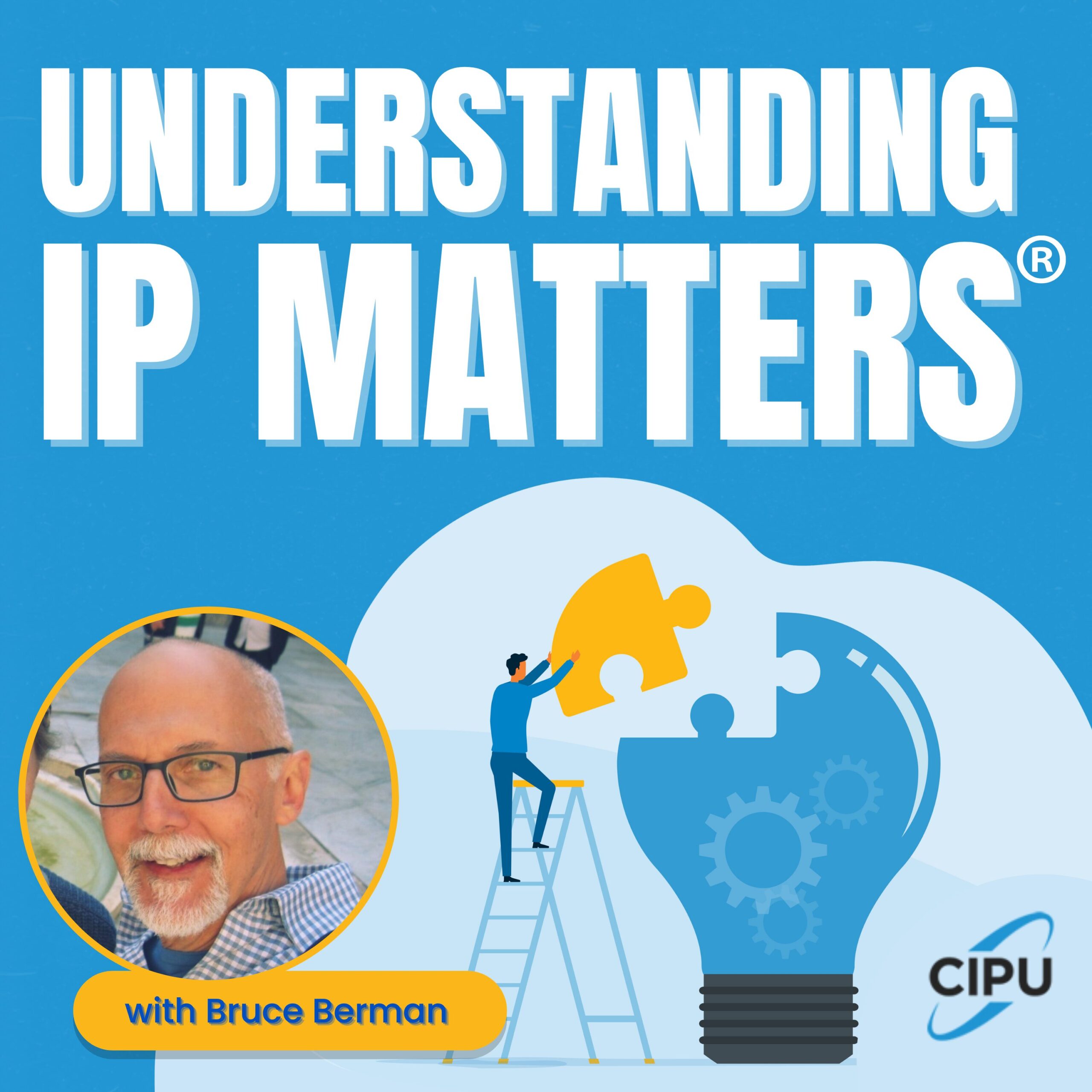
‘Understanding IP Matters’ explores the intellectual property story of people who have succeeded in the world of invention, creative expression, and brand – some with the scars to prove it. Available on both audio and video, the podcast tracks the journey from inventor and content creator to entrepreneur, as well as from business executive and lawyer to IP strategist. Understanding IP Matters episodes have been downloaded more than 15,000 times. Guests share with host Bruce Berman their take on how IP and technology developments impact business, innovation, and society.
For more Understanding IP Matters Episodes, click HERE.
A written transcript of each UIPM episode is available.
Go to Apple Podcasts on your computer or phone; tap the title of the episode you want to read; tap “Listen on Apple Podcasts;” then “Transcript.”
Varsity Sponsors
![[Advertisement]](https://ipwatchdog.com/wp-content/uploads/2026/09/ClaimHit-Oct-1-2026-sidebar-700x500-1.jpg)
![[Advertisement]](https://ipwatchdog.com/wp-content/uploads/2026/09/WE-BUY-PATENTS-SIM-IP-Ad-1-700x500-1.jpeg)
![[Advertisement]](https://ipwatchdog.com/wp-content/uploads/2026/09/Life-Sciences-2026-sidebar-early-bird-price-700x500-1.jpg)
From the IPWatchdog Institute
![[Advertisement]](https://ipwatchdog.com/wp-content/uploads/2024/09/Patent-Prosecution-Training-sidebar-700x500-2025-03-27.jpg)

Latest IPW Posts
Epiq Counsel Client is Seeking a Senior Trademark Paralegal (Global Portfolio | In-House)
September 25, 2026 @ 06:15 amEpiq Counsel Client is Seeking a Patent Paralegal (Global Portfolio | In-House)
September 25, 2026 @ 05:15 amSquires’ Anniversary Celebration Raises Serious Ethical, Legal Questions
September 24, 2026 @ 03:15 pmCoke Stewart Tells Women’s IP Forum It’s Time to ‘Shock’ the U.S. Patent System Into Action
September 24, 2026 @ 01:36 pm
Latest Podcasts



IPWatchdog Events
Webinar: AI for Patent Licensing – Beyond Statistical Triage to Evidence-Grounded Product Analysis
October 1 @ 12:00 pm - 1:00 pm EDTCLE Webinar: Protecting the Product – Mapping Features to Patent Claims and Closing Coverage Gaps
October 13 @ 12:00 pm - 1:00 pm EDTCLE Webinar: How to Prompt AI – University IP Workflows in Action
October 15 @ 12:00 pm - 1:00 pm EDT
Industry Events
AI Skills: A Phased Roadmap for Junior and Senior Attorneys (CLE Webinar)
September 29 @ 1:00 pm - 1:30 pm EDTFrom IPWatchdog
![[Advertisement]](https://ipwatchdog.com/wp-content/uploads/2021/12/WEBINAR-336-x-280-px.png)
![[Advertisement]](https://ipwatchdog.com/wp-content/uploads/2021/12/Ad-4-The-Invent-Patent-System™.png)