
![[IPWatchdog Logo]](https://ipwatchdog.com/wp-content/themes/IPWatchdog%20-%202023/assets/images/temp/logo-small@2x.png)

 3
3 The U.S. patent system is facing challenges from many stakeholders, including from groups that believe a weak patent system will result in lower drug prices and more widely available treatments.
Such a system would have the opposite effect: fewer treatments being developed due to less research dollars spent. Research and development, and subsequently new drug products, will not occur without a meaningful patent system to provide a level of certainty that investments can be recovered.
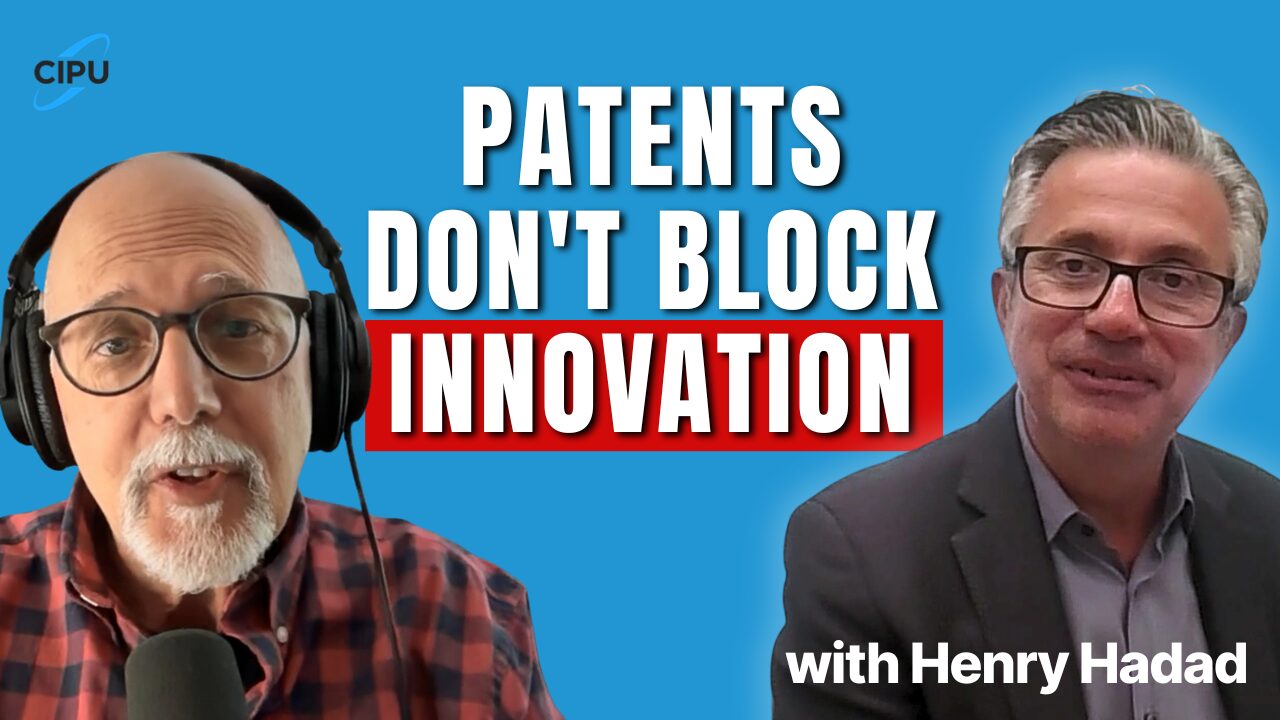
On the current episode of Understanding IP Matters (UIPM), for the first time on audio and video, Henry Hadad, Senior Vice President & Deputy General Counsel, Innovation Law, at Bristol Myers Squibb, whose family includes successful songwriters, one an Oscar-winner, believes that confusion over the reliability of IP rights slows breakthroughs and discourages investment.
Henry leads a team supporting Bristol Myers’ efforts to discover, develop and deliver groundbreaking treatments for patients with serious unmet medical needs. He is a recognized leader in the IP community, serving on the board of the Intellectual Property Owners Association (IPO), and currently as President of the IPO Education Foundation. Henry is a well-known advocate for a strong and predictable IP system that drives innovation and economic opportunities for all.
In this episode of “Understanding IP Matters,” Hadad and host Bruce Berman discuss:
- Education about the importance and impact of patents and IP, and how, without a better public understanding, there will be a continued “general dilution of the patent system, which I think is bad for society as a whole,” comments Hadad.
- How an unreliable patent system can result in negative long-term consequences.
- An evolution in inventorship rules should occur as Artificial Intelligence becomes more involved in the patenting process, especially in the pharmaceutical industry. Without an evolution in the law, further work in AI will be chilled. “We don’t want to be in a situation where we have a cure for cancer or heart disease and no one develops it because they can’t get patent protection,” notes Hadad.
- The United States has allowed its patent system to decline. This is in contrast to China, which has made an effort to strengthen its patent system. The growth and strength of China’s biotech industry, says Hadad, “should inspire the U.S. to do better. That’s what we need. We want a healthy, happy competition here to get the best drugs to the patients.”
- Now is not the time for complacency. Hadad implores: “Let’s keep the innovation engine going; let’s keep it driving forward because we’re on the cusp of great, great things.”
![[Advertisement]](https://ipwatchdog.com/wp-content/uploads/2026/09/ClaimHit-Oct-1-2026-sidebar-700x500-1.jpg)
![[Advertisement]](https://ipwatchdog.com/wp-content/uploads/2026/09/WE-BUY-PATENTS-SIM-IP-Ad-1-700x500-1.jpeg)
![[Advertisement]](https://ipwatchdog.com/wp-content/uploads/2026/09/Life-Sciences-2026-sidebar-early-bird-price-700x500-1.jpg)
![[Advertisement]](https://ipwatchdog.com/wp-content/uploads/2024/09/Patent-Prosecution-Training-sidebar-700x500-2025-03-27.jpg)




![[Advertisement]](https://ipwatchdog.com/wp-content/uploads/2021/12/WEBINAR-336-x-280-px.png)
![[Advertisement]](https://ipwatchdog.com/wp-content/uploads/2021/12/Ad-4-The-Invent-Patent-System™.png)




Join the Discussion
3 comments so far.
Anon
October 13, 2025 08:36 amSomething that struck me as I viewed the list of articles this morning.
The partial title of this particular article, “Patents Don’t Block Innovation, Ignorance Does” carries a subtle nuanced meaning that bears making explicit:
Blocking not does and can happen with patents, but this type of blocking is exactly what is desired from a patent system.
The patent system has always meant to be aboth a carrot and a stick approach, and the blocking aspect is absolutely critical and necessary.
The promotion aspect directly flows from this blocking. If one is blocked, one then is promoted to creating a new and different way of reaching what one wants.
This is not a bug.
This is a feature.
Anon
October 8, 2025 01:26 pmBravo regarding the recognition of the detriments of false narratives (from the Efficient InFringer Front, for example).
Nice discussion on the view that “inventorship” should be reconsidered in view of non-human inventors, in whole or in part (AI invented elements that a human cannot satisfy the current legal requirement as inventor). Computer tools and AI tools do need to be recognized for the critical differences that exist.
The problem with merely wanting something different necessarily draws back to the Lockeian nature that informs the Constitutional basis of the patent right at its foundation.
On a separate point, I do not agree with an implied notion that Pharma patents should be treated differently than other patents in different arts. Any such ‘divide and conquer mentality cannot survive the historical evolution of innovation.
Model 101
October 8, 2025 08:49 amSpot on!!!!!
I hope that the idiot judges on the Supreme Court and CAFC can find a way in their megalomaniac stupidity to understand this.