
![[IPWatchdog Logo]](https://ipwatchdog.com/wp-content/themes/IPWatchdog%20-%202023/assets/images/temp/logo-small@2x.png)
Posts in Federal Circuit
Split Federal Circuit Upholds Smart Mobile Patent Claims Against Challenge from Apple
The U.S. Court of Appeals for the Federal Circuit (CAFC) on Friday affirmed a final written decision from the Patent Trial and Appeal Board (PTAB) in an inter partes review (IPR) proceeding filed by Apple, Inc. The court’s decision upheld the patentability of several claims of a Smart Mobile Technologies LLC patent that Apple had challenged as obvious, with Circuit Judge Dyk issuing a partial dissent.
CAFC Vacates Summary Judgment on Inequitable Conduct and Walker Process Claims in Coiled Tubing Patent Dispute
The U.S. Court of Appeals for the Federal Circuit (CAFC) today issued a precedential decision in Global Tubing LLC v. Tenaris Coiled Tubes LLC vacating a district court’s summary judgment rulings on both inequitable conduct and a Walker Process fraud claim. The court determined that genuine disputes of material fact precluded summary judgment on both issues and remanded the case for further proceedings.
Tesla Loses at CAFC in Split Decision Upholding EV Charger Claims
Charge Fusion Technologies, LLC has managed to defend its patent at the U.S. Court of Appeals for the Federal Circuit (CAFC), with a split panel on Thursday affirming the Patent Trial and Appeal Board’s (PTAB’s) decision that Tesla failed to prove Charge Fusion’s electric vehicle (EV) charger claims unpatentable. The opinion was authored by Judge Chen, who was joined by Judge Reyna, while Judge Dyk filed a dissenting opinion.
Federal Circuit Denies Another Mandamus Petition Challenging USPTO’s ‘Settled Expectations’ Doctrine
The U.S. Court of Appeals for the Federal Circuit (CAFC) on Wednesday issued an order in In re Kahoot! AS, denying another petition for writ of mandamus that challenged the U.S. Patent and Trademark Office (USPTO) Director’s refusal to institute an inter partes review (IPR) petition based on “settled expectations” of the patent owner. The per curiam order was issued by Circuit Judges Taranto, Mayer, and Stark.
Tariff Ruling ‘Trumps’ Volkswagen’s Bid to Stop Squires’ IPR Institution Policy
On February 20, 2026, the Supreme Court decided Learning Resources, Inc. v. Trump, 607 U.S. ___ (2026), affirming the Federal Circuit’s en banc decision in V.O.S. Selections, Inc. v. Trump, that the International Emergency Economic Powers Act (IEEPA) does not authorize the President to impose tariffs. And it means the Federal Circuit should rule in favor of Director Squires and against Volkswagen in one of the more constitutionally focused writs of mandamus challenging Squires and his use of discretion to decide institution of inter partes reviews (IPRs). And there is no need for an oral argument.
CAFC Shoots Down Three More Mandamus Petitions Seeking to Curb USPTO Denial of IPR Institution
The U.S. Court of Appeal for the Federal Circuit (CAFC) on Tuesday issued three orders denying mandamus petitions filed by inter partes review (IPR) petitioners at the Patent Trial and Appeal Board (PTAB). Each of the petitioners was seeking relief from the court to compel the U.S. Patent and Trademark Office (USPTO) to institute their IPR petitions, following decisions that denied institution of the IPRs.
Federal Circuit Affirms Section 101 Ineligibility of AI Patent in Win for Amazon
The U.S. Court of Appeals for the Federal Circuit (CAFC) today affirmed a summary judgment ruling from the United States District Court for the Northern District of New York finding the claims of a natural language processing patent asserted against Amazon.com, Inc. invalid for being directed to ineligible subject matter. Rensselaer Polytechnic Institute and CF Dynamic Advances LLC originally brought the lawsuit against Amazon for infringement of United States Patent No. 7,177,798, which discloses a “method for processing a natural language input provided by a user.”
CAFC Affirms PTAB Rulings Upholding Netlist Patent
The U.S. Court of Appeals for the Federal Circuit (CAFC) on February 20 affirmed two final written decisions from the Patent Trial and Appeal Board (PTAB) in inter partes review (IPR) proceedings upholding claims of Netlist, Inc.’s patent.
CAFC Reverses 101 Ineligibility Ruling, Finds Gene Therapy Claims Are Not Directed to a Natural Phenomenon
The U.S. Court of Appeals for the Federal Circuit (CAFC) in a precedential decision on Friday reversed a district court’s grant of summary judgment that REGENEXBIO, Inc.’s patent claims were ineligible as directed to a natural phenomenon. The U.S. District Court for the District of Delaware found that REGENXBIO’s and the Trustees of the University of Pennsylvania’s gene therapy patent claims were directed to a natural phenomenon and therefore patent ineligible under 35 U.S.C. § 101. But the unanimous CAFC reversed that decision, thereby reviving REGENEXBIO’s infringement suit against Sarepta Therapeutics, Inc. and Sarepta Therapeutics Three, LLC.
Sony Prevails at CAFC in Decision Faulting Patent Owner’s Means-Plus-Function Analysis
The U.S. Court of Appeals for the Federal Circuit (CAFC) on Thursday issued a precedential decision finding Sony’s Playstation controllers and consoles did not infringe Genuine Enabling Technology’s (GET’s) patent for computer input devices. GET alleged that Sony directly and indirectly infringed its U.S. Patent No. 6,219,730 via certain Playstation products. Specifically, GET said that the products’ Bluetooth module “synchronized user input from controller buttons with input from controller sensors,” thereby meeting the claims’ “encoding means” limitation.
CAFC Partially Affirms PTAB Unpatentability Decision for Samsung but Vacates on Unchallenged Claims
The U.S. Court of Appeals for the Federal Circuit (CAFC) on Wednesday affirmed in part a decision of the Patent Trial and Appeal Board (PTAB) finding certain claims of ST Case1Tech, LLC’s (ST1’s) patent obvious, but vacated the decision as to two claims that petitioner Samsung had not challenged before the Board. The panel included Judges Reyna, Taranto and Stark and was authored by Judge Stark.
CAFC Affirms $42.5 Million Patent Infringement Verdict in Pre-Lit Christmas Tree Dispute
The U.S. Court of Appeals for the Federal Circuit (CAFC) on Tuesday issued a precedential decision in Willis Electric Co. v. Polygroup Ltd., affirming a jury verdict that found Polygroup liable for patent infringement. The CAFC upheld the U.S. District Court for the District of Minnesota’s decision to deny Polygroup’s post-trial motions for judgment as a matter of law (JMOL) on obviousness and for a new trial on damages. As a result, the ruling included an award of nearly $42.5 million in damages to Willis Electric Co., Ltd. Chief Judge Moore authored the opinion, joined by Judge Stark and District Judge Oetken.
CAFC Affirms $84.8 Million Antitrust Verdict Against Ingevity in Patent Tying Case
The U.S. Court of Appeals for the Federal Circuit (CAFC) today issued a precedential decision in Ingevity Corporation v. BASF Corporation, affirming a jury verdict that found Ingevity liable for unlawful tying under federal antitrust laws. On appeal, the CAFC upheld the U.S. District Court for the District of Delaware’s decision to deny Ingevity’s post-trial motions for judgment as a matter of law (JMOL). As a result, the ruling included an award of more than $84 million in trebled damages to BASF Corporation (BASF). Judge Lourie authored the unanimous opinion, joined by Judges Prost and Cunningham.
CAFC Partially Reverses Abiomed Patent Win, Revives Maquet Infringement Claims
The U.S. Court of Appeals for the Federal Circuit (CAFC) on Monday issued a decision that affirmed in part, vacated in part, and remanded a ruling from the U.S. District Court for the District of Massachusetts in a patent dispute between Maquet Cardiovascular LLC and Abiomed Inc. The Federal Circuit agreed with the lower court that certain claims of one Maquet patent were not infringed by Abiomed’s Impella heart pumps, but revived Maquet’s infringement allegations on five other patents after finding the district court had improperly construed key claim terms.
Netflix Scores Win at CAFC in Reversal of 101 Decision for Patent Owner
The U.S. Court of Appeals for the Federal Circuit (CAFC) on Monday in part reversed a district court’s decision upholding GoTV Streaming, LLC’s patents as eligible, finding instead that they were invalid under Section 101. While the opinion, authored by Judge Taranto, also reversed the district court’s finding that the claims were invalid for indefiniteness, the panel found they were directed to an abstract idea and therefore vacated the district court’s summary judgment of no inducement and its denial of GoTV’s motion for a new trial on damages, ordering the district court to enter judgment for Netflix, Inc., ending the case.
Varsity Sponsors
![[Advertisement]](https://ipwatchdog.com/wp-content/uploads/2026/02/Integral-Molecular-Mar-5-2026-sidebar-700x500-1.jpg)
![[Advertisement]](https://ipwatchdog.com/wp-content/uploads/2026/02/LIVE-2026-sidebar-regular-price-new-700x500-1.jpg)

Latest IPW Posts
Supreme Court Denies Thaler’s Latest Attempt to Register Copyright to AI-Generated Image
March 2, 2026 @ 05:42 pmSquires Updates Conflict of Interest Guidance for Examiners Following DOJ Settlement Announcement
March 2, 2026 @ 04:15 pmDOJ and USPTO File Statement Backing Injunctions for NPEs
March 2, 2026 @ 02:15 pmSplit Federal Circuit Upholds Smart Mobile Patent Claims Against Challenge from Apple
March 2, 2026 @ 12:15 pmOpinion: The ITC Has Lost Sight of the Public Interest
March 2, 2026 @ 07:15 am
Latest Podcasts
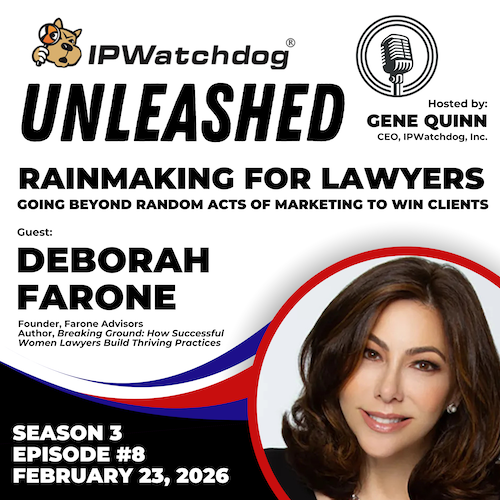

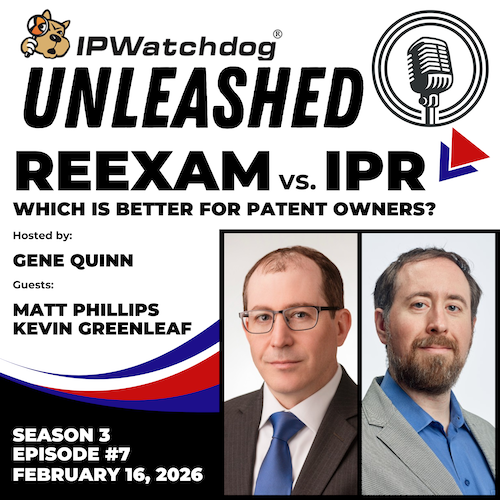
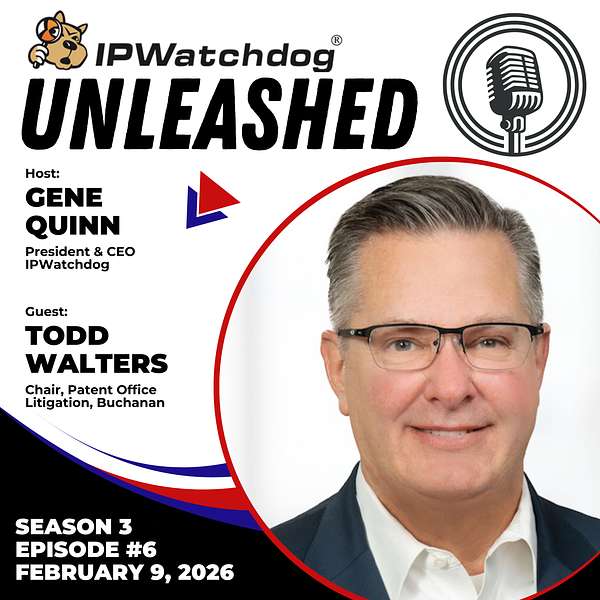
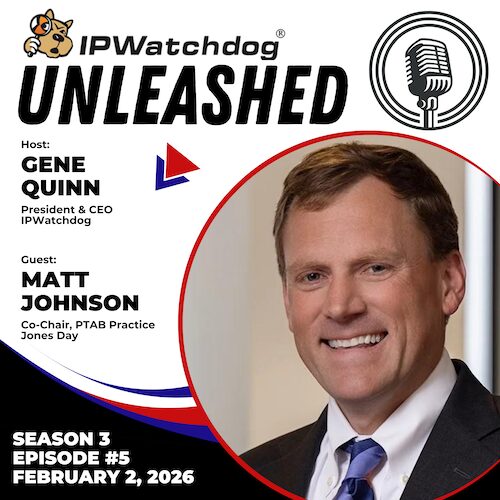
IPWatchdog Events
Webinar: Resurrecting Antibody Genus Protection – Allowed Claims Through CDR-Scanning
March 5 @ 12:00 pm - 1:00 pm ESTIPWatchdog LIVE 2026 at the Renaissance Arlington Capital View
March 22 @ 1:00 pm - March 24 @ 7:00 pm EDT
Industry Events
24th Annual Rocky Mountain Intellectual Property & Technology Law Institute
May 28 @ 8:30 am - May 29 @ 4:30 pm MDTFrom IPWatchdog
![[Advertisement]](https://ipwatchdog.com/wp-content/uploads/2021/12/WEBINAR-336-x-280-px.png)
![[Advertisement]](https://ipwatchdog.com/wp-content/uploads/2021/12/Ad-4-The-Invent-Patent-System™.png)