
![[IPWatchdog Logo]](https://ipwatchdog.com/wp-content/themes/IPWatchdog%20-%202023/assets/images/temp/logo-small@2x.png)

 0
0 “The court…found that the PTAB’s reading of the petition was the most natural understanding of the language Apple used.”
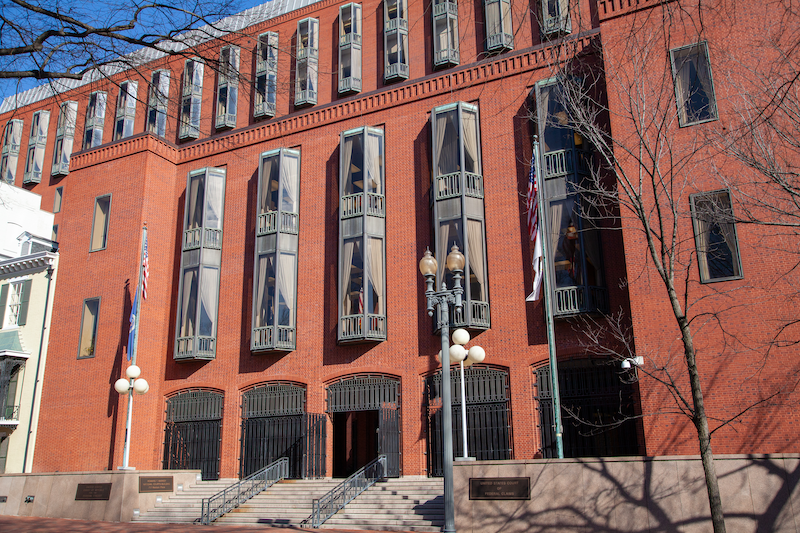 The U.S. Court of Appeals for the Federal Circuit (CAFC) on Friday affirmed a final written decision from the Patent Trial and Appeal Board (PTAB) in an inter partes review (IPR) proceeding filed by Apple, Inc. The court’s decision upheld the patentability of several claims of a Smart Mobile Technologies LLC patent that Apple had challenged as obvious, with Circuit Judge Dyk issuing a partial dissent.
The dispute concerned U.S. Patent No. 9,614,943, which has a priority chain dating back to 1996 and is titled “System to Interface Internet Protocol (IP) Based Wireless Devices With Subtasks and Channels.” The patent addresses a need for wireless devices to have multiple transmitters and receivers to improve signal fidelity and bandwidth. It proposes adding “multiple antennas” to wireless devices, particularly cellular telephones, as well as to stationary network components it calls “network switch boxes.” The patent also describes an embodiment where the devices may participate in a virtual private network (VPN).
Apple initiated an IPR in May 2022, asserting that claims 1–9 and 12–20 of the ‘943 patent were obvious based on nine grounds involving six prior art references. In its final decision in December 2023, the PTAB agreed with Apple in part, holding claims 1, 5–9, and 12–14 unpatentable for obviousness. However, the PTAB upheld claims 2–4 and 15–20, finding that Apple had not provided adequate rationales for combining two specific pairs of prior art references. Apple appealed the PTAB’s decision concerning these upheld claims.
In an opinion authored by Judge Taranto, the Federal Circuit affirmed the PTAB’s findings on both challenges. The first argument involved claims 3 and 4, which Apple argued would have been obvious based on a combination of a European patent application known as “Byrne,” which describes a multi-mode radio telephone, and an international publication known as “WO748” that describes a system to improve in-building wireless reception. The second challenge concerned claims 2–4 and 15–20, which Apple contended were obvious over combinations involving Byrne and a U.S. patent referred to as “Raleigh,” which describes a process for improving communication in systems with multiple transmitters and receivers.
Regarding the Byrne-WO748 combination, the Federal Circuit agreed with the PTAB’s conclusion that Apple failed to show a motivation to combine the references. The PTAB had found that Apple did not persuasively demonstrate why a person of ordinary skill in the art would have been motivated to add a VPN to the telephone described in Byrne, especially since the Byrne reference already included its own encryption measures. The Federal Circuit determined that the PTAB acted within its discretion in how it interpreted Apple’s petition. The court noted that the PTAB reasonably understood Apple’s argument to be that Byrne’s telephone itself would communicate over the VPN, and that Apple had not proven this would offer a benefit over the phone’s existing security features. The opinion stated, “Apple has not made a showing that the Board unreasonably understood the motivation assertion of Apple’s petition.” The court found that the PTAB’s reading of the petition was the “most natural understanding” of the language Apple used. Since it found the PTAB’s conclusion on the lack of motivation was supported by substantial evidence, the court did not need to address the PTAB’s separate finding that there was no reasonable expectation of success in making the combination.
Furthermore, the PTAB rejected Apple’s arguments because it found no reasonable expectation of success in combining the two references into a single telephone, citing various “implementation challenges.” Apple argued that the PTAB abused its discretion by limiting its analysis to a telephone and failing to consider other implementations, such as in a vehicle, which are among the “remote units” described in the Raleigh patent. The Federal Circuit disagreed, finding the PTAB was within its discretion to assess only the theory that was clearly presented in Apple’s petition. The court noted that the petition repeatedly referred to the combined device as a “telephone” and did not clearly present an argument for a non-telephone combination. The court concluded that the PTAB did not ignore Apple’s evidence but rather found it unpersuasive, determining that “the full record shows insufficient support for Apple’s only reasonable expectation of success argument for the Raleigh-Byrne combination.”
Judge Dyk concurred with the majority’s decision on the Raleigh-Byrne grounds but dissented on the Byrne-WO748 combination for claims 3 and 4. In his dissent, Judge Dyk argued that substantial evidence did not support the PTAB’s finding of insufficient motivation to combine. He reasoned that the communication path involved at least two legs, a first wireless leg between the phone and the remote unit, and a second wired leg over a public network. Even if Byrne’s encryption protected the first leg, a skilled artisan would have been motivated to use a VPN to protect the second leg. Judge Dyk wrote that Apple’s uncontroverted evidence showed that a VPN would provide a “secure tunnel” through the “public network,” and that the PTAB and the majority missed this point. He concluded that he would vacate the PTAB’s findings on claims 3 and 4 and remanded the case for further consideration. Ultimately, the Federal Circuit affirmed the PTAB’s decision, leaving claims 2–4 and 15–20 of Smart Mobile’s ‘943 patent valid.
![[Advertisement]](https://ipwatchdog.com/wp-content/uploads/2026/06/Patently-Jun-23-2026-sidebar-700x500-1.jpg)
![[Advertisement]](https://ipwatchdog.com/wp-content/uploads/2026/06/Patent-Bots-Jun-25-2026-sidebar-700x500-1.jpg)




![[Advertisement]](https://ipwatchdog.com/wp-content/uploads/2021/12/WEBINAR-336-x-280-px.png)
![[Advertisement]](https://ipwatchdog.com/wp-content/uploads/2021/12/Ad-4-The-Invent-Patent-System™.png)




Join the Discussion
No comments yet.