
![[IPWatchdog Logo]](https://ipwatchdog.com/wp-content/themes/IPWatchdog%20-%202023/assets/images/temp/logo-small@2x.png)

 3
3 “IP is no longer ancillary; it is the core of enterprise value.” – Cornerstone Report
Source: Cornerstone Report
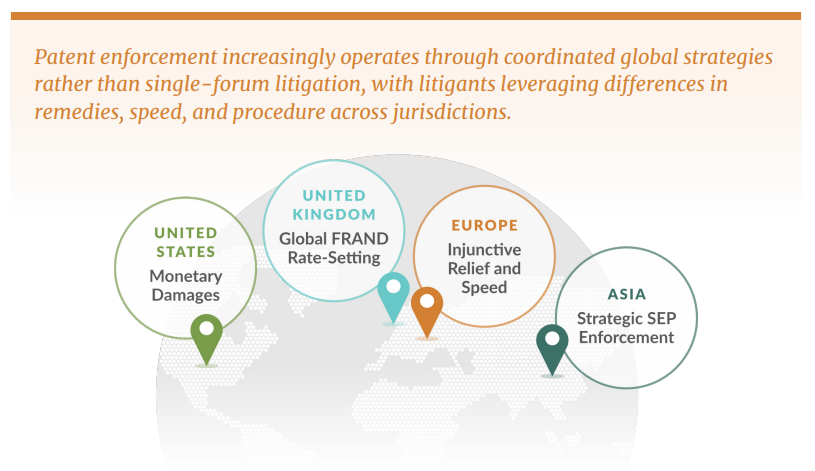
Last week, economic consulting firm Cornerstone Research published a report, titled Intellectual Property Litigation: U.S. Trends in Global Perspective, detailing global diversification in patent litigation and indicating that the United States is no longer the dominant forum for patent disputes. This shift away from a U.S.-centric infringement landscape has taken place at the same time that intangible assets now represent the vast majority of corporate value with many intellectual property (IP) owners increasingly choosing trade secret protection for domestic disputes, a trend being driven by advances in artificial intelligence (AI) technology.
U.S. Patent Enforcement Fragments During Rise of Corporate Value of Intangible Assets
The last fifty years has seen tremendous pace in global innovation turning intellectual property from an afterthought to the foundation of modern corporate value. Whereas tangible assets accounted for 83% of value for corporations listed on the S&P 500 in 1973, today more than 90% of a corporation’s value is attributable to intangible assets like patents, software, data and brands. “IP is no longer ancillary; it is the core of enterprise value,” Cornerstone’s IP litigation report declares.
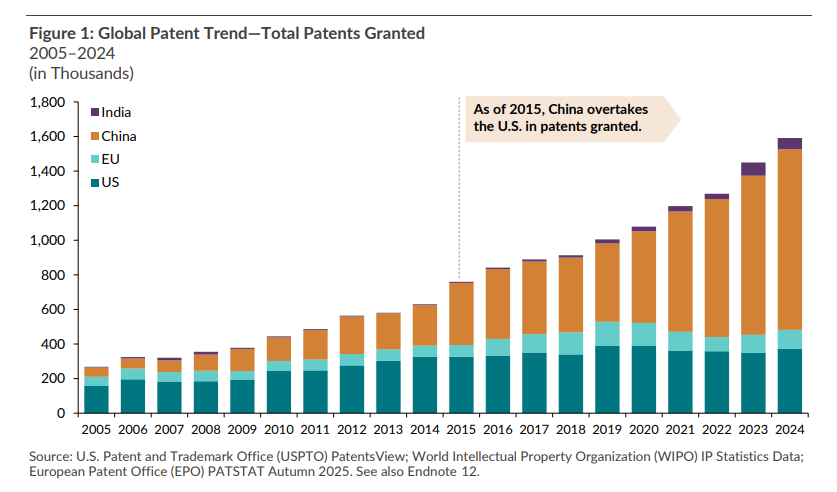
Although the U.S. remains a top source of high-value innovation due to blue-chip technology firms and a large concentration of deep venture capital and research and development (R&D) infrastructure, Cornerstone’s report highlights that our nation no longer maintains the lead role in global patenting. Along with a mature innovation base in the European Union, China has arisen from a secondary player in the 2000s into the primary driver of patent growth, overtaking the United States in 2015 in total numbers of patents granted. In just the past few years, India has also emerged as a major patent jurisdiction, with Cornerstone noting policy reforms, expanding R&D activity and deeper integration into global technology ecosystems as major reasons behind that nation’s rise.
At the same time that intangible asset value has exploded, the process of protecting that value through patent rights has become more fragmented and uncertain in the United States. Much of this uncertainty has been introduced by the U.S. Supreme Court’s eBay v. MercExchange (2006) ruling removing the presumption of injunctive relief for patent owners proving infringement, as well as passage of the America Invents Act (AIA) in 2011. Although patent infringement filings in the U.S. increased immediately following the AIA’s enactment, Cornerstone found a series of procedural and institutional changes causing a decline in filings that stabilized beginning around 2020.
Currently, enforcement of U.S. patents is strongest in industries with complex technology stacks, interoperability requirements and large downstream commercial markets, the Cornerstone report notes. According to the economic research firm, many U.S. patent disputes today center on foundational technologies underpinning the digital economy such as wireless communications and connected devices, cases which often involve standards-essential patents (SEPs), as well as life sciences cases where dispute outcomes materially affect competitive positioning and revenue trajectories, Cornerstone notes. Other major recent shifts in IP litigation include a rise of Schedule A litigation to enforce IP in online ecosystems, and monetization-focused enforcement campaigns by non-practicing entities (NPEs).
Patent Enforcement Being Exported to Courts Offering Injunctive Relief, Setting Global Rates
Compared to other jurisdictions, patent enforcement in the United States is a slow process that has resulted in a median time-to-trial of about 2.5 years between 2015 and 2025, with parallel proceedings at the AIA-enacted Patent Trial and Appeal Board (PTAB) creating significant timeline extensions. During that same period of time, specialized IP courts and administrative processes in China and the EU’s introduction of the Unified Patent Court (UPC) have created shorter pathways to adjudication in those jurisdictions. Further, national courts in Germany and elsewhere remain attractive alternatives to companies owning U.S. patents because of shorter timelines and the possibility of obtaining injunctive relief.
Several structural impacts wrought by the AIA, including joinder rules resulting in increased numbers of total filings and shifting invalidity battles to the PTAB, have reinforced the post-eBay decline in injunctive relief which is now overwhelmingly awarded to product companies. These complexities in obtaining relief from patent rights have led to a rise in trade secret cases accelerated by passage of the Defend Trade Secrets Act (DTSA) of 2016, which created a federal cause of action for misappropriation under a uniform nationwide framework.
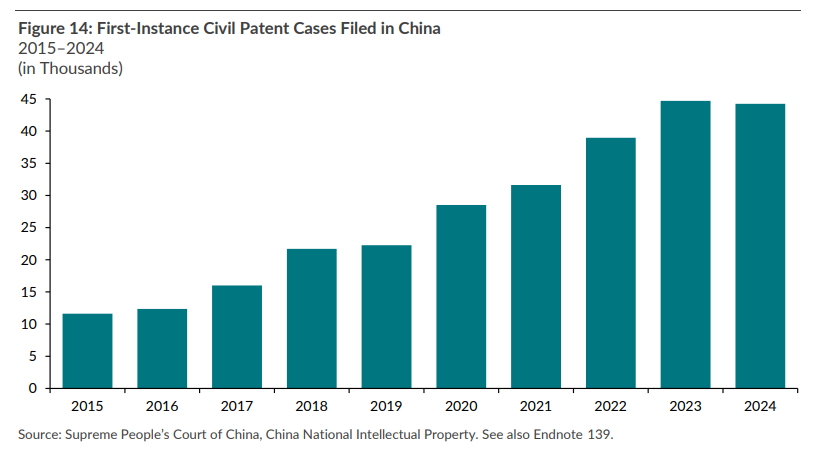 Along with Europe and China, patent enforcement has also been exported globally to nations like the United Kingdom, where courts have been setting global rates for SEP licensing, and the Netherlands, where pathways to injunctions are rapid. China has also emerged as a major patent litigation venue, with first-instance civil cases for patent infringement rising from more than 10,000 cases filed in 2015 up to nearly 45,000 such cases filed in 2023. Cornerstone’s report notes that other major venues for patent enforcement currently include Brazil, where automatic patent term extension mechanisms have been struck down by high court rulings, and Colombia, where the availability of injunctive relief in SEP litigation makes it an important jurisdiction in global enforcement campaigns.
Cornerstone’s report concludes by highlighting major changes to both IP law and economics created by the advent of AI. Fair use rulings in U.S. copyright cases like Bartz v. Anthropic have moved legal analyses away from the legal permissibility of AI training toward economic questions like licensing-market effects and market substitution. The application of fair use doctrine diverges in the EU, where text and data mining exceptions are enumerated under the Copyright Directive, and countries like India and the UK where fair dealing frameworks limit permissible AI training to specific purposes.
Global differences in legal frameworks across the IP spectrum are likely to accelerate forces like regulatory fragmentation and forum competition, Cornerstone’s report concludes. With the global expansion of AI shaping how IP enforcement is conducted, the way nations define their IP laws individually says much about the future prospects of U.S. patent rights in light of the global diversification of infringement filings.
![[Advertisement]](https://ipwatchdog.com/wp-content/uploads/2026/06/Womens-IP-Forum-2026-sidebar-super-early-bird-ends-July-24-700x500-1.jpg)
![[Advertisement]](https://ipwatchdog.com/wp-content/uploads/2026/07/Juristat-Varsity-Ad-2026-IPW-ad-Solo_2.png)
![[Advertisement]](https://ipwatchdog.com/wp-content/uploads/2026/07/DeepIP-Jul-28-2026-sidebar-700x500-1.jpg)
![[Advertisement]](https://ipwatchdog.com/wp-content/uploads/2026/07/Ankar-AI-Jul-30-2026-sidebar-700x500-1.jpg)






![[Advertisement]](https://ipwatchdog.com/wp-content/uploads/2021/12/WEBINAR-336-x-280-px.png)
![[Advertisement]](https://ipwatchdog.com/wp-content/uploads/2021/12/Ad-4-The-Invent-Patent-System™.png)






Join the Discussion
3 comments so far. Add my comment.
Michael J. Schober
June 23, 2026 02:48 pmThe shift toward trade secrets mentioned in the Cornerstone report is one of the most concerning trends here. The fundamental purpose of the patent system is the public exchange of knowledge in return for protection. If companies are forced to lock up their innovations as trade secrets because U.S. patents are too weak or take too long to enforce, it slows down technological progress for everyone. It is no wonder other jurisdictions are capitalizing on our hesitation.
Model 101
June 22, 2026 10:17 amUncertainty?
It is very certain that any patent in litigation will be invalidated by 101.
Nancy J Linck
June 22, 2026 09:10 amThe article doesn’t identify the removal of Judge Pauline Newman from the Federal Circuit by Chief Judge Moore as another contributor to the devaluation of patent rights in the US. Since then, the court has continued in full force without Judge Newman’s dissents to serve as a “death squad” to those patents that survive the PTAB’s and district court’s scrutiny.
Add Comment