


 0
0 “Golf clubs sit among the most heavily patented consumer goods categories in the world…. When an automaker enters this category, it isn’t entering a green field.”

When the world’s best golfers descend on Royal Birkdale in Southport, England, for the 154th Open Championship, they arrive at golf’s oldest major — the tournament that has defined the sport since 1860. Played on the windswept links where the game forged its traditions, The Open has always celebrated history.
But this year, it also marks the arrival of something entirely new.
Europe’s elite automotive manufacturers are stepping onto the first tee. In the months leading up to the Championship, McLaren launched its first premium line of golf irons, while Bugatti, in partnership with Japan’s Honma Golf, unveiled an ultra-luxury collection of clubs carrying price tags more commonly associated with fine watches than sporting equipment. Together, the launches signal more than another round of luxury brand diversification. They reflect a growing convergence of high-performance engineering, intellectual property strategy, and elite sport.
The logic is cleaner than it first appears.
Decades of Exposure
Few industries on earth understand materials science better than high-performance automotive engineering. Carbon composites, titanium alloys, weight distribution, vibration damping, aerodynamic optimization – these are the foundations of modern supercars. Increasingly, they are also the building blocks of the most ambitious golf equipment ever made.
These high-performance manufactures didn’t bring just carbon fiber to golf. They brought decades of patented innovation, and, with it, decades of exposure.
That exposure is not hypothetical. Golf clubs sit among the most heavily patented consumer goods categories in the world: one industry analysis counts more than 2,200 patent filings covering club technology alone, concentrated among seven incumbents: Acushnet/Titleist, Karsten Manufacturing (Ping), Sumitomo Rubber (Cleveland, Srixon), TaylorMade, Bridgestone, Callaway, and PXG – who collectively hold over 90% of that filing volume.
When an automaker enters this category, it isn’t entering a green field. It’s stepping into one of the densest patent thickets in consumer sporting goods, built by manufacturers with a long and active record of litigating to protect it. TaylorMade sued a rival designer as recently as 2024 over its P790 iron patents, alleging that clubs sold through Costco’s Kirkland Signature line infringed five separate patents – a reminder that even long-established players continue to fight over club-head design at the claim level. And two decades earlier, in Karsten Manufacturing Corp. v. Cleveland Golf Co., 242 F.3d 1376 (Fed. Cir. 2001), the maker of Ping clubs lost an infringement suit against Cleveland over the geometry of an iron’s cavity back and trailing edge – a case that turned entirely on how narrowly the asserted patent claims had been drafted during prosecution.
For a newcomer building irons from scratch, that history is the quiet subtext behind every design choice: precisely the kind of claim-construction dispute a company like McLaren now has to design around.
McLaren
 McLaren’s debut Series 1 and Series 3 irons deploy Metal Injection Molding, structural mesh technology, carbon-fiber components, and tungsten weighting. Each of those technologies traces a direct line back to Formula One. The company has stated its mission plainly: to “push the boundaries of equipment design and manufacturing to unlock new levels of precision” for golfers. The brand’s first global golf ambassador, Justin Rose, was involved from the earliest stages of development, reportedly testing prototypes and advising on the club’s design for close to two years before launch, and becoming both an ambassador and an investor in the venture alongside fellow major champion Michelle Wie West and Ryder Cup veteran Ian Poulter.
McLaren’s arrival carries an extra resonance that is easy to overlook.
The modern game of golf was not invented in Japan or California. It was codified in Scotland. The Open Championship (the oldest of the sport’s four majors) remains the game’s most historically charged event. St Andrews, Muirfield, Royal Birkdale, Royal Portrush: the most sacred venues in golf sit on the British Isles.
The sport is woven into Britain’s sporting identity in much the same way motor racing is.
And McLaren’s expansion into golf appears to have been the product of a deliberate, multi-year strategy rather than a short-term branding exercise. The company laid its legal groundwork well ahead of its first product launch: McLaren Services Ltd pursued international trademark protection for MCLAREN GOLF through the Madrid Protocol, with a U.S. application on file as of May 2024, covering not just golf clubs and equipment but apparel, headwear, towels, retail services connected to the sale of golf goods, and the organization of golf events.
Regardless of the precise filing details, the strategic logic is clear enough on its face, and it is worth naming for what it is: the breadth of the classification – extending well past goods and into retail services and event organization – is a textbook brand-protection filing, designed to foreclose gray-market licensing disputes and adjacent squatting before the first club ever reached a retailer. It is also a strategy with a real legal ceiling. UK and EU trademark law does not permit brand owners to register indefinitely broad specifications without consequence. So, when McLaren enters golf, it does not arrive as a foreign luxury brand seeking adjacency. It arrives as a representative of a nation that helped write the rules.
Bugatti
Bugatti has taken a different route, and a considerably more extreme one. Its partnership with Japanese club-making house Honma produced a limited-edition collection that unites Honma’s tradition of meticulous Japanese craftsmanship with Bugatti’s signature approach to materials, proportion, and scarcity. The two companies describe the collaboration as being joined by an “uncompromising pursuit of perfection” — a phrase that sounds like marketing until you see the price architecture: the collection spans three lines, with the most exclusive Super Premium set limited to just twenty examples worldwide.
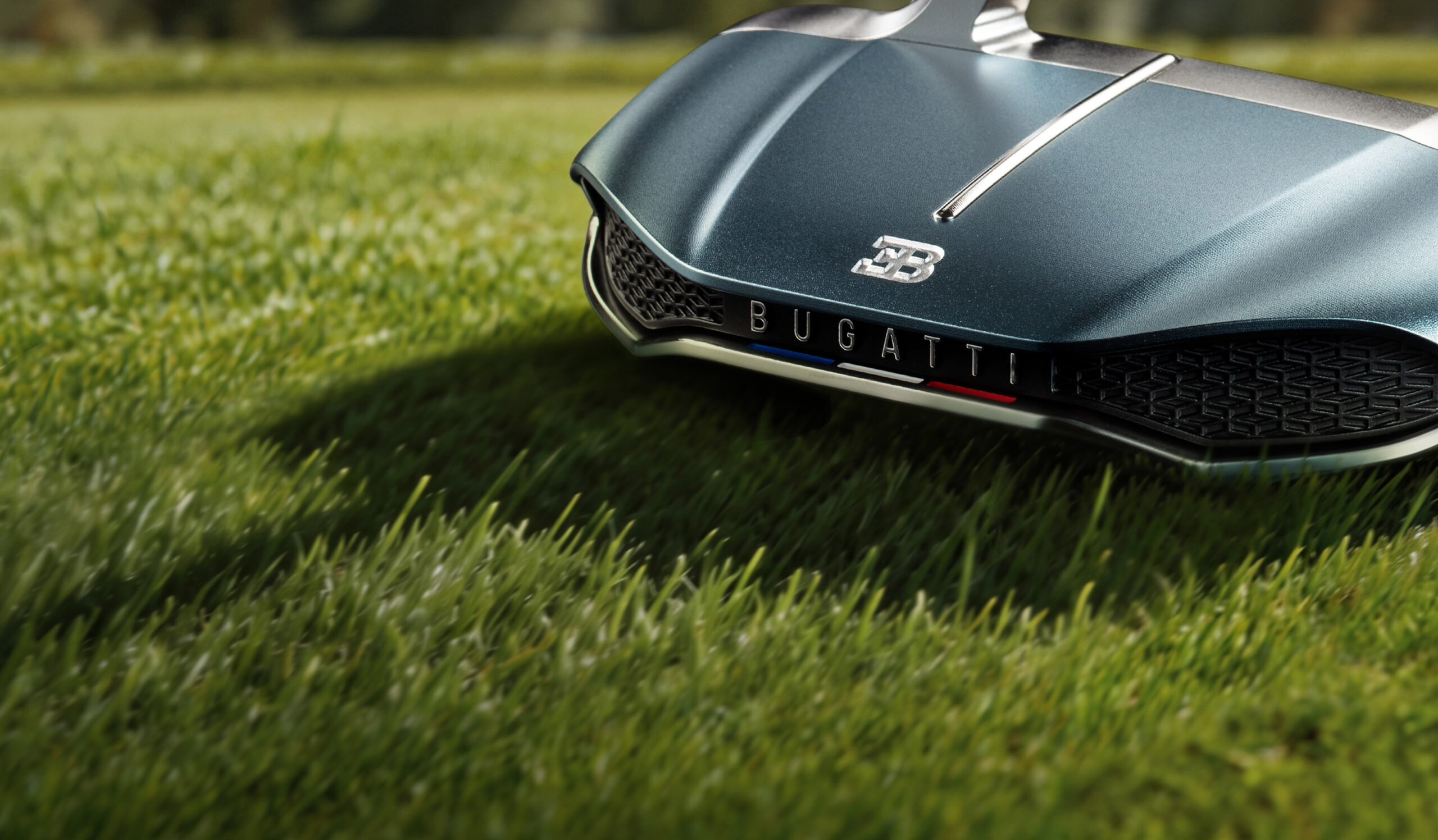 These are not golf clubs in any conventional commercial sense.
They are luxury objects with shafts and faces. Their appeal extends well beyond launch monitor numbers. The equivalent, in old-money terms, is arriving at the club with a limited-edition timepiece showing beneath a cuff.
The Bugatti–Honma collaboration reflects a different, but equally instructive, intellectual-property structure than McLaren’s solo build. Honma brings more than manufacturing capacity to the partnership — it brings an established portfolio of proprietary club-making patents and design registrations built up over decades as an independent manufacturer, according to the company’s own annual reporting.
Bugatti, by contrast, contributes the commercial force of a globally recognized luxury mark. The collaboration thus combines two distinct forms of intellectual property: brand equity on one side, and protected product technology on the other.
That division of labor is exactly the structure that trademark-licensing law is built to police. A brand owner that licenses its mark to a manufacturing partner — as Bugatti has effectively done here — is required under both U.S. and UK/EU law to maintain meaningful quality control over how that mark is used, or risk losing the trademark entirely through what courts call “naked licensing.”
For a car company licensing its name onto hand-built clubs manufactured entirely by a third party, the practical lesson is blunt: whatever quality-control language sits in the underlying agreement between Bugatti and Honma is doing real legal work, not just commercial housekeeping – it’s what stands between a protected luxury collaboration and an unenforceable trademark.
![[Advertisement]](https://ipwatchdog.com/wp-content/uploads/2026/10/Questel-Oct-22-2026-sidebar-700x500-1.jpg)
![[Advertisement]](https://ipwatchdog.com/wp-content/uploads/2026/10/ClaimHit-Oct-28-2026-sidebar-700x500-1.jpg)
![[Advertisement]](https://ipwatchdog.com/wp-content/uploads/2026/09/Life-Sciences-2026-sidebar-early-bird-ends-Oct-25-700x500-1.jpg)
![[Advertisement]](https://ipwatchdog.com/wp-content/uploads/2026/09/WE-BUY-PATENTS-SIM-IP-Ad-1-revised-on-Sep-28-2026-700x500-1.jpg)
![[Advertisement]](https://ipwatchdog.com/wp-content/uploads/2024/09/Patent-Prosecution-Training-sidebar-700x500-2025-03-27.jpg)






![[Advertisement]](https://ipwatchdog.com/wp-content/uploads/2021/12/WEBINAR-336-x-280-px.png)
![[Advertisement]](https://ipwatchdog.com/wp-content/uploads/2021/12/Ad-4-The-Invent-Patent-System™.png)




Join the Discussion
No comments yet.