
![[IPWatchdog Logo]](https://ipwatchdog.com/wp-content/themes/IPWatchdog%20-%202023/assets/images/temp/logo-small@2x.png)

 0
0 “At a time when there is near-universal consensus that we need a more accountable internet…the Supreme Court’s decision is an unfortunate divergence.”
 It’s easy to take for granted that books, news, films, shows, songs, video games, photographs, artwork, and more are ubiquitously available through apps, streams, downloads and other digital means. But the thriving legitimate digital marketplace we enjoy today didn’t emerge by accident. It was built, in significant part, on the historical bedrock of secondary liability—the well-established common-law legal principle that one who assists another in committing a wrong is just as liable as the direct wrongdoer. In the internet ecosystem, that means platforms, internet service providers (ISPs), and other online intermediaries bear some responsibility when they knowingly facilitate or profit from copyright infringement.
We Already Have a Tool to Protect ISPs
In the late 1990s, Congress enacted the Digital Millennium Copyright Act (DMCA), an effort to protect copyright online while ensuring that doctrines of secondary liability didn’t sweep in intermediaries that played their part in combating infringement. Congress.gov describes this bargain as follows: “safe harbors shelter online service providers (OSPs) from liability for indirect copyright infringement on their platforms under certain conditions, while also encouraging OSPs to cooperate with copyright owners in combating infringement online.”
While the DMCA—and courts’ interpretation of it—wasn’t perfect, online platforms, intermediaries, and creators made content widely available to audiences over the internet, but the platforms and intermediaries were not free from any and all accountability. The possibility of secondary liability for copyright infringement created incentives that drove the proliferation of voluntary agreements, notice-and-takedown frameworks, and anti-piracy initiatives that now undergird the entire legitimate digital ecosystem for creative works—giving creators and creative companies some measure of security that digital distribution models wouldn’t be hollowed out by piracy. Without it, there would have been little reason for powerful intermediaries to come to the table at all.
The scale of what the creative economy supports is staggering. According to a recent report, the core copyright industries contribute over $2 trillion to the U.S. economy and employ 11.6 million American workers. These are not abstract statistics. They represent musicians, filmmakers, authors, game developers, journalists, and the countless small businesses that serve and surround them—people whose ability to earn a living depends on an internet where copyright is respected.
Cox Threatens the Balance
That is why the Cox decision, which undermines Congress’ balanced framework, is so troubling. Justice Sotomayor put it plainly in her concurrence, lamenting that “[t]he majority’s new rule completely upends that balance and consigns the safe harbor provision to obsolescence.”
She was right to sound the alarm.
Creators large and small were already facing a daunting challenge in copyright enforcement—litigation is expensive, complex, and slow—and the Cox decision makes matters even more challenging. Large, sophisticated companies can, to some degree, try to weather the erosion of secondary liability’s foundation. They have legal teams, as well as business arrangements that create mutual incentives to protect content. But individual creators and small businesses often lack those tools. The pre-Cox legal backstop was imperfect, but it was something. Now even that is in jeopardy. And sadly, the powerless, whom the law is most fundamentally supposed to protect, will be left defenseless.
Piracy, meanwhile, is not a victimless crime—nor is it solely an economic one. Research by the Digital Citizens Alliance has shown that users who visit pirate websites and apps are three times more likely to report a problem with malware than those who don’t. Moreover, a 2022 investigation found nearly 80% of pirate sites served malware-ridden ads to users. This is not a problem only for lawyers and business executives; it is a public safety problem landing in the living rooms of American families.
The Future Could Be Bleak
Looking ahead, the picture grows more concerning still. Incumbent platforms may retain some incentive to maintain anti-piracy programs—for brand reasons, for advertiser relationships, for the goodwill of the creative communities they depend on, and because some aspects of secondary liability remain. But what about the next generation of AI-driven intermediaries? For a new entrant looking to gain ground, a Cox-blessed blind eye towards infringement could look less like a legal risk and more like a competitive advantage. The decision could become an invitation.
And let’s be clear about who will not lose sleep over any of this: the ISPs, whose business model depends on the number of ratepayers connected to their pipes, not on what those users’ access or the safety of the content on the other side. As long as the bills get paid, the composition of the internet is not their problem. But it is everyone else’s problem—creators, innovators, policymakers, and the public.
Hope in Congress
Congress should be watching carefully to ensure bad actors don’t exploit Cox. At a time when there is near-universal consensus that we need a more accountable internet (e.g. to protect children, the economy, and democracy), the Supreme Court’s decision is an unfortunate divergence. Thankfully, in the short term at least, lower courts have rejected some attempts by Meta and others to dismiss AI related copyright infringement claims on Cox grounds. But the application of the Cox decision must be vigilantly monitored in cases involving AI platforms and other services that may try to invoke the Cox decision to skirt liability.
In the meantime, the good news is that a proven and long-needed anti-piracy tool that could also blunt the impact of the Cox decision is within reach. Judicial site blocking legislation is being considered by a bipartisan, bicameral group of lawmakers—and it’s about time. Fifty-five countries around the world have already adopted safe, effective measures to block access to foreign piracy sites. The results speak for themselves. Peer-reviewed research has repeatedly shown that judicial blocking can reduce piracy to affected sites by as much as 90%. Meanwhile, the United States remains a glaring exception—the top-targeted market by pirates in the world, enticing more than 17.3 billion visits to piracy sites in 2024, far outpacing countries like China and Russia. That is an embarrassing and dangerous distinction.
Judicial site blocking is a safe, effective tool that has been widely deployed around the world to great effect, with no concurrent threats to free speech, access to legal content, or a well-functioning internet. Congress should enact it.
The Cox decision makes it more urgent than ever.
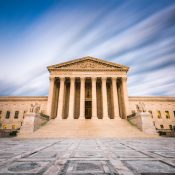
Image Source: Deposit Photos
Image ID: 6496641
Copyright: stuartmiles
![[Advertisement]](https://ipwatchdog.com/wp-content/uploads/2026/07/IP-Author-Aug-6-2026-sidebar-700x500-1.jpg)
![[Advertisement]](https://ipwatchdog.com/wp-content/uploads/2026/07/Juristat-Aug-11-2026-sidebar-700x500-1.jpg)
![[Advertisement]](https://ipwatchdog.com/wp-content/uploads/2026/07/Womens-IP-Forum-2026-sidebar-register-early-bird-now-700x500-1.jpg)
![[Advertisement]](https://ipwatchdog.com/wp-content/uploads/2026/07/ClearstoneIP-Varsity-Ad-2026-Ad-2.jpg)
![[Advertisement]](https://ipwatchdog.com/wp-content/uploads/2026/07/Juristat-Varsity-Ad-2026-IPW-ad-Solo_2.png)
![[Advertisement]](https://ipwatchdog.com/wp-content/uploads/2024/09/Patent-Prosecution-Training-sidebar-700x500-2025-03-27.jpg)




![[Advertisement]](https://ipwatchdog.com/wp-content/uploads/2021/12/WEBINAR-336-x-280-px.png)
![[Advertisement]](https://ipwatchdog.com/wp-content/uploads/2021/12/Ad-4-The-Invent-Patent-System™.png)



Join the Discussion
No comments yet. Add my comment.
Add Comment