
![[IPWatchdog Logo]](https://ipwatchdog.com/wp-content/themes/IPWatchdog%20-%202023/assets/images/temp/logo-small@2x.png)

 0
0 “[Amarin’s] response brief noted that seven other manufacturers sell the same generic drug using materially identical skinny labels and that Amarin has not sued any of them because they confined their marketing to unpatented indications.”
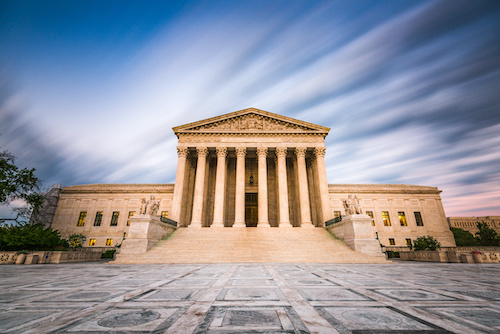 The U.S. Supreme Court on Monday granted the Solicitor General’s motion for leave to participate in oral argument as amicus curiae and for divided argument in Hikma Pharmaceuticals USA Inc. v. Amarin Pharma, Inc., a case concerning induced patent infringement in the pharmaceutical skinny label context. The order followed the filing of a merits response brief by Amarin on March 20, defending the U.S. Court of Appeals for the Federal Circuit (CAFC) decision that found Amarin plausibly alleged that Hikma Pharmaceuticals actively induced infringement of patents covering uses of Amarin’s cardiovascular drug Vascepa.
The Court granted certiorari in January, after Hikma Pharmaceuticals petitioned for review of the CAFC’s June 2024 ruling. Hikma Pharmaceuticals presented two questions, including whether a drugmaker’s labeling a product a “generic version” while citing public sales information about the branded drug constitutes infringement of a patented use fully carved out by the generic’s label. It also asked whether a complaint states an induced infringement claim if it does not allege any instruction or statement by the defendant mentioning the patented use.
According to Amarin’s response brief, the United States Food and Drug Administration (FDA) originally approved Vascepa in 2012 as a treatment for severe hypertriglyceridemia. Amarin thereafter invested more than $300 million and several years into the Reduce It clinical trial, which monitored more than 8,000 patients and demonstrated that Vascepa reduces the risk of major adverse cardiovascular events by up to 30 percent. The FDA approved Vascepa for this cardiovascular indication, which the brief stated physicians described as a “game changer” for patients facing high risks of heart attack or stroke. By 2020, over 90 percent of Vascepa’s sales were attributable to the patented CV indication. Amarin and Mochida Pharmaceutical Co., Ltd. obtained U.S. Patent Nos. 9,700,537 and 10,568,861 to protect these innovations.
Hikma Pharmaceuticals filed an abbreviated new drug application (ANDA) with a section VIII statement seeking approval only for the SH indication, promising to market its generic drug exclusively for the unpatented use. Amarin argued that Hikma Pharmaceuticals. broke that promise by promoting Vascepa in ways intended to capture all sales and uses of the product. The response brief detailed that the Hikma website marketed the generic product for “Hypertriglyceridemia,” a broader term that encompasses the patented CV indication. Press releases issued by Hikma Pharmaceuticals publicized the drug as “generic Vascepa” and its “generic equivalent” without qualification, and touted $919 million in domestic Vascepa sales, which reflected the patented CV use. Amarin also noted that Hikma’s label retained information relevant to CV patients, such as details on statin interactions and a reference to the Reduce It trial, while omitting a “limitation of use” that would have clarified the generic was not approved for cardiovascular risk reduction.
The district court granted Hikma’s motion to dismiss and entered final judgment to facilitate an interlocutory appeal. The CAFC reversed, holding that the complaint plausibly pleaded that Hikma Pharmaceuticals “actively induced healthcare providers’ direct infringement.” The CAFC emphasized that this was “not a section viii case” where the allegations rested solely on a label that was “not skinny enough.” The complaint emphasized “a run-of-the-mill” induced infringement case grounded on “the totality of the allegations of inducement” as “a whole.”
Amarin’s response brief argued that the case does not call for interpreting any statute or regulation governing the pharmaceutical industry, but instead concerns the induced infringement statute protecting all patented inventions under 35 U.S.C. Section 271(b). Amarin contended that Hikma Pharmaceuticals engaged in active inducement by advertising a specific product to an audience for a patented use. Amarin further maintained that the counterarguments offered by Hikma Pharmaceuticals and the United States misapplied the pleading standard by assuming the version of facts presented by Hikma Pharmaceuticals and drawing inferences against Amarin. The response brief emphasized that there is no heightened pleading standard for induced patent infringement and that suggestive references can be actionable, noting that a “single instance” of induced infringement sustains a claim for liability.
Regarding the policy implications, Amarin argued that affirming the CAFC decision would advance the policies underlying the Constitution, the Patent Act, and the Hatch-Waxman Act. The response brief noted that seven other manufacturers sell the same generic drug using materially identical skinny labels and that Amarin has not sued any of them because they confined their marketing to unpatented indications. Amarin also pointed to data showing that the rate of Section VIII filings by eligible generics remained at 43% both before and after the CAFC’s 2021 decision in GlaxoSmithKline LLC v. Teva Pharmaceuticals USA, Inc., countering the argument that the decision below would affect the skinny label pathway.
Amarin also urged the Court to dismiss the writ of certiorari as improvidently granted. It argued that Hikma Pharmaceuticals abandoned the positions it had staked at the certiorari stage, including its contentions regarding pre-Twombly pleading standards and whether inducement is a question of law or fact. Even if the Court concluded that the operative complaint did not meet the pleading threshold, Amarin maintained that it would still be entitled to leave to amend. It noted that fact discovery since the CAFC mandate has uncovered additional evidence of intentionally induced infringement.
The oral argument is set for April 29, 2026.
![[Advertisement]](https://ipwatchdog.com/wp-content/uploads/2026/02/LexisNexis-Mar-31-2026-sidebar-700x500-1.jpg)





![[Advertisement]](https://ipwatchdog.com/wp-content/uploads/2021/12/WEBINAR-336-x-280-px.png)
![[Advertisement]](https://ipwatchdog.com/wp-content/uploads/2021/12/Ad-4-The-Invent-Patent-System™.png)




Join the Discussion
No comments yet. Add my comment.
Add Comment