
![[IPWatchdog Logo]](https://ipwatchdog.com/wp-content/themes/IPWatchdog%20-%202023/assets/images/temp/logo-small@2x.png)
 0
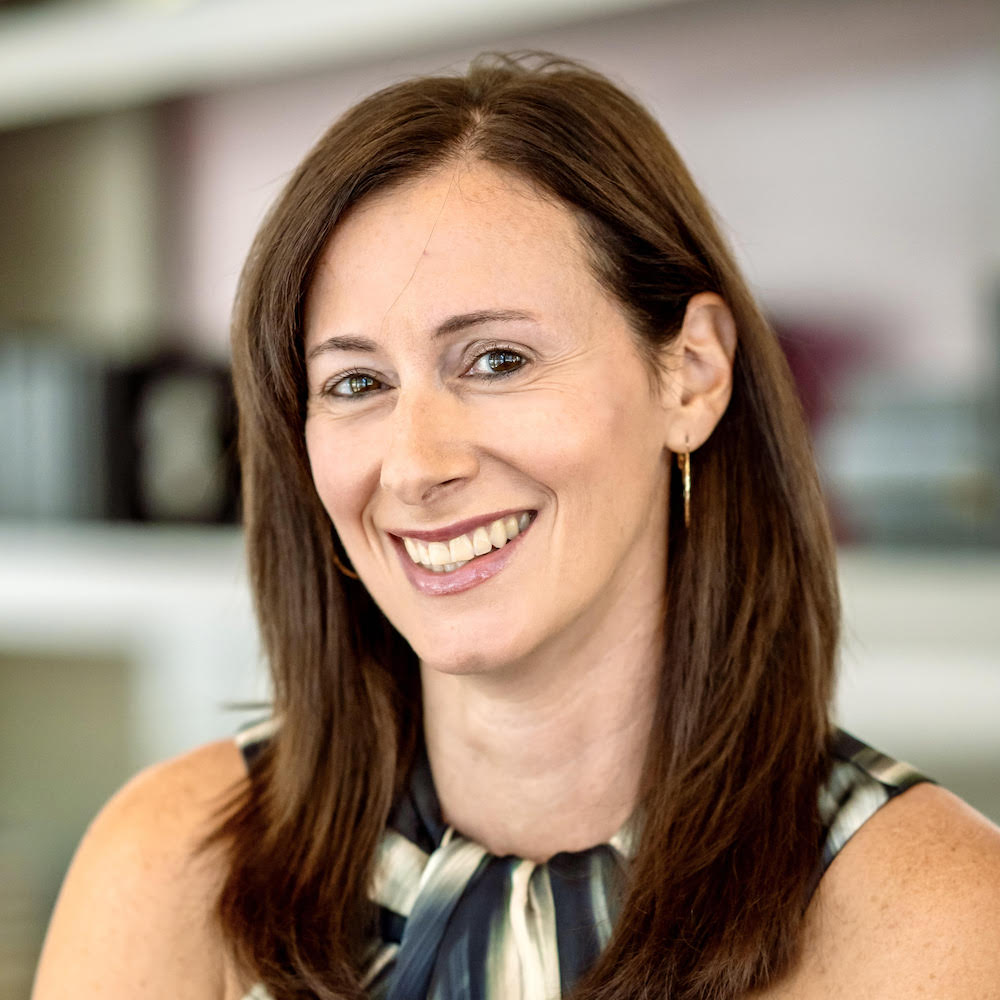
0 “My pitch to all of you is to figure out how to make the system better; we need more certainty and predictability.” – Judge Pauline Newman
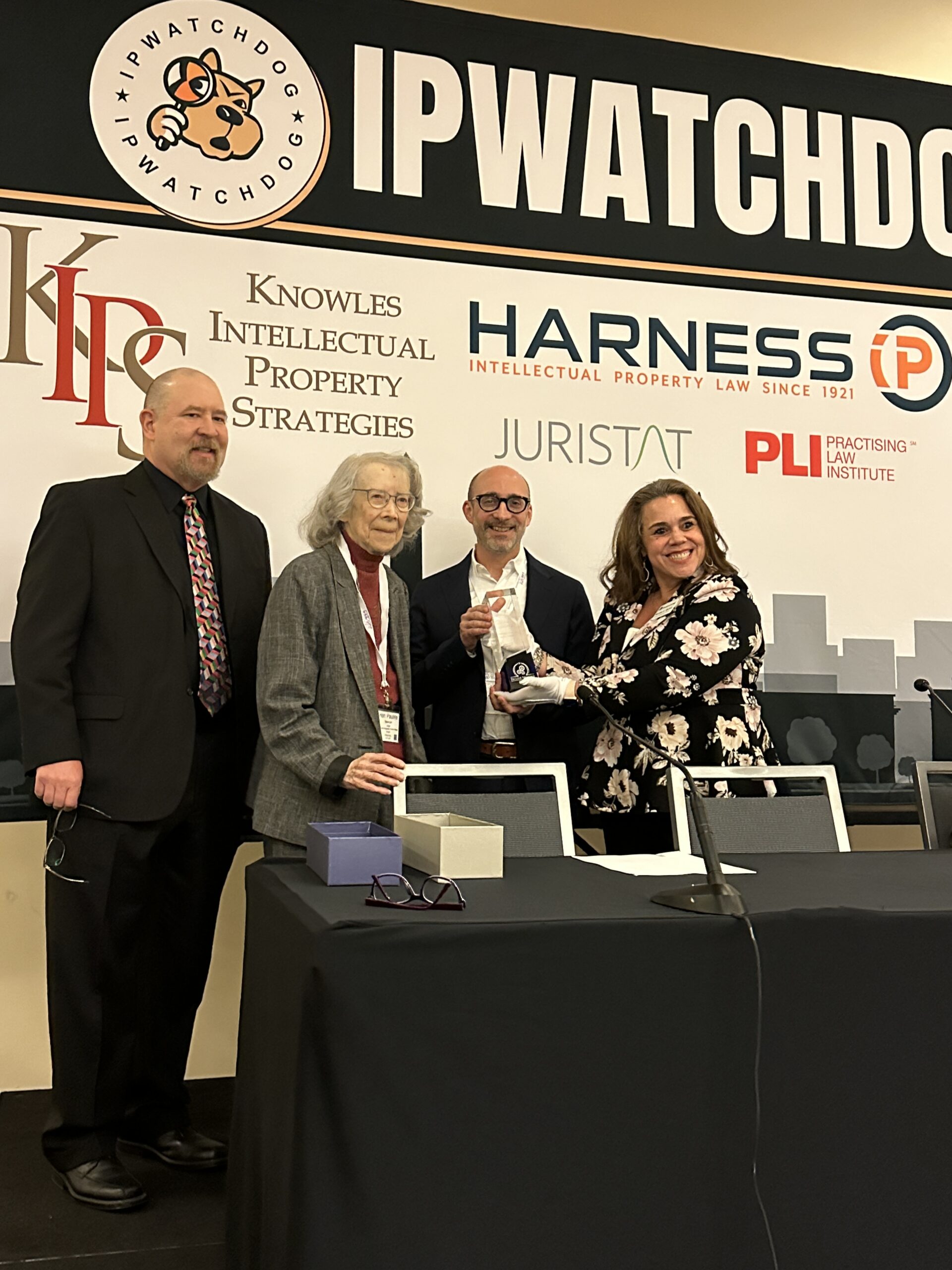
From left: Gene Quinn, Judge Pauline Newman, Corey Salsberg, Renee Quinn.
On day one of IPWatchdog LIVE 2026, panelists discussed the global IP landscape, the economics of patent portfolios, patent dealmaking and the ins and outs of drug patent critiques, before U.S. Court of Appeals for the Federal Circuit (CAFC) Judge Pauline Newman and Retired CAFC Judge Paul Michel introduced the recipients of their respective eponymous awards for 2026.
Corey Salsberg of Novartis received the Pauline Newman Award and Chris Israel of ACG Advocacy was the Paul Michel Award recipient this year.
In her remarks introducing Salsberg, Judge Newman—who continues to fight her April 2023 removal from the CAFC, most recently via a petition to the U.S. Supreme Court—commended Salsberg for his efforts to provide practical solutions to the problems highlighted in the sessions throughout the day and urged others to join him.
“The problems discussed in the sessions today are largely the same or worse than they were” early in her career as a judge, Newman remarked. “My pitch to all of you is to figure out how to make the system better; we need more certainty and predictability,” she added.
The Pauline Newman Award, created with the blessing of Judge Newman, is given each year to recognize the unique achievements of one patent attorney over the course of their career. Past recipients of the award include Henry Hadad, Phil Johnson, and Steve Caltrider.
Salsberg, who is Vice President and Global Head of IP Affairs for Novartis, and President of the Federal Circuit Bar Association (FCBA) for the 2025-2026 term, expressed particular pride in receiving an award named after the “great dissenter” of the CAFC, Judge Newman. Salsberg reflected on his own career in comparison and noted two things he has done that he said are fundamental to the art of dissent.
First, said Salsberg, he has raised his hand and showed up. “Sometimes dissenting is just about showing up” to be a voice of dissent in the face of anti-IP consensus, he explained.
“The overwhelming consensus today is that IP hurts or doesn’t help innovation… We’re outnumbered on the inside, and in congress, [where IP advocates like Senator Thom Tillis (R-NC) will be retiring,] the number of those wearing our uniform is going down. Over the course of my career, I’ve tried to play in that bigger game and to show up,” Salsberg said.
Secondly, Salsberg said he has tried to tell the IP story better. “Not tell a better story, we already have a great story to tell… But we need to figure out how to get people to listen better.” Salsberg encouraged audience members to make a connection and establish common ground with those who might hold anti-IP views. “In a world where everything is becoming AI generated, we can’t underestimate the value of connection; like many of Newman’s dissents that eventually became law, our minority view can change minds.”
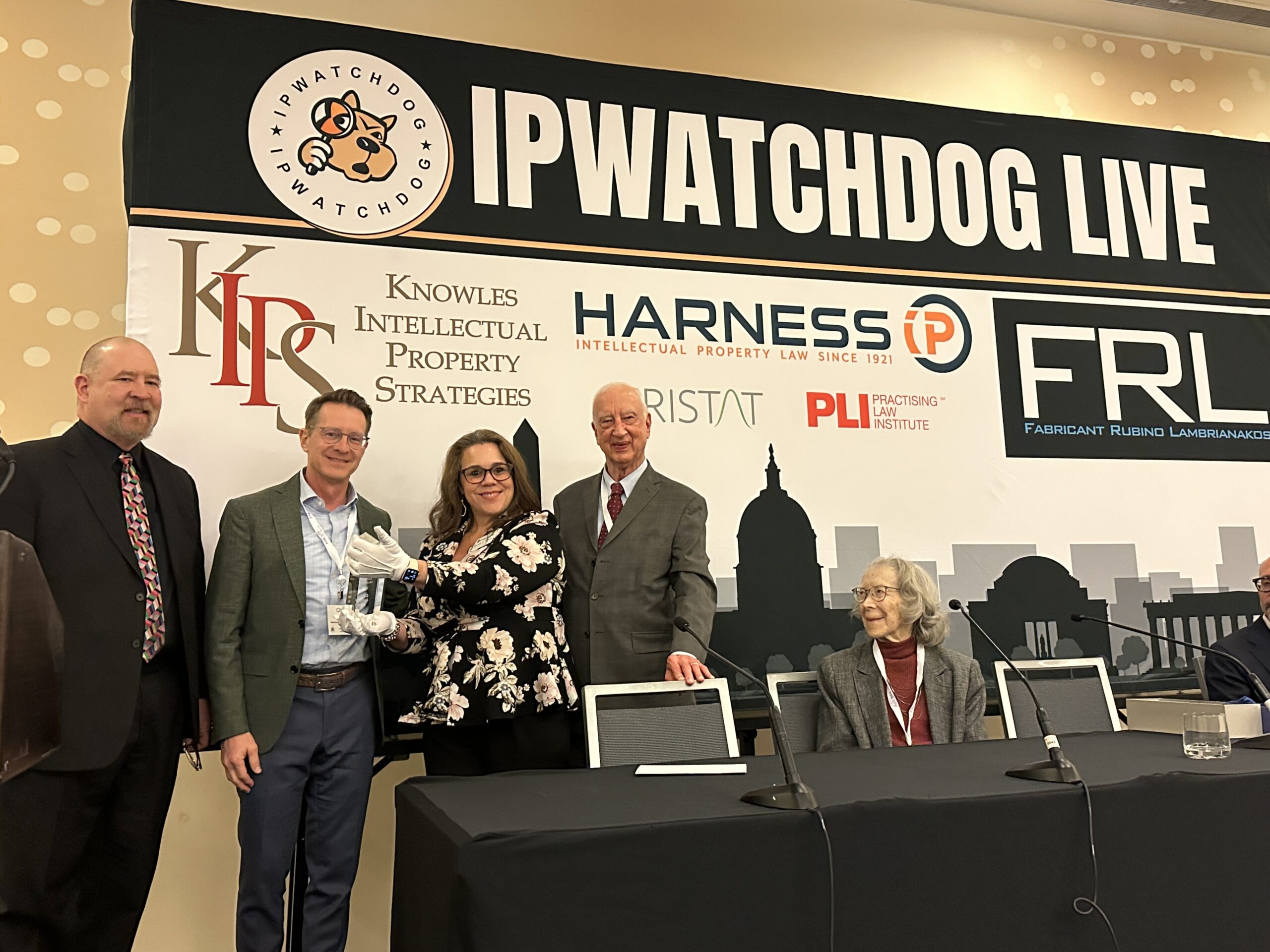
From left: Gene Quinn, Chris Israel, Renee Quinn, Judge Paul Michel and Judge Pauline Newman.
The second award of the night was presented by Judge Michel to Chris Israel, a Senior Partner at American Continental Group who previously served in the George W. Bush Administration as Deputy Chief of Staff to the Secretary of Commerce, and then later as the first U.S. International Intellectual Property Enforcement Coordinator, a post that would become known within the IP community as the “IP Czar.”
Michel told attendees that “policies concerning IP will either be dominated by facts and truth, or narratives that are false,” and dubbed Israel’s voice on IP issues “unfailingly logical, balanced, fair and correct.” Israel said he was profoundly proud and grateful to accept the award from Judge Michel and to share the stage with Judge Newman, and encouraged those in the room to continue to be inspired by ideas, inventors and creativity and to stay motivated to work toward a pro-IP system.
An Uphill Battle
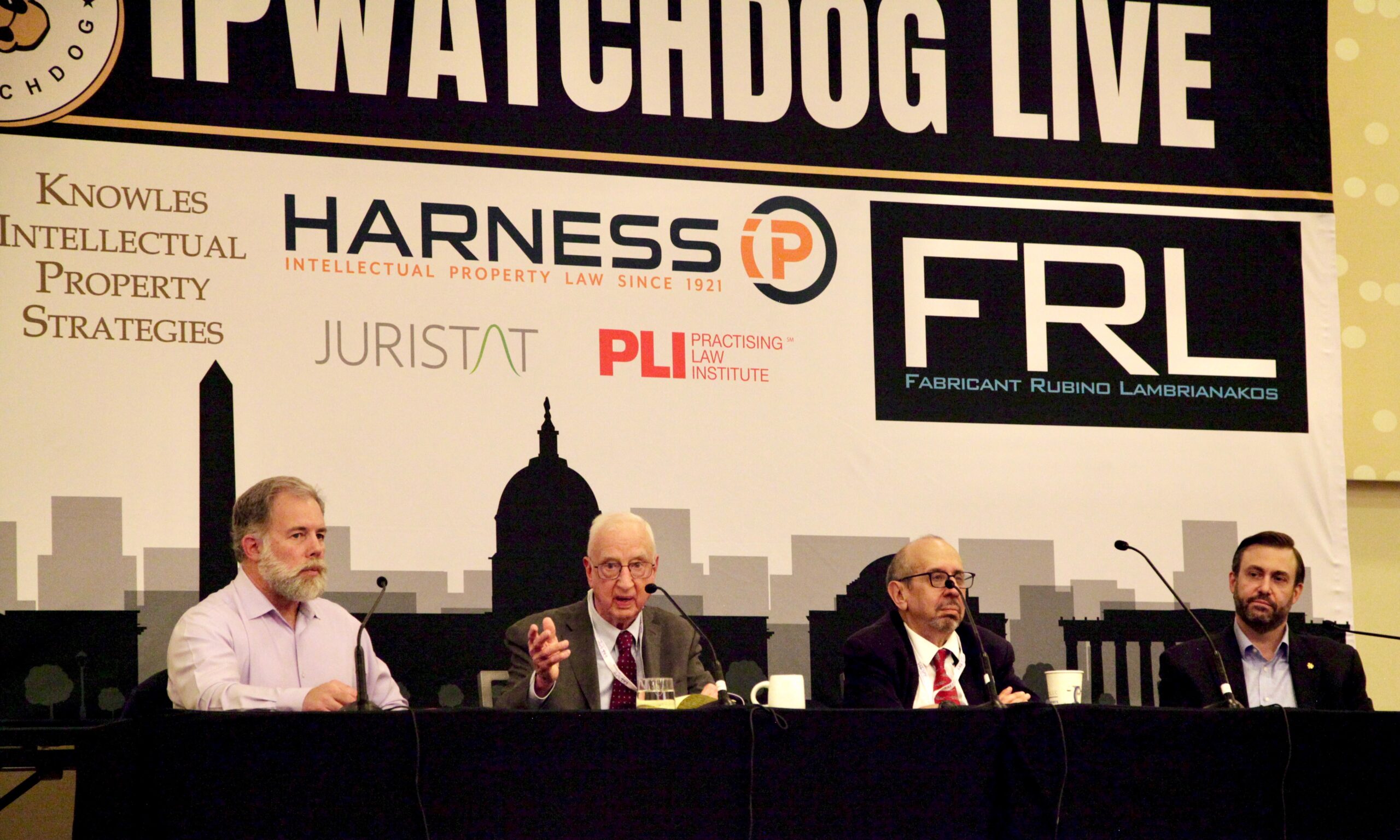
From left: Patrick Kilbride, Judge Paul Michel, Mark Cohen,Peter-Anthony Pappas
“During the opening session of the day, which focused on the Global IP Landscape, Judge Michel lamented the failure of U.S. lawmakers to make the necessary changes to the U.S. patent system quickly enough to remain competitive. While other jurisdictions can update patent laws to account for evolving technologies, for example, U.S. reforms have been stymied for years in areas like injunctive relief and patent eligibility. “We’re still living with the America Invents Act enacted in 2011 and now it’s 2026,” Michel said.
From a judicial standpoint, the Unified Patent Court (UPC) has “huge advantages” over litigating in the United States today, such as stronger remedies, faster timelines and specialist judges, said Michel. On the legislative front, China, Europe and the UK can all make changes on a much more regular basis than the United States, which is beholden to a congress with few members who are active on IP and a system at the mercy of corporate lobbyists. Referring to his fellow panelist Peter-Anthony Pappas, Director of IP Policy for the U.S. Senate’s Committee on the Judiciary, Michel commented: “Peter-Anthony cannot get legislation moving in the Senate no matter how hard he works because staffers are besieged by heavily financed lobbying efforts by people who don’t want any progress on any patent bill.”
Pappas replied that the struggle comes down to the need for a massive education effort in the legislative branch: “You have to have senators and representatives in office who care about IP. Without that, it’s a steep uphill battle.”
Later in the day, another panel discussed the challenges faced by the pharmaceutical industry in the face of proposed legislation like the Skinny Label Big Savings Act and the ETHIC Act, as well as the Supreme Court petition for certiorari in Hikma v. Amarin. Panelists, including Salsberg, explained the high-risk, expensive process of pharmaceutical R&D and patenting, and said the legislation is prompted by false narratives that will ultimately be dangerous for the industry, as well as patients.
IPWatchdog LIVE 2026 is taking place Sunday – Tuesday at the Renaissance Arlington Capital View Hotel. See the full agenda here.
![[Advertisement]](https://ipwatchdog.com/wp-content/uploads/2026/02/LIVE-2026-sidebar-regular-price-new-700x500-1.jpg)
![[Advertisement]](https://ipwatchdog.com/wp-content/uploads/2026/02/LexisNexis-Mar-31-2026-sidebar-700x500-1.jpg)




![[Advertisement]](https://ipwatchdog.com/wp-content/uploads/2021/12/WEBINAR-336-x-280-px.png)
![[Advertisement]](https://ipwatchdog.com/wp-content/uploads/2021/12/Ad-4-The-Invent-Patent-System™.png)





Join the Discussion
No comments yet. Add my comment.
Add Comment