
![[IPWatchdog Logo]](https://ipwatchdog.com/wp-content/themes/IPWatchdog%20-%202023/assets/images/temp/logo-small@2x.png)

 2
2 “Stewart told Quinn that she felt ‘right out of the gate [after the AIA], we got off on the wrong foot with discretionary denials.’… The petitions were treated as if they were going to be instituted unless the patent owner could prove why they shouldn’t be… ‘Patent owners were already behind before the proceeding started. We just tried to level the playing field.’”
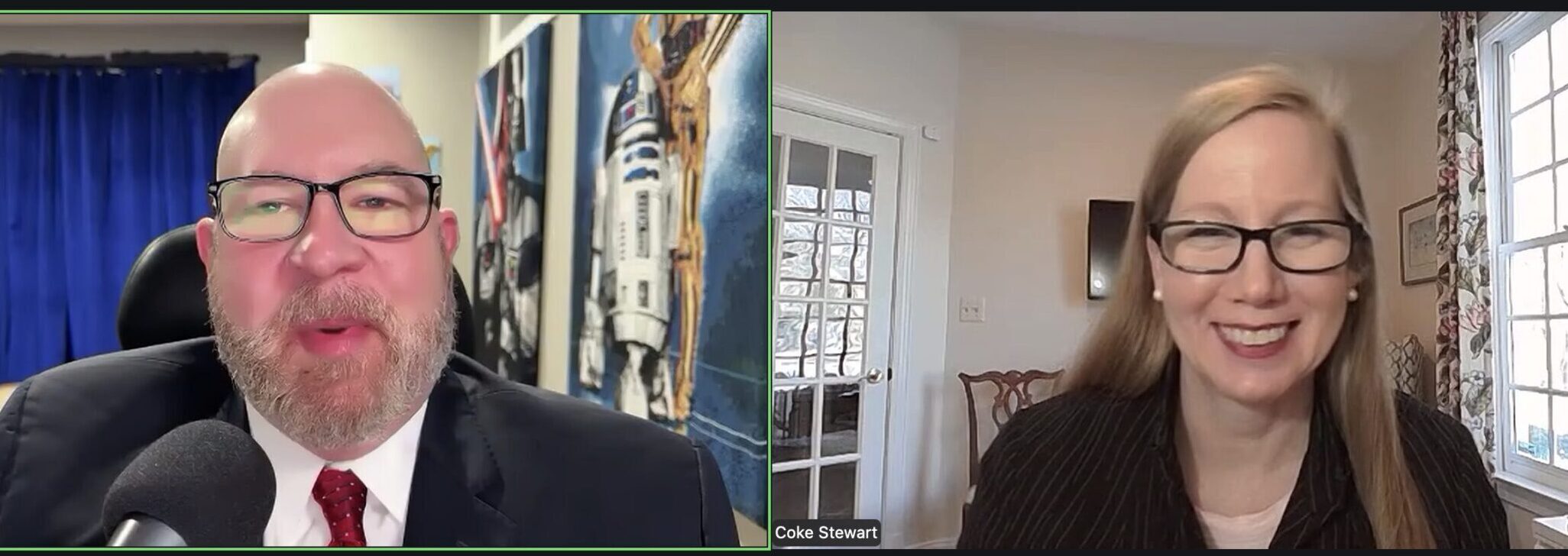 U.S. Patent and Trademark Office (USPTO) Deputy Director Coke Morgan Stewart joined IPWatchdog’s Founder and CEO Gene Quinn this morning to kick off the Virtual PTAB Masters Program 2026. Discussing the many procedural changes that have been implemented at the Patent Trial and Appeal Board (PTAB) under first Stewart as Acting Director and then current Director John Squires’, Stewart urged patent owners responding to petitions at the PTAB to tell their stories and petitioners to focus on patents in need of clear “error correction.”
Stewart recalled that at the start of her tenure as Acting Director she was particularly “dismayed at the state of the Office,” especially workforce issues. With six empty buildings (two of which are now occupied by the National Science Foundation), Stewart said the campus felt neglected and empty, so efforts to get employees back to the office dominated her team’s time and attention for those first few months. While Stewart said they are in a better place now than they were, and a sense of community is developing again, it is “still just a shadow of our former self.”
With respect to PTAB changes, one of Stewart’s first major policy shifts was to rescind former USPTO Director Kathi Vidal’s 2022 memo, titled “Interim Procedure for Discretionary Denials in AIA Post-Grant Proceedings with Parallel District Court Litigation,” and to implement her own approach, titled “Interim Processes for PTAB Workload Management.” That process has been expanded under Squires and includes the somewhat controversial concept of discretionarily denying institution based on the “settled expectations” of the patent owner.
Asked about her motivations for introducing the settled expectations doctrine, Stewart told Quinn that she felt “right out of the gate [after the America Invents Act (AIA)], we got off on the wrong foot with discretionary denials.” The petitions were treated as if they were going to be instituted unless the patent owner could prove why they shouldn’t be, thereby turning the tables on the party with the issued property right, she added. “Patent owners were already behind before the proceeding started. We just tried to level the playing field.”
Under the leadership of Secretary of Commerce Howard Lutnick, Stewart felt she had the opportunity to move forward with reforms that had been discussed for years but were never pursued. “We wanted to get judges out of the business of trying to make policy decisions,” Stewart said. “I don’t think judges like to do that. So, an initial thought was, ‘let’s get those judgment calls off the plates of the judges and before the front office.’”
Stewart noted that when she first came on Board as Acting Director the institution rate was about 50-50 and now it’s about 60-40 on the side of denials of institution.
Stewart also wanted to create more stability by going back to the original intent of the AIA, which was to weed out “bad” patents. “The AIA came from a concern that there were patents that shouldn’t have been issued, but that’s not what was happening,” she said. “It was more just second-guessing decisions that had been made by the office before.” Thus, she asked how the Office could get back to focusing on error correction.
Stewart explained that, under the AIA, judges had come to a point where they were doing what the statute told them to do, which was to find claims brought to them unpatentable. “The AIA was created to weed out so called bad patents and that was the culture of the Office,” she said. “You’re there to find problems. Judges were expected to find the patentability problems.
Now, Stewart said, particularly with respect to Director Review decisions, the Office is looking chiefly to do error correction. Stewart said, “If you think there’s been a mistake in your case let us know… I do not want to send decisions to the Federal Circuit that have errors.”
Stewart also noted that the Office now does postmortem training with every Supervisory Patent Examiner (SPE) (800-1,000 people) on any case where errors are found.
At the same time, lawyers and inventors have strayed too far away from effectively telling the stories of their inventions, both Quinn and Stewart agreed. So, to patent owners, Stewart implored: “Tell your story and talk about secondary considerations. That’s what we’re looking to see.”
The Virtual PTAB Masters Program 2026 is taking place on Thursday and Friday, January 29-30. Register to attend for free here.
![[Advertisement]](https://ipwatchdog.com/wp-content/uploads/2026/07/Juristat-Aug-11-2026-sidebar-700x500-1.jpg)
![[Advertisement]](https://ipwatchdog.com/wp-content/uploads/2026/07/IP-Author-Aug-13-2026-sidebar-700x500-1.jpg)
![[Advertisement]](https://ipwatchdog.com/wp-content/uploads/2026/07/Womens-IP-Forum-2026-sidebar-register-early-bird-now-700x500-1.jpg)
![[Advertisement]](https://ipwatchdog.com/wp-content/uploads/2026/07/Juristat-Varsity-Ad-2026-IPW-ad-Solo_1.png)
![[Advertisement]](https://ipwatchdog.com/wp-content/uploads/2026/07/ClearstoneIP-Varsity-Ad-2026-Ad-2.jpg)
![[Advertisement]](https://ipwatchdog.com/wp-content/uploads/2024/09/Patent-Prosecution-Training-sidebar-700x500-2025-03-27.jpg)




![[Advertisement]](https://ipwatchdog.com/wp-content/uploads/2021/12/WEBINAR-336-x-280-px.png)
![[Advertisement]](https://ipwatchdog.com/wp-content/uploads/2021/12/Ad-4-The-Invent-Patent-System™.png)







Join the Discussion
2 comments so far.
Anon
January 30, 2026 11:05 amTwo different aspects strike me with this narrative.
First, I am troubled with the notion that “people must be in the offices in order to build teamwork and rapport.”
Frankly, that is one huge step backward and would dismiss perhaps the only truly positive lesson learned from the Age of COVID: productivity can be achieved through dispersed teams which has the benefit of giving workers much needed flexibility (and read that also as diminishing micro-management) with remote work.
I think that a serious ‘5-Why’ exercise needs be completed to see the true drivers of the ‘return to office’ – and those drivers are very much suspected to be not productivity or innovation related, but instead fixed (and sunk) costs of real estate and fixed office costs that “business plans” are seeking to justify rather than ‘bite the bullet’ and liberate from those archaic cost structures.
To me, this is on huge elephant in the room.
The second item I have spoken at length upon, so here would merely note that those writing the (absymal) AIA, wrote with the view that “their narrative” would ‘always‘ hide in the shadows of the unelected deep state (if you want to use a different, less evocative term, go ahead), of those ‘running’ the Reject Reject Reject office, and never contemplated the fact that a change of guard within the administrative office might take place.
That change <b<did take place and what you are seeing is nothing more – and exactly what – the AIA provided to the Administrative Agency in the unchecked (and unappealable) power of institution decision.
I will share that I wrote to my Congressmen at the time and explained why this was a bad piece of legislation for many points – and expressly included this point.
Doug Pittman
January 29, 2026 01:20 pmTell your story?
Before our outstanding new Director John Squires, inventors couldn’t tell their stories without spending $250,000.00 and that was only on paper.
Now thankfully that’s been changed so inventors can be heard in front of PTAB.
Step by Step it’s clearing up but based on what I heard from the Death Squad folks there is a long long way to go.