
![[IPWatchdog Logo]](https://ipwatchdog.com/wp-content/themes/IPWatchdog%20-%202023/assets/images/temp/logo-small@2x.png)

 19
19 This week on IPWatchdog Unleashed, I have a conversation about patent eligibility with patent attorneys and IPWatchdog Advisory Committee members John Rogitz and Clint Mehall.
There can be little doubt that the U.S. patent system is at an inflection point. The growth of artificial intelligence (AI) is accelerating, and there is a growing understanding that dominating AI technologies is a matter of national and economic security. But as important as everyone seems to recognize AI innovation to be, there is widely diverging handling of AI innovations within government, with almost astonishingly different views between the Executive Branch and the Judicial Branch, and the Legislative Branch simply missing in action.
On one side stands a U.S. Patent and Trademark Office (USPTO) making a concerted effort to restore predictability and coherence to patent eligibility. On the other side sits a Federal Circuit that continues to inject uncertainty, inconsistency, and—too often—intellectual laziness into Section 101 jurisprudence. That tension was front and center in our discussion about the state of patent practice, Director Squires’ recent initiatives, and the broader policy implications for innovation in the United States.
John, Clint and I discuss how the USPTO is trying to bring certainty to the examination of patent applications that have been plagued with patent eligibility headaches and complications for most of the last 15 years. During our conversation we focus on the recent updates to the Manual of Patent Examining Procedures (MPEP), which came out earlier this month in response to the decision of the Appeals Review Panel in Ex parte Desjardins. We also spend time discussing the continued mess that is the Federal Circuit approach to patent eligibility and the absence of Congressional oversight or reform.
Restoring Discipline, Structure and Certainty
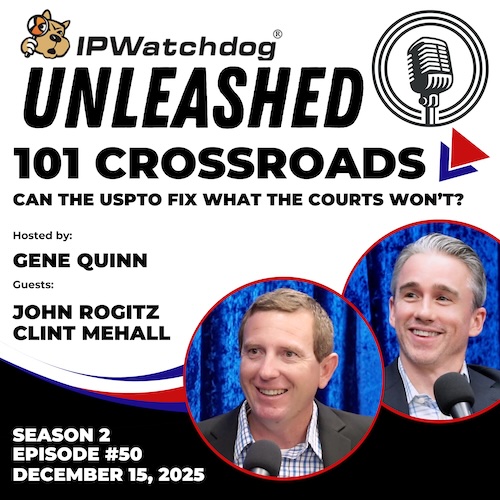 Under the leadership of USPTO Director John Squires, the Patent Office is attempting to restore discipline and structure to the Section 101 inquiry. The Office earlier this month updated Section 2106 of the Manual of Patent Examining Procedures (MPEP) in light of the ARP’s recent decision in Ex parte Desjardins, which was before Director Squires, Acting Commissioner Valencia Martin Wallace, and PTAB Vice Chief Judge Michael Kim. In Desjardins, the panel of Squires, Wallace and Kim decided that improvements to the training of a machine learning technology were patent eligible. With the Patent Office emphasizing the importance of real-world technological improvements, requiring examiners to engage with the specification, and rejecting overbroad “abstract idea” characterizations—particularly for AI and machine-learning inventions. With the MPEP not emphasizing that a claimed invention can satisfy the patent eligibility requirement not only by improving the functioning of a computer, but also if it improves at technical field. To that end, in Desjardins the invention related to how the machine learning model itself would function in operation, which was enough to render the claimed invention patent eligible, at least in the view of the Office.
At the same time the Patent Office is taking action, the Federal Circuit continues to inject uncertainty into the system. As John notes during our conversation, the decision of the USPTO in Desjardins could be viewed as inconsistent with the precedential decision of the Federal Circuit in Recentive Analytics, Inc. v. Fox Corp., which was handed earlier this year, on April 18, 2025, by a panel of Judges Dyk, Prost and Chief District Judge Goldberg, who was sitting by designation.
Writing for the unanimous panel, Judge Dyk explained that Recentive was a case of first impression, which asked “whether claims that do no more than apply established methods of machine learning to a new data environment are patent eligible.” Not surprisingly, this panel held that they are not, and during the podcast we talk about some of the possible mistakes made in the drafting of the patent and claims at issue in Recentive, which seems highly questionable. More specifically, relying on conventional techniques without identifying specific improvements achieved has not been enough for most of the last generation.
Notwithstanding, we can’t let the Federal Circuit off the hook entirely, or even a little bit. I point out that I find it hard to take any patent eligibility decision of the Federal Circuit seriously. The court continues to steadfastly refuse to define the term “abstract idea,” which is the essential question. They time and time again claim they are constrained by Supreme Court precedent, but that is simply not true. The Supreme Court never forbid the Federal Circuit from defining the term “abstract idea”; that is just something the Federal Circuit has taken it upon themselves to refuse to do. The Federal Circuit also continues to decide patent eligibility matters—which necessarily requires the court to decide what these claims cover—without a claim construction, which is entirely absurd. How can the court possibly know what a claim covers without construing the claims? It is as if the Federal Circuit possesses some psychic power that allows them to know without effort or thought what claims mean, which is as silly as it sounds.
This is not doctrinal confusion—it is a judicial choice that enables early case dismissal while undermining the patent statute and harming innovators. And while the USPTO is clearly moving in the right direction, meaningful judicial cooperation or legislative correction of Section 101 there is only so much the USPTO can do. Indeed, patent eligibility reforms at the Patent Office can only go so far. Sure, they can help applicants obtain patents, but without a modicum of sanity from the Federal Circuit, keeping those patents once issued remains only a fleeting hope.
Weak Patents Enable Copying, Not Progress
The conversation ultimately focuses on first principles: patents are private property rights, and private property is foundational to innovation. And a patent system that cannot protect modern technology cannot sustain long-term innovation. This is not theoretical. It is visible in markets where dominant platforms replicate competitor functionality with impunity.
The bottom line is this: Weak patents encourage copying. Strong patents do not block innovation, but instead force creative, motivated innovators to innovate around, which is precisely how technological progress accelerates and why a patent system works to create more—not less—innovation.
More IPWatchdog Unleashed
You can listen to the entire podcast episode by downloading it wherever you normally access podcasts or by visiting IPWatchdog Unleashed on Buzzsprout. For more IPWatchdog Unleashed, see below for our growing archive of previous episodes.
![[Advertisement]](https://ipwatchdog.com/wp-content/uploads/2026/09/Patently-Sep-22-2026-sidebar-700x500-1.jpg)
![[Advertisement]](https://ipwatchdog.com/wp-content/uploads/2026/06/Womens-IP-Forum-2026-sidebar-regular-price-700x500-rev1.jpg)
![[Advertisement]](https://ipwatchdog.com/wp-content/uploads/2026/09/WE-BUY-PATENTS-SIM-IP-Ad-1-700x500-1.jpeg)
![[Advertisement]](https://ipwatchdog.com/wp-content/uploads/2026/08/OneTransform_700x500_v1-REVISED.jpg)
![[Advertisement]](https://ipwatchdog.com/wp-content/uploads/2024/09/Patent-Prosecution-Training-sidebar-700x500-2025-03-27.jpg)




![[Advertisement]](https://ipwatchdog.com/wp-content/uploads/2021/12/WEBINAR-336-x-280-px.png)
![[Advertisement]](https://ipwatchdog.com/wp-content/uploads/2021/12/Ad-4-The-Invent-Patent-System™.png)


Join the Discussion
19 comments so far.
Anon
January 8, 2026 09:55 amI see that Greg has ‘let loose’ again on the ‘next’ IPWatchdog 101 thread.
See: https://ipwatchdog.com/2026/01/06/cafc-upholds-district-court-invalidation-wireless-transmission-decoding-claims-101/
I hear the frustration.
It is akin to the frustration from others (with different perspectives) that sound in knowing that the US Supreme Court has Royally [sic] messed things up, and have done so for quite some time.
I have to wonder on the nigh-repeat, definite rhyme in history and how the likes of PJ Frederico and (later Judge) Rich must have felt when throughout the early part of last century the Supreme Court acted in the manner to warrant one of its own to christen the Court with the phrase, “the only valid patent is one that has not yet appeared before us.”
Many of us – and myself explicitly included – have shared in this outrage.
Some of us – and myself explicitly included – have discussed in detail one or more actual paths of curbing the errors of the Supreme Court (with my own discussions provided for different branches of the government).
Sadly, I have yet to see any additional paths being offered (that are not tainted with the poison pills of ‘stakeholders’ who really do not want the system fixed).
Will this be the year that is different?
That would be wild (but that’s another thread).
Posted in duplicate (except the link) on the new thread.
Anon
December 30, 2025 12:29 pmAs to other Greg comments…
“I repeat my earlier concerns. Constitutionally, it is not the role of the courts to provide the patent system with a definition of “process” that resolves these 101 problems. ”
I have covered this extensively, albeit in different terms.
I have even provided not one but two avenues of correction – one for Congress and one for the Supreme Court itself (if it so chooses to do the right thing and clean up its mess).
“Finally, I completely disagree with Curious objection to my objection. I wrote”You want to solve this problem quickly? Pass a law that patent law firms must refund their clients for any 101/103/112 rejections.”
Curious responded: “LOL. What law firm is going to prosecute a patent under that regime? Unless it is contingency fee work, lawyers get paid whether their client wins or loses. Lawyers don’t work for free.””
Greg errs – and painfully so in who he is attempting to attribute “defective” to.
This is likely due to Greg’s role being an inhouse counsel.
It is simply NOT the role of the patent practitioner to write “defective-free” when the defects are universal to the system within which we operate.
We comply fully with our ethical duties without the notion of refunds by advising our clients of the conditions within which the patent efforts exist.
There is no other duty. There is no other obligation – UCC or otherwise.
The “defects” Greg sees are not the defects that Greg “gets” to have refunds for. His “must” is at best self-serving drivel.
Anon
December 29, 2025 04:36 pm“such usage reflects pure fear”
No. No it does not.
Forever and a day I have explained that the use of anonymous and pseudonymous nomenclature is grounded in a fine tradition of commentary in the United States.
Ascribing fear is simply unwarranted and uncalled for.
Greg Aharonian
December 29, 2025 02:58 pmTo “Anon” and “Hopeful” (and one of the many problems of the patent system is that there is so much fear in the patent system that people have to use these anonymous names such as “Curious” – such usage reflects pure fear).
I repeat my earlier concerns. Constitutionally, it is not the role of the courts to provide the patent system with a definition of “process” that resolves these 101 problems. “Process” is a fundamental statutory term that can only be dealt with by the Legislative branch.
The Constitutional flaw with Benson and its succeeding ilk isn’t what they say (though most of it contradicts computer science where it isn’t contradictory), but rather that they say anything other than “We refuse to hear this case because the issue is one of fundamental statutory language that we have no Constitutional authority to decide”. And every 101 case since then should have said the same thing, until such time as Congress does it job and clears up the many statutory language messes of the 1982 Patent Reform Act.
“SCOTUS that has the last word on what terms” – not for fundamental terms, because that is effectively acting Legislatively. SCOTUS can only rule that statutory terms satisfy Due Process Public Notice, that the statutes and legislative history are clear enough in meaning to help the public act without violating those terms.
Now, one might be willing to bend the rules a bit here, and give the courts a crack at one, given the failure of the legislative in 1952. But all of the SCOTUS and CAFC 101 caselaw since Benson, considered collectively (which is how it must be cited) is completely and totally self-contradictory (Flook-Puke versus Diehr-Straights, for example, where the majority in one case became the minority in the other) where it doesn’t contradict computer science and engineering. And don’t talk about Alice – geesh, Thomas spit on Due Process Public Notice when he explicitly wrote that he wasn’t going to define “abstract” put still use it to kill a patent. What a contempt for the public and the Constitution.
Benson is a good example of this mess. Suppose in 1952, Congress had written into 101 that old “processes with significant post-solution activity” could be patentable. Well, the Supreme Court would have the right to decide if Congress had provide sufficient Due Process Public Notice as to what “significant” means (a weasel term similar to idea, expression, as such [EPO], obvious, etc.). So it is all the worse than it is the Supreme Court which legislated these terms into 101. Who judges if their legislation satisfies Due Process?
You see respect for Due Process in other civil laws. Sometime ago a city passed a law stating that a ‘group’ of people couldn’t loiter in public. The law didn’t provide a threshold for the cardinality of the group. But the Supreme Court ruled that because it was a civil law (i.e., no jail time), that anything more than a few people was a group, subject to the discretion of the local prosecutors. Had the penalty been criminal, I suspect that Supreme Court would have want a number, “X or more people”, for the law to be Constitutional.
The Supreme Court had no Constitutional right to add “abstract” and “post-solution activity” to 101, which it effectively did in Benson. If that was the will of Congress in 1952, WHICH IT WASN’T, then Congress should have added that to 101. All the will of Congress was is that all processes that satisfies 102/103/112 (which can effectively kill the crap, allowing us to get rid of 101) – are patentable. All processes.
What I am waiting for (since the patent world doesn’t have the spheroids to so challenge) is for OpenAI to fight off all copyright lawsuits by legitimately arguing that 17 USC 102 is fatally vague, and thus Unconstitutional, because the statutes are silent as to what is “idea” and what is “expression”, and they denying the public of any Due Process Public Notice as to how to navigate under 17 USC 102.
Finally, I completely disagree with Curious objection to my objection. I wrote”You want to solve this problem quickly? Pass a law that patent law firms must refund their clients for any 101/103/112 rejections.”
Curious responded: “LOL. What law firm is going to prosecute a patent under that regime? Unless it is contingency fee work, lawyers get paid whether their client wins or loses. Lawyers don’t work for free.”
All other professions under the UCC have obligations to refund monies when the sell defective products or provide defective services. You wrote a patent claim that is rejected under 101 or 103? You wrote a defective claim – you sold a defective product. You owe a refund. (A 102 rejection is the fault of the applicant not paying for a prior art search – no refund needed there).
Now you might legitimately object, “Greg, no one can offer such a refunds. The statutes, MPEP and caselaw are 100% confusing.” I agree. But that doesn’t excuse your lack of refunds. You sold a defective product. Don’t want to pay a refund? Go practice some other area of law where things are clearer (such as tax law :-). Willing to provide a refund? Then fight to remove the courts from 101 and get Congress to do its job and write lengthier statutes that SCOTUS can rule upon if they satisfy Due Process.
And there are people (who understand economics and the law) who do offer complete guarantees in the patent world – patent insurance companies. If you buy a patent defense insurance policy, once you pay your premiums and deductible, the insurance company pays all the costs of litigation and any damages if you lose. Guaranteed under contract law. I have done a ton of analyses for such policies, and rarely do we worry about 101 to determine premiums (which creates the guarantee).
Patent lawyers charge huge amounts of clearance opinions that say little more than “You might get sued”. Patent insurance companies will charge similar amounts, provide a clearance opinion, but say/guarantee a lot more “If you get sued, we cover your costs”. And many times, they don’t provide the clearance opinion, because the legal analysis is irrelevant to the client. The only legal language that matters is that of contract law. Patent law is left to myself and the underwriters.
So A) get the courts out of 101 – since Benson they have totally failed.
And B) patent lawyers must start offering refunds when the Office Action failure is their fault (I will create a patent writers insurance policy if you must).
Judges can be comfortable and competent with marriage law (since they can relate through their marriages). They can be comfortable and competent with tax and debt law because they pay taxes and deal with their own debts. Most laws judges can personally relate from their own life experiences.
None of them have ever tried writing, compiling, link, running and optimizing a computer program. They have no freakin idea what software and computer science is – to rule on 101 issues. No idea.
Anon
December 29, 2025 08:14 amDear Hopeful,
Have you lost hope? Should I set aside my own hope that you will respond to the counter points that I have presented?
Anon
December 20, 2025 10:59 amDear Hopeful,
Let me return and beat a dead horse, given that you appear to be thinking that your stated position is sufficient.
“will cause the lower courts to wake up and carefully study Alice and what it really held(1) and why, even if the term “abstract idea” is interpreted to mean a fundamental(2) prior building block. The latter would stimulate further debate and some chaos about what it means, including because it seems the PTO would not be the place for such decisions to be made(3); but the number of patents that would be invalidated under such a preemption test(4) is vastly less than what we have seen in the lower courts and PTO since Alice was handed down.”
1) the notion of what it really held is the existing muddle – and this is precisely due to the fact that the Supreme Court has simply denied every petition of cert that was (hopefully) provided in order to clarify exactly the muddle that the lower courts have been doing with the Supreme nonsense.
The fact that the Supreme Court has acted as it has must be acknowledged, and any hope to be held, must be held in that light.
2) I note that this term (fundamental) was yet another undefined term, and our Supreme Court is not authorized by the Constitution to write what it thinks that term should mean.
By the by, I covered this in detail in my past discussions on the Kavanaugh Scissors by which I provided reasoning by which the Supreme Court could – if it so chose – walk back its error based on legal concepts that the Court itself has reiterated recently.
3) I not only agree that the PTO is not the place, but as I have indicated more than once, the PTO has already ‘played this game,’ and the courts have rebuked such attempts (the easy example was the attempt by a certain medical entity to follow – precisely – a PTO published example of what would be an eligible claim, only for the lower court, and that of the designated patent court of the CAFC, following its brow-beaten pattern, to outright dismiss what the PTO had published).
4) I am also aware that practitioners have tried to make the ‘preemption test’ argument in front of that very same CAFC, and that too was dismissed.
It’s not that I want to rain on your parade, it is though that much more than your position is necessary to correct the errors that have been made in law.
The Supreme Court-written law is indeed broken.
First step in correcting that is the necessary step of recognizing and admitting both the fact that it is broken and the reasons why it is broken.
If both aspects of that first step are not taken, we will repeat history (and to this repetition, I have also – repeatedly and in great detail – written about). The 10,000 foot reminder of that historical lesson is the rampant anti-patent nature of the Supreme Court throughout the few early decades of the 20th century and the unresolved, and many faceted, “Gist of the Invention” Supreme Court writings that invoked a Justice of that body to remark, :The only valid patent is one that has not yest appeared before us.”
This sorry state was what roused a then sleeping Congress to explicitly rebuke the Supreme Court and remove its authority along that line of ‘reasoning’ in the Act of 1952.
Anon
December 20, 2025 08:03 amDear Hopeful,
I suspect that you missed the historical reference of the phrase.
As for its role, I do not entirely dismiss the aspect of hope being present in any legal battle. That being said, mere hope is never enough. Certainly such underlies appeals and petitions for cert, but just as certainly, as seen over the last decade or so, the Supreme Court has denied every petition for cert hoping for the Court to correct its errors.
If you want to lean into the actual Alice decision as if claims extant to hardware were nonetheless deemed ‘abstract’ (as undefined as the Court left it), then your position does not stand correct on its face and absolutely needs to be further addressed.
You do need to address the Constitutional infirmities – you do not get to accept them unquestioningly. The Supreme Court is not above the law. Blind acceptance is very much a part of the problem. I hope** that you understand that.
** my hope supplemented with my reasoning so provided.
Hopeful
December 19, 2025 05:03 pmAnon:
Hope is not a strategy? Well, if not for you, it is for me, at least partially as I explained in my missive.
Hope, along with an explanation of what the hope seeks and why, is the basis of most litigation, including most appeals and petitions for cert for example.
Your refutation of Supreme Court authority to take action to prevent the patent laws from stifling innovation (in the Court’s view) may be correct theoretically, but long-standing Supreme Court law has so held for a very long time, as Alice itself explains.
In addition, that hardware may be involved is not the question. As Alice also explains, the question is whether the claim, even if it recites hardware, risks preemption of an abstract idea. Rightly or wrongly, the Court in Alice thought the claims in issue did just that as a practical matter.
So, again, as Director Squires has correctly pointed out and the lower courts have so often and so curiously missed, the question under Alice is risk of preemption of an abstract idea, not whether hardware or anything else is involved.
I do not address your other points since, inter alia, I believe what I stated stands as correct on its face and need not be further addressed.
Hopeful.
Anon
December 19, 2025 08:44 amDear Hopeful,
Hope is not a strategy.
Your first paragraph dutifully reflects the Iancu attempt to move away from examiners actually dealing with case law citations (as you correctly reflect, these are fatally contradictory).
As to your second paragraph, explicitly, “that it has the power to ensure that that the patent laws seek to stimulate innovation rather than stifle it,” – this suffers from multiple Constitutional problems.
First, it is a direct abrogation of Constitutional authority, which explicitly provides that authority to the Legislative Branch (and is thus ultra vires).
Second, it violates the precept of ‘No advisory opinions,’ as its basis is necessarily what might happen.
Third, it violates the actual understanding of how innovation works (the precept of ‘Necessity is the mother of innovation.”
As I noted directly below, I have posted in great detail on all these points.
Also as I have already noted, your next paragraph with its comment of, “This is not to say that Alice did not seem to be unquestionably limited to the thought that its notion of “abstract ideas” was limited to purely mental processes does refer to the immediate takeaway that claims that both sides of the issue before the Court averred to be ‘directed to’ actual hardware, thereby, the “holding’ as it were necessitates the illogic that ‘abstract’ must include hardware. So no, your view of attempting to so limit Alice cannot itself hold.
Finally, as to the Executive Branch taking any action, such is ineffectual at best (this type of Executive proclamation is not the first attempt), and misleading at worst. The ‘lower courts’ is also not your answer as any decision there will lead to the (current) appeals court which has shown itself to be so brow-beaten (firehosed simians in a cage analogy) that rectification there not only will not happen, one will only continue to be faced with panel decisions that continue to proliferate the self-contradictory decisions.
Hopeful
December 18, 2025 02:43 pmThe PTO Director has a duty to provide guidance to the examining corp that seeks to make sense out of a Supreme Court decision, Alice, and multiple thoroughly inconsistent lower court decisions that clearly contradict it in so many ways.
And with regard to Alice, in my view the only way to make sense of it under Constitutional law is to interpret it as holding, based on long standing Supreme Court rulings that it has the power to ensure that that the patent laws seek to stimulate innovation rather than stifle it, a patent that risks preemption of an abstract idea (a mental process, especially those that are fundamental building blocks of human ingenuity) risks stifling of innovation (at least in the Court’s view) and is thus ineligible. Very few patents qualify as ineligible under this limited holding and reasoning.
This is not to say that Alice did not seem to be unquestionably limited to the thought that its notion of “abstract ideas” was limited to purely mental processes; but it is to say that, absent clarity from the Court or Congress, the lack of clarity in Alice about this topic should be so construed to prevent the chaos it has caused in our essential patent system. And, in any event, an “abstract idea” under Alice is limited, by Alice’s wording itself, to fundamental prior art building blocks of human ingenuity.
So, until the Supreme Court or Congress takes action in this field, I applaud the PTO Director for instructing the examining corps to recognize that ineligibility in the field of abstract ideas is about such preemption, not all the other nonsensical considerations that have worked their way into ineligibility consideration and have nothing to do with whether a claim risks preemption of an abstract idea or fundamental prior art building block.
Hopefully, the Director’s recent strong guidance in this field will cause the lower courts to wake up and carefully study Alice and what it really held and why, even if the term “abstract idea” is interpreted to mean a fundamental prior building block. The latter would stimulate further debate and some chaos about what it means, including because it seems the PTO would not be the place for such decisions to be made; but the number of patents that would be invalidated under such a preemption test is vastly less than what we have seen in the lower courts and PTO since Alice was handed down.
Hopefully.
Anon
December 18, 2025 07:59 amI am bemused by the ruminations on this page, and how several are echoing my long outstanding prescriptions for dealing with the ultra vires writing of patent law by the judicial branch in clear abrogation of the separation of powers and the direct allocation (singularly) of that authority to the legislative branch in our Constitution.
Perhaps one could have an AI engine explicitly crawl the history of this blog and collate my writings on the subject (goodness knows that I have delineated the problem and several solutions in appropriate detail many, many times now). I’ve even coined terms like the “Kavanaugh Scissors” as a mode for the Supreme Court to extract itself, as well as pointed out that Congress has the authority to remove the Supreme Court from hearing patent cases, given that such is not an item of original jurisdiction (as long as some Article III court can still hear cases to preserve Marbury, and that particular Article III court is newly formed so as to be free from the past Supreme Court ‘group of caged monkeys being fire-hosed’ syndrome.
Stephen Schreiner
December 17, 2025 06:26 pmGene is right that the fundamental problem is that the Supreme Court never defined “abstract ideas” and the Federal Circuit refuses to do so. To be fair, maybe the Federal Circuit takes a pass because it’s pretty hard to define the term. What is meant by “abstract ideas”? Nobody knows.
It has become a nonce word (catch-all) for any invention that a tribunal decides shouldn’t be allowed to be patented. It’s worse than the old “I know it when I see it” definition of obscenity, as famously stated by Justice Stewart. We know this is the case because the cases are unpredictable. See American Axle. You don’t “know it when you see [an abstract idea].”
There needs to be a legislative fix.
Breeze
December 17, 2025 04:59 pm“That won’t work.”
That’s what I said.
“A fix to 101 requires …statutory language that EXPLICITLY limits the Court’s ability to monkey with the law.”
That’s what I said.
Curious
December 17, 2025 04:07 pmA first approach could be to simply delete section 101, so 35 USC doesn’t say anything about what is eligible for patenting.
That won’t work. The Supreme Court’s case law is so far divorced from the language of the statute that removing the statute won’t impact anything.
Anything the USPTO does won’t help either. Issued patents that will ultimately get invalidated by the courts won’t help either.
You want to solve this problem quickly? Pass a law that patent law firms must refund their clients for any 101/103/112 rejections.
LOL. What law firm is going to prosecute a patent under that regime? Unless it is contingency fee work, lawyers get paid whether their client wins or loses. Lawyers don’t work for free.
After all, drafting claims implies you fully understand the law to draft claims that satisfy 101/103/112.
For someone who has been commenting in this space for a very long time, that comment reflects a high level of ignorance as to how things work. Whether something gets rejected (at the USPTO or invalidated by the courts) is highly speculative. We operate in a huge gray area (because SCOTUS doesn’t like bright line tests) that allows one judge (or Examiner) to rule entirely differently than another judge. Additionally, 103 has the same gray area and then you add in the imperfect knowledge of the entire scope of prior art.
Give me laws that are predictably applied, and I can give you some kind of guarantee. However, the current case law is rife with inconsistent holdings that allow Examiner’s/judges to reject/allow/invalidate/uphold a patent based upon their subject feelings. Under that regime, I’m guaranteeing very little — aside from the believe that if you are a small inventor, your patent will eventually get invalidated by the courts no matter how good it is.
to bring in the experts for these statutory terms – science and engineers
scientists and engineers are experts in science and engineering — not the meaning of statutory terms (particularly when those terms were likely written by non-scientists/engineers). It is SCOTUS that has the last word on what terms in the statute mean, and don’t tell me that a scientist or engineer has any expertise in divining how SCOTUS will rule on any particular term.
most of the people in the system hold the (technical) Arts (and its people) in contempt
Then you’ve been working with the wrong patent attorneys. We are just as frustrated as the inventors. Our job is to provide good results to our clients and it is extremely frustrating when we are prevented from doing so. The vast majority of the patent practitioners I know of strongly believe in the patent system. However, this patent system has been hijacked by big money to provide the desired results of the mega large corporations — which want their patent thickets upheld to keep out competitors and want the little guy’s patents invalidated because they don’t want to pay licensing fees.
A fix to 101 requires (assuming that SCOTUS has no interest in fixing the problem they created) statutory language that EXPLICITLY limits the Court’s ability to monkey with the law. There are ways to do that, but the big money that funds Congress won’t allow that to come to fruition.
Anon
December 17, 2025 09:35 amEver as Mr. Morgan takes the side of infringers (showing his anti-patent holder proclivities), his point here is a valid one.
It is not (generally**) helpful to obtain patents that will not hold up when one goes to enforce the patents.
This does reflect my own long-standing assertion (to others of the anti-patent holder ilk) that most all clients do not want ‘cheap and poorly examined patents.’
This should turn the discussion from “patent quality” to where it belongs: “patent examination quality.”
** I do provide that some clients – and it is their choice – do want (and will only pay for) sub-par ‘quick and dirty’ patent grants in order to build a sizable portfolio as a business decision. Is this ‘abuse of the system?’ Perhaps. But at the same time, when the “0h Noes Tro11s” propaganda was first starting out, the (now very old) 271 Blog published a study showing that non-practicing entities did a better job of vetting patent worth on the patents that they were obtaining. It is by and large the larger and more established firms that would aim for the low quality examined patents.
Paul Morgan
December 16, 2025 05:33 pmThere is a real danger is that the curent PTO Agency, which has no even presumptive authority to interpret statutes or case law since the death of Markman, may be doing so anyway re 101 and Markman to allow far more patent applications to issue with claims that wil not be enforceable. Who does that actually benefit?
Breeze
December 16, 2025 10:27 amThere is no “legislative fix” to the “101 problem.” Let’s assume solutions at the opposite ends of the spectrum of patentable subject matter. A first approach could be to simply delete section 101, so 35 USC doesn’t say anything about what is eligible for patenting. A second approach could be to amend section 101 to list everything that is eligible for patenting, possibly even amending it every time a court rules a patent claim invalid for lack of patentable subject matter, to the point where section 101 could be thousands, if not millions, maybe even billions, of words in length. Those two approaches would represent the extreme ends of the spectrum of how a “legislative fix” to the “101 problem” could be carried out. Either say nothing about eligibility or try to say everything about eligibility.
Regardless of which approach is ultimately used, SCOTUS will, when, or really if, it decides to “rule” again on a patent eligibility case will, in their arrogance and stupidity, simply ignore 35 USC and pronounce, “We have consistently held that there are three judicial exceptions to patent eligible subject matter…”
The only “fix” is to remove patent law from the jurisdiction of SCOTUS. I guess we would need a “statutory overrule” of the mess of case law SCOTUS has created, but they need to be removed from patent law. All patent law. 101. 103. 102. 112.
All of it.
Greg Aharonian
December 16, 2025 08:39 amThis is not a “101” problem. It is a “101/103/112” problem of a Due Process Constitutional nature. That is, the terms “process” in 101, “obvious” in 103, and “enabled” in 112 are neither defined in statute nor defined in Legislative History. That makes, prima facie, the three statutes fatally vague and thus unConstitutional, because the public has no Due Process Public Notice as to what the terms mean, in order to prepare patent claims that are processes, that are not obvious and are enabled.
As these are fundamental statutory terms, it is neither the role of the Judicial Courts nor the Administrative USPTO, to define the terms, because that is essentially writing the law, which is solely the role of the Legislature.
You want to solve this problem quickly? Pass a law that patent law firms must refund their clients for any 101/103/112 rejections. After all, drafting claims implies you fully understand the law to draft claims that satisfy 101/103/112. Can’t offer a guarantee? Implicit admission of malpractice. One reason why insurance companies don’t like giving E&O specifically to patent law firms.
And the sad thing is, all three governmental bodies are incompetent to solve this Due Process definitional problem.
It is clear from 50 years of 101 caselaw about “abstract” (which is either scientifically incorrect, or self-contradictory with its own caselaw – such as Benson/Flukepuke/Direstraights and the nonsense of Alice where Thomas explicitly said “I ain’t defining abstract”) that the courts just do not understand anything about computer science. I once suggested to Judge Michel that they hire a few scientists and engineers as CAFC clerks, to have competent people to research the science and engineering of the terms in front of them. He laughed in my face. If you mathematically model all of the SCOTUS/CAFC caselaw on 101, it is a massive collection of contradictions. Not that Michel, or any other judge cares about.
It is clear from 50 years of inaction, and failed attempts, that Congress can’t solve this definitional problem. Take “business methods” – every time they try to define “business methods” to ban their patenting (if you remember Berman), their definitions end up being circular, and thus meaningless. Their prohibition of patents on tax methods is meaningless because it is not hard to write a patent specification on a method of tax reduction, for example, that nowhere uses the word “tax”.
And it is clear from 50 years of inaction, that the USPTO – very wisely – doesn’t not want this job of resolving 101 (or 103 or 112). I was there 31 years ago at the first hearings on software patents (in Crystal City and San Jose), and it was clear that a) they didn’t want this problem, and b) didn’t understand the science and engineering. And they still don’t. They are bureaucrats implementing orders of others (the Legislature). Stick their necks out to address this problem? You don’t know bureaucrats.
You want to know if someone talking about this problem is incompetent? The use the term “software patent problem”. It is actually the “software/hardware patent problem” because the science and engineering is quite clear – there is no difference because they are equivalent under the Church-Turing thesis. Anything patentable as hardware must be patentable as software – an algorithm blasted into a FPGA (pure hardware) is equal to a C program on a processor (pure software). What you end up selling is a cost issue, not an engineering issue. I have yet to meet a single judge/bureaucrat/legislator who understands this. They all Buddha’s blind men and the elephant. “physical”/”non-physical” are judicial concerns, not those skilled in the technical arts. I spoke about this 31 years ago at both town halls in San Jose and Crystal City (as did a few patent lawyers from semiconductor companies) and was ignored then, and still ignored now.
One problem of pure arrogance is the refusal of all three bodies, plus the patent bar, to bring in the experts for these statutory terms – science and engineers. For example, there are entire conferences where software engineers discuss “abstract software engineering”, a very important programming paradigm. Not once have any of these people been consulted by the patent system about ‘abstract’, not once has any caselaw cited any of their patents. Federal judges never go to engineering conferences, or read engineering journals, to learn the science and engineering they are writing about on their stone tablets. Treasonous arrogance.
I have been watching these debates for 30 years (yet another scientist and engineer not invited in), and nothing has changed. Those allowed to discuss and try to ‘improve’ things continue to fail dealing with non-legal issues they don’t understand. Those who do understand are ignored and locked out.
I have a simple test for any proposed legislation to address the Constitutional problems of 101, 103 and 112: “Does it lead to less billable hours for law firms?” It it does, it won’t pass. If it doesn’t, it won’t change anything for those of us – inventors – paying for this scandal.
The sad thing is, this problem is 100 years old. 100 years ago, electrical engineers were writing to the IEEE magazines, complaining about the patent office and judges not understand anything about the electrical motor patents they were examining or judging. You can take letters to the editor from then, swap “motor” for “software”, and they read the same.
The patent system is suppose to help promote the (technical) Arts – a Constitutional imperative – but most of the people in the system hold the (technical) Arts (and its people) in contempt.
The Courts are not the solution. The USPTO is not the solution. And those that buy Congress will not allow it to be the solution.
Anon
December 15, 2025 05:40 pmAt the 19 minutes mark (the drop it on your toe type of reasoning) was already there in the Alice decision itself as claims (averred to the Court by both sides of the case, so not at issue) were directed to abject physical items.
At the 22 minutes mark, I would not move to the point of novelty test (as noted). Claims are read – as a whole – for a reason (covered at the 26 and half mark).
During the 24 minute mark, Gene is 100% correct on Diehr being overruled, but as I have pointed out previously, the Court not only disagrees, but also plainly states that Diehr was a case most on point.
Great conversation as to the proxy effect that appears to be being used, as well as the better aim being utility.