
![[IPWatchdog Logo]](https://ipwatchdog.com/wp-content/themes/IPWatchdog%20-%202023/assets/images/temp/logo-small@2x.png)

 0
0 “The Court’s ruling creates an unfair situation: for infringement a patentee can ask the court for a broader claim construction to ensnare the infringer through later developed technology, but then not suffer the consequence that such technology need not be described in the specification.” – Brief of Biophore Pharma, Inc.
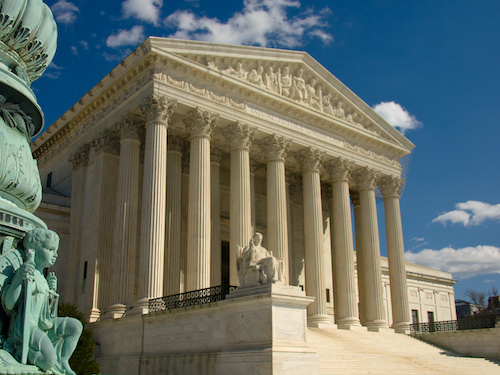 A number of amici weighed in last week to urge the U.S. Supreme Court to grant a petition asking the Justices to consider whether “in a patent-infringement suit, a court may consider after- arising technology to hold that the patent is invalid under § 112(a) of the Patent Act.”
The case arises from a U.S. Court of Appeals for the Federal Circuit (CAFC) January 2025 precedential decision reversing a district court’s determination that certain claims of a patent for Novartis’ heart failure drug Entresto were invalid for lack of written description, and affirming a finding that the claims were not shown to be invalid for obviousness, lack of enablement, or indefiniteness.
MSN Pharmaceuticals, Inc. then filed a petition for certiorari to the Supreme Court in August of this year, arguing that there is “doctrinal chaos” surrounding the topic of after-arising technology in the context of patent infringement suits. While some Federal Circuit decisions have held “that when a patentee secures a claim construction that ensnares, as infringing, an accused device that features after-arising technology, the patentee risks invalidating its own patent on written-description and enablement grounds,” other decisions have held in the same circumstance that “the patent may survive a validity attack—even if the patent does not describe or teach the after-arising technology.”
Here, the CAFC ultimately found that Novartis’ patent’s lack of description for a complexed form of valsartan and sacubitril “does not affect the validity of the patent” because that complex, which wasn’t discovered until four years after the priority date of the ‘659 patent, is not what was claimed. The appellate court thus found that the district court clearly erred in its analysis of written description and reversed the district court’s holding.
The amici who weighed in on October 8 all support the petitioners/petition. They include two briefs from law professors, two from generic pharmaceutical companies and one from the Public Interest Patent Law Institute (PIPLI). Unified Patents also filed a brief on October 1 in support of the petitioners.
All of the briefs agreed that there is conflicting precedent from the Federal Circuit on after-arising technology and urged the Court to take up the case. “The Court’s ruling creates an unfair situation: for infringement a patentee can ask the court for a broader claim construction to ensnare the infringer through later developed technology, but then not suffer the consequence that such technology need not be described in the specification,” wrote Biophore Pharma, Inc.
Sigmapharm Laboratories, a generic pharmaceuticals manufacturer, noted that the Supreme Court’s recent ruling in Amgen Inc. v. Sanofi did not address “what happens when a patent, as construed, covers embodiments utilizing technology that was not specifically described because it did not exist at the time of the patent application” and the present case therefore represents a perfect opportunity for the Court to step in.
A law professors’ brief filed by Joshua Sarnoff of DePaul University College of Law and eight others argued that the Court should grant the petition because it is straightforward and there is clear doctrinal confusion. “This case does not involve complicated facts or difficult line-drawing,” wrote the professors. “Rather, it presents an opportunity for the Court to resolve a fundamental issue affecting every patent claim: may, and if so to what extent and in what doctrinal contexts may, the meaning of a claimed invention apply to unforeseen, future technological applications?”
The PIPLI brief focused on the ways the Federal Circuit decision upsets the balance between patent owner rights and the public interest. “Under the Federal Circuit’s decision, patent owners may exclude others from making, using, and developing technology that the patent owner never invented or disclosed to the public,” said the brief.
In a recent guest article for IPWatchdog, Roy Wepner of Kaplan, Breyer, Schwarz, posited a potential argument to the Court asking an additional question: “whether or not after-arising technology may be used to invalidate a patent, can after-arising technology now be used to validate an otherwise invalid patent?”
Wepner said the Federal Circuit’s decision “opens a Pandora’s Box of complications” that threaten to destabilize the patent system.
![[Advertisement]](https://ipwatchdog.com/wp-content/uploads/2026/02/LexisNexis-Mar-31-2026-sidebar-700x500-1.jpg)





![[Advertisement]](https://ipwatchdog.com/wp-content/uploads/2021/12/WEBINAR-336-x-280-px.png)
![[Advertisement]](https://ipwatchdog.com/wp-content/uploads/2021/12/Ad-4-The-Invent-Patent-System™.png)




Join the Discussion
No comments yet.